

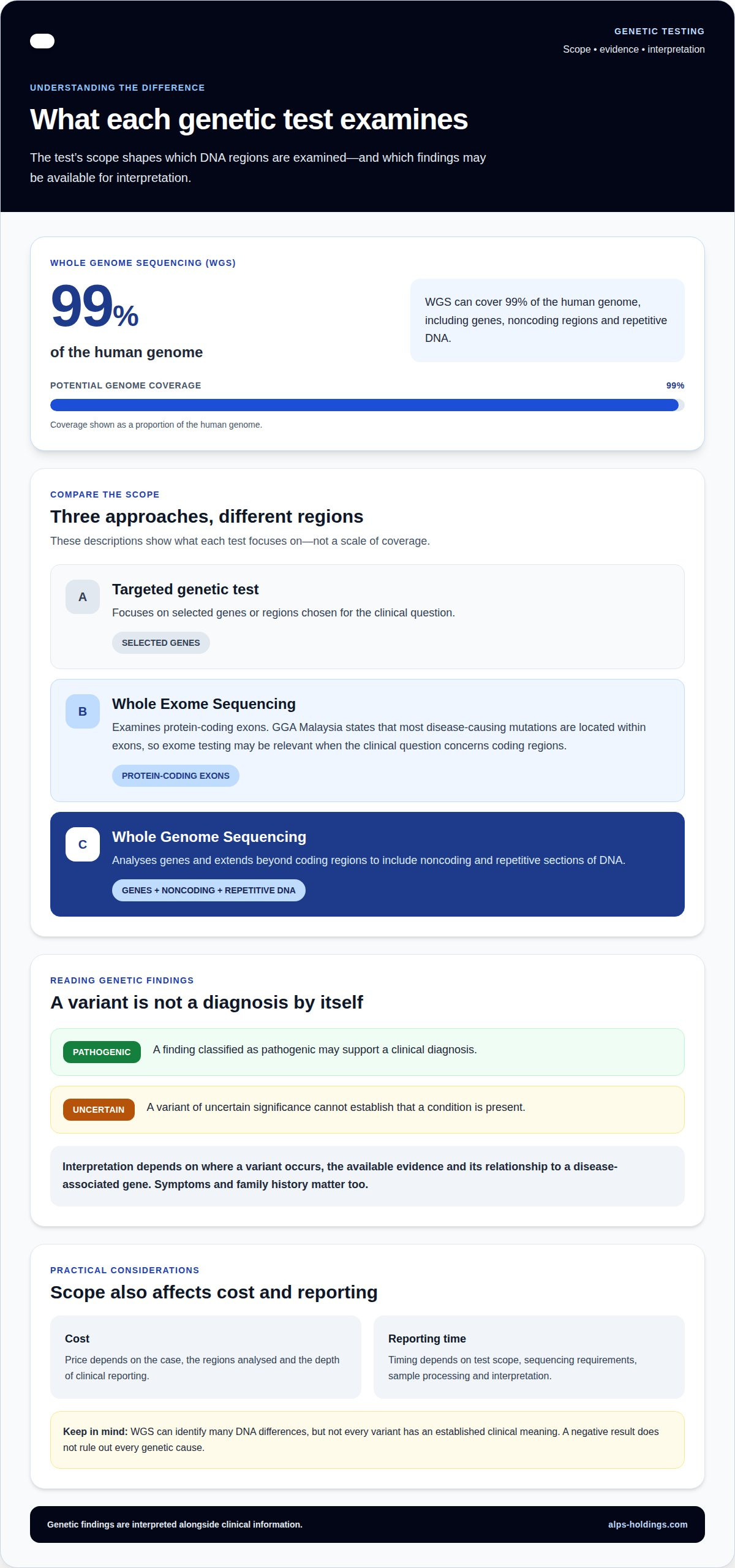
A genome is more than a catalogue of genes: it also includes noncoding regions and repetitive DNA. A whole genome sequencing test in Malaysia reads and analyses these parts of an individual’s DNA, and whole-genome sequencing can cover 99% of the human genome. The breadth of the test can reveal more than an examination limited to selected genes or protein-coding regions.
Genetic testing can feel complex because different methods examine different parts of DNA, and results may raise questions about current care and future health risks. Understanding what each test can reveal is an important first step in interpreting what its findings may mean.
This article explains what a genome is, how whole genome sequencing compares with other genetic tests, and how findings may inform treatment decisions or identify inherited risks. It also explains why results need to be considered alongside a person’s health and clinical history.
Key Takeaways
- Understand how whole genome sequencing differs from tests focused on selected genes or protein-coding regions.
- Learn what to consider about blood or saliva collection and how sample quality supports genetic analysis.
- See how genetic findings can contribute to treatment discussions while being interpreted alongside clinical information.
- Explore how inherited-risk findings may inform health planning and when ALPS Group’s Whole Genome Sequencing may be relevant.
Whole genome sequencing and other genetic technologies
Whole genome sequencing (WGS) reads genes, noncoding regions and repetitive DNA. It can cover 99% of the human genome, providing a broader view than tests limited to selected regions.
Genetic Variants and Disease-Associated Genes
A genetic variant is a difference in a DNA sequence. Its significance depends on where it occurs, the available evidence and its relationship to a disease-associated gene. A finding classified as pathogenic may support a clinical diagnosis, while a variant of uncertain significance cannot establish that a condition is present. Interpretation considers symptoms and family history, not the variant alone.
Comparing Genetic Testing Options
Tests differ in which parts of DNA they examine. A targeted genetic test focuses on selected genes, while Whole Exome Sequencing examines protein-coding exons. WGS also analyses noncoding and repetitive sections. GGA Malaysia states that most disease-causing mutations are located within exons, so exome testing may be relevant when the clinical question concerns coding regions. WGS provides broader coverage, including variants outside those regions.
Test Costs and Turnaround Times
Cost and reporting time depend on the test’s scope, sequencing requirements, sample processing and interpretation. The price depends on the case and is provided after a quote request; factors include the regions analysed and the depth of clinical reporting. WGS may involve broader analysis than a targeted panel, while complex findings can require further interpretation. Ask how the laboratory defines turnaround time, including whether it starts at sample receipt or processing.
Genetic Counselling and Test Limitations
Genetic counselling can help explain possible findings, their implications for relatives and the limits of testing, both before testing and after results are reported. WGS can identify many DNA differences, but not every variant has an established clinical meaning, and a negative result does not rule out every genetic cause. In Malaysia, genetic-test data are subject to applicable personal-data protections. Consent should clarify the purpose of collection, access, storage and disclosure. Discussing the report with a trained healthcare professional helps put findings in clinical context.
Blood or saliva sample collection
Whole genome sequencing starts with a biological sample containing DNA, commonly collected from blood or saliva. Blood provides DNA mainly from white blood cells, while saliva contains cells shed from the mouth. The laboratory extracts the DNA, checks its suitability for sequencing and analyses the resulting genetic data. The sample type should follow the test’s validated collection process, because collection and handling can affect the material available for analysis.
At-home saliva sample collection
At-home collection can make saliva testing practical, but the kit instructions set out the correct steps. The instructions may require avoiding food, drink or oral hygiene immediately before collection. Fill the sample to the marked level, seal the container securely and include the required identification details. Food residue, an unlabelled tube or a leaking container can complicate laboratory processing. Follow the instructions for that kit rather than applying procedures from another genetic test.
Sequencing genomes from saliva
A saliva sample can provide human DNA for sequencing if it contains enough suitable material. Laboratory processing separates DNA from other sample components before quality assessment and sequencing. Analysis can then identify genetic variants across the regions covered by the test, including findings relevant to inherited diseases. A result describes the DNA analysed; it does not by itself diagnose a condition or establish how a variant affects the patient.
Blood collection follows a different process: a trained collector takes the sample and places it in the specified tube. For either sample type, accurate identification links the laboratory result to the correct patient. The collection method, transport conditions and sample quality all matter before sequencing begins. If a specimen cannot support analysis, another sample may be needed, affecting the testing process. Before collection, understand the required sample type, preparation steps and return procedure for the chosen test.
Precision medicine and tailored treatment
Precision medicine uses clinical and molecular evidence to tailor care to a person’s biology. Whole genome sequencing may detect variants that help explain a diagnosis, identify inherited disease mechanisms or add context to cancer assessment. The sequence is not a treatment plan on its own. Clinicians interpret findings alongside symptoms, family history, imaging and other laboratory results before considering a change in care.
For cancer, genomic findings can help identify molecular targets relevant to treatment selection. Next-generation sequencing can support a lung cancer treatment decision in a week, while comprehensive gene profiling can support one in less than a week. These timeframes describe testing approaches, not guaranteed clinical outcomes. The key question is whether a detected variant has evidence linking it to a therapy or trial relevant to that cancer type.
Medication selection and dosage require a separate clinical assessment. A genetic variant may affect how a person processes a medicine, but prescribing decisions also take into account the drug, diagnosis, other medicines, organ function and treatment response. For example, a clinician may review a relevant pharmacogenetic result before choosing between medicines or adjusting a dose. Whole genome sequencing may reveal useful variants, but a finding alone does not determine a prescription.
In Malaysia, the National Biotechnology Policy 2.0 identifies Flagship Program 4 as outlining biologics, omics technologies and targeted therapies to advance precision and personalized medicine. In practice, a reader can take three steps: clarify the clinical question, review which genomic findings relate to it, then discuss treatment implications with the treating professional. This keeps a broad DNA report connected to a specific decision, such as whether a cancer therapy aligns with an identified molecular target.
Whole genome sequencing and individual health risks
Whole genome sequencing can reveal inherited variants associated with disease risk, but a risk finding is not a diagnosis. Known inherited gene mutations cause 5 to 10 percent of all cancers. In Malaysia, an estimated 4-6% of the population suffers from rare disorders. These figures describe population-level patterns, not an individual’s likelihood of developing a condition.
Some results are secondary findings: variants detected outside the original reason for testing. In a Malaysian whole exome sequencing study conducted from August 2020 to December 2021, 5.5% of participants who opted to receive secondary findings had pathogenic or likely pathogenic variants linked to cardiovascular disorders or cancer. Such findings may prompt a clinical discussion about relevant health assessment and family implications.
Unexpected findings may include a variant associated with a condition unrelated to the patient’s symptoms, or a result whose significance remains uncertain. A genetic result can also indicate elevated risk without showing whether or when a disease will develop. Interpretation should distinguish pathogenic findings from uncertain variants and consider each result in light of personal and family medical history.
For a whole genome sequencing package in Malaysia, review its stated coverage and reporting scope. Whole genome sequencing can cover 99% of the entire human genome, including genes, noncoding sections and repetitive DNA. The name “Genome Primary Health package” alone does not establish what it includes; assess whether its description explains coverage, health-risk reporting and the handling of secondary findings.
Public health screening and individual genome testing serve different purposes. Screening initiatives generally assess populations for specified health conditions, while individual sequencing examines a person’s DNA and may reveal findings beyond one screening question. Rare genetic disorders occur in 40-82 per 1000 live births worldwide, but population estimates do not predict an individual outcome. Before testing, consider which findings you want reported and how results could affect health decisions or relatives.
ALPS Group: Whole Genome Sequencing
ALPS Group Inc. offers Whole Genome Sequencing for people seeking broad analysis of genetic information in a clinical context. It may be relevant when a clinician needs to investigate a suspected inherited condition, interpret complex genetic findings or assess whether broader sequencing could address a specific health question. Results require clinical interpretation and should be considered alongside symptoms, family history and other relevant findings.
Before proceeding, define the question the test is intended to address and consider how findings, including unexpected results, may inform follow-up discussions. ALPS Group Inc.’s molecular laboratory meets MS ISO 15189:2022 standards, supporting its medical laboratory testing work.
For information about Whole Genome Sequencing, contact ALPS Group Inc.
Make your next step clinically purposeful
Genomic information is most useful when it addresses a clear health question and is interpreted in the context of clinical care. Before proceeding, consider what you hope testing will clarify, which findings you would want to receive and how the results could inform discussions with your healthcare professional. This preparation can keep the process focused on decisions that matter to you.
For those considering a whole genome sequencing test in Malaysia, ALPS Group Inc. offers Whole Genome Sequencing alongside mRNA Testing and Biochemistry, Serology & Immunology Tests. The appropriate test depends on the question being investigated; broader genomic analysis is not a substitute for every targeted clinical test.
To discuss testing options with ALPS Group Inc., contact the team about testing. A well-defined question is a constructive starting point for informed, patient-centred care.
Frequently Asked Questions
Who can benefit from WGS?
WGS may be useful when a suspected inherited condition remains unexplained after narrower testing, or when a strong family history is relevant to a clinical assessment. It can also help investigate a complex diagnosis when a clinician considers broad genomic analysis appropriate. For example, someone with symptoms affecting several body systems may need a different test from someone seeking information about one known familial variant.
Where can I get whole genome sequencing in Malaysia?
ALPS Group Inc. offers Whole Genome Sequencing in Malaysia. Before arranging testing, define the health question and gather relevant clinical information, such as a previous genetic report or family history, to discuss with the healthcare professional involved in care. Choose a whole genome sequencing test in Malaysia according to the question being investigated and the analysis required, rather than broad coverage alone.
How much does whole genome sequencing cost in Malaysia?
The cost depends on the case and is provided after a quote request. Factors include the test’s analysis scope, sequencing requirements, sample processing and requested reporting. Compare what the quoted service covers, including whether interpretation or additional analysis is included. ALPS Group Inc. offers Whole Genome Sequencing; request its price directly rather than estimating it from unrelated genetic tests or published package figures.
How do I prepare for whole genome sequencing and provide a sample?
Follow the collection instructions for the specific test, since preparation differs between blood and saliva kits. For saliva collection, use the supplied container and complete its identification details as directed; do not transfer the sample to another vessel. For blood collection, follow the arranged collection procedure. Keep any referral information and relevant previous test reports available for the clinical discussion.
How long do whole genome sequencing results take in Malaysia?
Result timing varies with sample acceptance, sequencing workflow, analysis scope and the interpretation required. A straightforward report may follow a different process from one involving complex findings or additional review. The most useful timeline is the period from the laboratory’s receipt of an acceptable sample to release of the final report. Sample quality and the need for further analysis can affect the process.
How accurate is whole genome sequencing, and what are its limitations?
Accuracy depends on the laboratory method, sequencing coverage and the type of genetic variant being assessed. A result can identify relevant DNA changes, but some findings remain uncertain, and not every disease mechanism is detectable or understood. A negative report does not exclude every genetic explanation, while a risk-associated variant cannot predict with certainty whether disease will develop. Clinical context remains essential.