

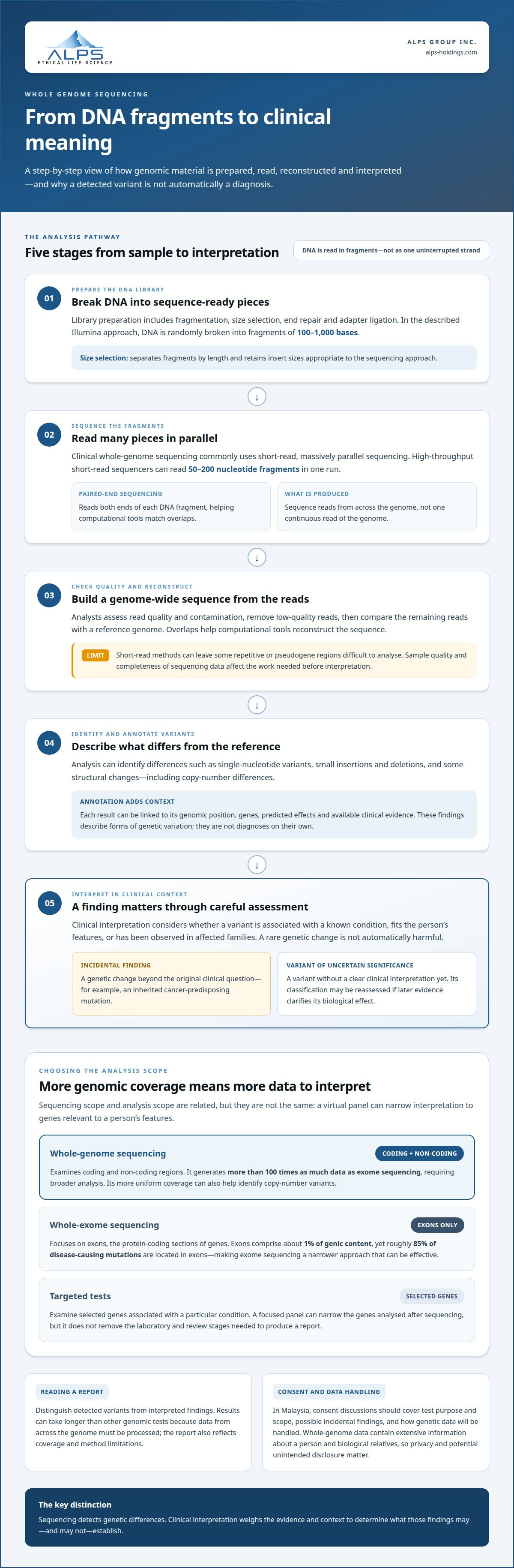
A genome is not read as one uninterrupted strand. In the whole genome sequencing process, DNA is fragmented, sequenced, and computationally reconstructed; the resulting data are analysed for genetic variants. Some findings may be incidental to the original reason for testing, while others remain uncertain because their clinical significance is not yet clear.
Sequencing can cover coding and non-coding regions, but more data do not make every result straightforward to interpret. Understanding the difference between a detected variant and a finding that may help guide care is key to knowing what the analysis can, and cannot, establish.
This article explains how DNA preparation, sequencing, reconstruction, and interpretation fit together, then explores incidental findings and variants of uncertain significance. It also clarifies why the scope of analysis matters when genomic data are turned into a clinical result.
Key Takeaways
- Distinguish sequencing the full genome from analysing every gene: a virtual panel can narrow interpretation to genes relevant to a person’s features.
- Understand how DNA library preparation, including fragmentation, end repair and adapter ligation, supports sequencing and reconstruction.
- Recognise why incidental findings and uncertain variants may need careful clinical interpretation rather than a straightforward conclusion.
- Compare the broader genomic view with targeted tests and exome sequencing, while keeping coverage limitations in mind.
How Does Whole Genome Sequencing Work?
The whole genome sequencing process reads DNA fragments and reconstructs their sequence for analysis. Compared with narrower tests, it can capture coding and non-coding regions, although analysis may focus on genes associated with a person’s clinical features.
Whole-Genome and Exome Coverage
Whole-genome sequencing examines coding and non-coding regions, whereas whole-exome sequencing focuses on exons, the protein-coding sections of genes. This distinction matters when a suspected cause lies outside those coding regions or when broader genomic coverage is useful.
Exons comprise about 1% of genic content, yet roughly 85% of disease-causing mutations are located in exons. Exome sequencing can therefore be an effective, narrower approach, while targeted tests examine selected genes associated with a particular condition. Whole-genome sequencing generates more than 100 times as much data as exome sequencing, requiring broader analysis. Its more uniform coverage can also help identify copy number variants, which involve changes in the number of DNA copies.
Sequencing Technologies and Platforms
Clinical whole-genome sequencing commonly uses short-read, massively parallel sequencing, which reads many DNA fragments concurrently. High-throughput short-read sequencers can read 50-200 nucleotide fragments in one run, producing data across the genome.
In paired-end sequencing, both ends of each DNA fragment are read, helping computational tools match overlaps and reconstruct the sequence. This matters because sequencing produces fragments, not one continuous read of the genome. After quality checks, software compares sequence reads with a reference genome and identifies variants. The platform and analysis approach affect which regions are covered and how confidently differences can be interpreted.
Sample-to-Results Timeline
The process from sample to results includes DNA preparation, sequencing, quality review, computational analysis, and interpretation. Whole-genome results can take longer to return than results from other genomic tests because the analysis must process data from across the genome.
Sample quality and the completeness of sequencing data affect the work needed before interpretation. Analysts assess read quality and contamination, remove low-quality reads, then identify differences from a reference genome. Clinical interpretation considers whether a finding fits the reason for testing. A focused panel can narrow the genes analysed after sequencing, but it does not remove the laboratory and review stages needed to produce a report.
Incidental findings and uncertain variants
Whole-genome analysis can reveal genetic changes beyond the original clinical question. An incidental finding might include an inherited cancer-predisposing mutation, while a variant of uncertain significance has no clear clinical interpretation yet.
Sequencing can detect single-nucleotide variants, small insertions and deletions, and some structural changes, including copy-number differences. These findings describe forms of genetic variation, not diagnoses on their own. Short-read methods can also leave some repetitive or pseudogene regions difficult to analyse, so a report reflects both detected changes and the method’s limitations.
Variant annotation adds context by linking each result’s genomic position with genes, predicted effects, and available clinical evidence. Interpretation then weighs factors such as whether a variant is associated with a known condition, fits the person’s features, or has been observed in affected families. A molecular finding becomes clinically meaningful through this assessment, not simply because it is present.
Natural selection changes the frequency of inherited variants across generations when some affect survival or reproduction. Many variants are neutral, while others may influence disease susceptibility; a rare genetic change is not automatically harmful. For example, a variant classified as uncertain may be reassessed if later evidence clarifies its biological effect.
In Malaysia, a consent discussion should cover the test’s purpose and scope, possible incidental findings, and how genetic data will be handled. The clinical or research context shapes the relevant oversight processes, so consent should make clear what information may be generated and shared.
Whole-genome data can raise privacy concerns because they contain extensive information about a person and biological relatives. Potential risks include unauthorised access, unintended disclosure, or later use beyond the original purpose. Genomics England states that approved researchers can access only data participants have consented to share for further study.
When reviewing a report, distinguish detected variants from interpreted findings, and note whether uncertain results may change as new evidence emerges.
Genomic DNA fragmentation and size selection
Before sequencing, genomic DNA is prepared as a library of fragments that a sequencing platform can process. Fragment length and adapter preparation influence how sequence data are generated and reconstructed.
Genomic DNA Fragmentation
DNA fragmentation breaks extracted genomic DNA into shorter pieces while preserving the nucleotide order within each piece. This makes the material suitable for sequencing, which reads fragments rather than one uninterrupted strand.
In the described Illumina approach, DNA is randomly broken into fragments of 100-1000 bases. Random fragmentation allows reads to represent regions across the entire genome, including areas containing genes linked to disease or cancer. The resulting data can later help identify changes affecting a protein-coding sequence or other genomic regions.
Fragment Size Selection
Size selection separates DNA fragments by length, retaining the insert sizes appropriate to a sequencing approach. In whole-genome shotgun sequencing, described methods select long inserts of 2-2.5 kb or short inserts of 0.5-1.2 kb.
Insert length affects how sequence reads relate to one another. Longer inserts can span a wider genomic interval, while shorter inserts provide more compact pieces for sequencing. The selected range shapes the evidence available to assemble reads and locate differences across the genome.
After fragmentation and size selection, laboratory preparation repairs fragment ends and ligates adapters to them. Adapters are short DNA sequences attached to library fragments, enabling the sequencing platform to process and identify them. This step turns prepared genomic DNA into a sequencing library; it does not change the biological meaning of a detected variant.
During next-generation sequencing, the platform reads the prepared fragments and produces nucleotide data for computational analysis. Quality review can identify low-quality or adapter-containing reads for removal before variant assessment. The final interpretation may consider mutations, deletions, or other changes associated with a clinical question, such as an inherited disease or cancer. Fragment preparation is the essential link between obtaining DNA and generating interpretable sequence data.
Whole-genome sequencing overview and advantages
Whole-genome sequencing examines coding and non-coding DNA across the genome, rather than selecting only a small group of genes. The human genome contains an estimated 6 billion base pairs, so this broad view creates data for multiple applications from one sample.
Its value depends on the question being investigated. In cancer care, analysis can identify tumour mutations that may inform eligibility for targeted treatment or clinical trials. For infectious disease investigations, sequencing can detect and classify organisms such as tuberculosis bacteria and SARS-CoV-2. These applications use genomic evidence differently, but both depend on interpreting sequence changes in context.
For bacteria, whole-genome sequencing can provide detailed information in a single test. Comparing an organism’s sequence with a reference can reveal genetic differences, supporting identification and classification. In an individual’s genome, the same reference-based approach helps identify variants, including single-nucleotide changes and small insertions or deletions.
Whole-genome sequencing can also detect copy-number variants, and its more uniform genome coverage may support their identification better than whole-exome sequencing. This distinction matters when a clinically relevant change involves a larger DNA segment rather than a single nucleotide in a coding region. A broader dataset can therefore support analysis beyond protein-coding exons.
Whole-genome sequencing has limitations. Short-read sequencing may not analyse some repetitive or pseudogene regions, and sequencing does not reveal DNA methylation status. Mosaicism may also be missed when read depth is limited. These limitations matter because a negative result does not mean every biological mechanism or genomic region was assessed equally.
The central takeaway is that whole-genome sequencing offers breadth, while the clinical value depends on the research question, data quality, and interpretation. Explore whole-genome sequencing when broader genomic analysis is relevant to your testing needs.
ALPS Group: Whole Genome Sequencing
ALPS Group Inc. provides Whole Genome Sequencing for readers seeking broad genomic analysis to inform a clinical or research question. Its molecular laboratory meets MS ISO 15189:2022 standards. Sequencing can be relevant when analysis across coding and non-coding regions is appropriate, while interpretation should reflect the reason for testing and the limits of the findings.
ALPS Group Inc. also offers mRNA Testing, Biochemistry, Serology & Immunology Tests, and Microbial Tests. These are distinct testing options, chosen according to the biological question being investigated. Understanding the difference between sequence generation, variant interpretation, and clinical meaning can help frame the next discussion about testing.
For information about the whole genome sequencing process, contact ALPS Group Inc. to discuss your testing needs.
Carry the Genomic Insight Into Your Next Decision
The value of the whole genome sequencing process lies not only in generating data, but in connecting results to a clear question and an informed next step. Before pursuing testing, consider what you need the analysis to clarify and how findings may be interpreted alongside other relevant evidence. This focus can make the discussion more precise and keep the result tied to its intended purpose.
ALPS Group Inc. offers Whole Genome Sequencing, mRNA Testing, and Biochemistry, Serology & Immunology Tests. These options address distinct testing needs, so the discussion should begin with the question at hand, not simply the breadth of available data.
For a considered conversation about sequencing, contact ALPS Group Inc. to discuss sequencing. A clear question is a constructive starting point for the next stage of genomic investigation.
Frequently Asked Questions
How does it work?
Whole-genome sequencing converts DNA into digital sequence data that can be assessed for differences. After laboratory preparation, a sequencing instrument reads DNA fragments, and software organises the reads for analysis. Analysts then assess relevant variants against the clinical question, such as whether a finding may explain a particular feature. The resulting report distinguishes observed genetic changes from conclusions about their significance.
What are the limitations of WGS?
WGS cannot answer every biological question from DNA sequence alone. For example, it does not determine DNA methylation status, and limited read depth can make some mosaic variants difficult to identify. Repetitive regions may also be challenging to analyse with short-read methods. Results must therefore be interpreted within the test’s analytical scope, and a finding’s clinical meaning may remain uncertain even when the sequence change is detected.
What is the difference between targeted NGS and WGS?
Targeted next-generation sequencing examines selected genes or regions, while WGS analyses data across the genome. A targeted panel may suit a focused question, such as investigating a known group of genes linked to a condition. Broader sequencing can provide a wider search when the relevant region is unclear, but it also produces more data to interpret. The choice depends on the clinical question and intended analysis.
What is whole genome sequencing and what can it reveal?
Whole-genome sequencing determines DNA sequence information across an organism’s genome. In human testing, analysis may reveal inherited variants, changes associated with disease, or findings relevant to tumour biology. In microbial testing, genome data can help identify and classify an infectious organism. A result describes genetic evidence; it does not automatically establish how a variant affects health or predict an individual’s future.
What are the steps in the whole genome sequencing process?
The main stages are specimen receipt, DNA extraction, library preparation, sequencing, data quality assessment, variant analysis, and interpretation. Each stage contributes different evidence: laboratory checks assess sample and read quality, while analysis compares sequence data and evaluates potential findings. The final report presents interpreted results in relation to the reason for testing, rather than treating every detected difference as a diagnosis.
How is a sample collected and prepared for whole genome sequencing?
Sample collection follows the test’s specified specimen protocol, and the specimen is identified and handled to preserve usable DNA. In the laboratory, DNA is extracted from the submitted material, assessed for suitability, and prepared as a sequencing library. Preparation includes breaking DNA into fragments and attaching adapters so the sequencing platform can process them. Correct identification and careful handling support reliable downstream analysis.
