

More DNA does not automatically provide a clearer medical answer. In genome sequencing versus genetic testing, the key difference is scope: whole-genome sequencing examines a person’s entire genome, while a targeted genetic test focuses on selected genes or variants linked to a specific question. The broader view can reveal more variation, but interpreting what those findings mean for health requires care.
It’s reasonable to wonder why a healthcare professional might recommend a targeted test instead of sequencing an entire genome. The choice depends on the clinical question: a focused test examines a defined set of genes, while genome sequencing surveys a much wider range of DNA. This article explains how the approaches differ, how inherited or acquired variants may relate to disease, and why a result can be informative without predicting future health completely. It also outlines what each test’s scope can and cannot show, helping you understand the reasoning behind different forms of genetic analysis in Malaysia.
Key Takeaways
- Match the test’s scope to the question being investigated: a focused test examines selected genes, while whole-genome sequencing surveys a much broader range of DNA.
- Learn why finding a genetic variant does not automatically establish that it causes disease; interpretation depends on the variant and its biological context.
- Understand how genomic findings can inform investigation of inherited and other health conditions, while recognizing that no single test detects every condition.
- See when ALPS Group’s Whole Genome Sequencing may be relevant to a broader examination of DNA.
Whole genome sequencing compared with smaller DNA tests
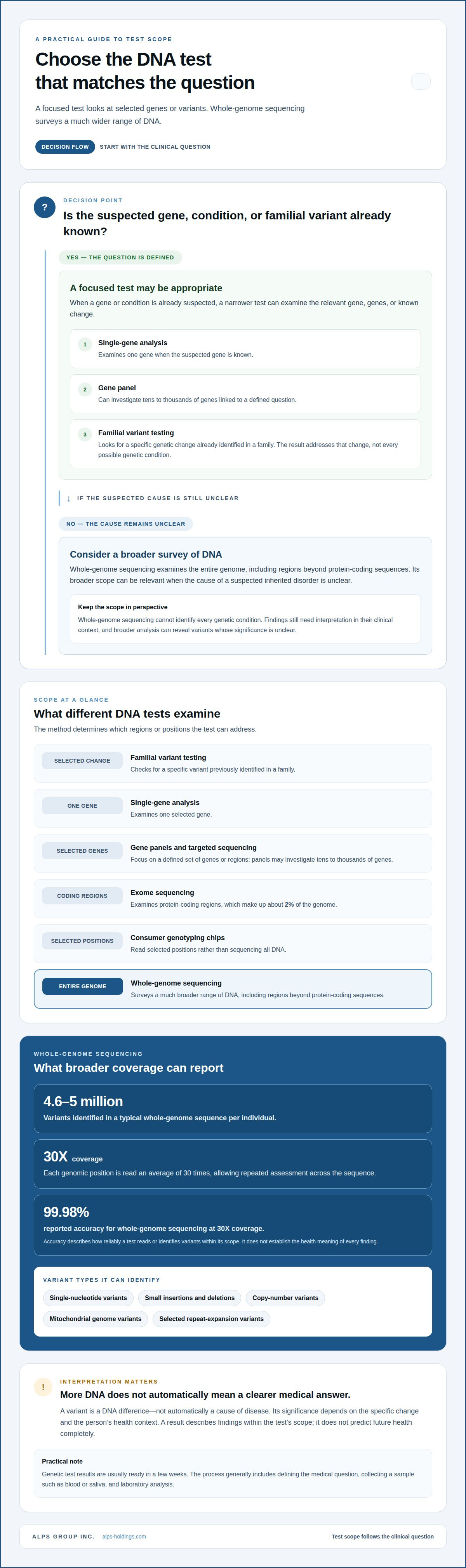
Whole-genome sequencing examines a person’s entire genome, whereas targeted tests look at selected genes or variants. The right scope depends on the health question being investigated.
Available tests include single-gene analysis, gene panels, targeted sequencing, exome sequencing, and consumer genotyping. A single-gene test examines one gene, while a panel can investigate tens to thousands of genes. Targeted sequencing focuses on selected genes, and exome sequencing examines protein-coding regions, about 2% of the genome. Consumer genotyping chips read selected positions rather than sequencing all DNA.
For a suspected inherited disorder, a focused test may be appropriate when a gene or condition is already known. Whole-genome sequencing can survey a broader range of DNA, including regions beyond protein-coding sequences, when the cause remains unclear. It cannot identify every genetic condition, and findings need to be interpreted in their clinical context.
Variants Detected by Sequencing
Variants are differences in DNA, and whole-genome sequencing can identify several types across the genome. These include single-nucleotide variants, small insertions and deletions, copy-number variants, and mitochondrial genome variants; it can also detect selected repeat-expansion variants. A targeted test may miss a variant outside the genes or regions it examines, so scope matters when the suspected cause is uncertain.
A typical whole-genome sequence identifies 4.6 to 5 million variants per individual. At 30X coverage, each genomic position is read an average of 30 times, allowing repeated assessment across the sequence.
Test Accuracy and Limitations
Accuracy describes how reliably a test reads or identifies variants within its scope; it does not establish the health meaning of every finding. Whole-genome sequencing at 30X coverage is reported to enable 99.98% accuracy. However, no single genetic test detects every condition, and broader analysis can reveal variants whose significance is unclear.
Genetic test results are usually ready in a few weeks. The process generally involves defining the medical question, collecting a sample such as blood or saliva, and analysing it in a laboratory. The report describes findings within the test’s scope, so the method chosen determines what it can address.
Genetic variants and their possible health effects
A genetic variant is a difference in DNA that may affect how a gene or biological process works. Its significance depends on the specific change and the person’s health context.
In Malaysia, privacy considerations include what genetic data is collected, who can access it, how long it is retained, and whether it is shared for care or research. Before providing a sample, discuss what consent covers.
Human Genetic Variation
People share about 99.9% of their genetic makeup, while variation in the remaining 0.1% can provide clues about disease. A rare variant affects fewer than 1% of the population, but rarity alone does not mean it causes a condition. Each person has two copies of each gene, one inherited from each parent, and a change in one or both copies can have different implications.
Familial variant testing looks for a specific genetic change already identified in a family. If a relative’s result identifies a disease-associated variant, testing another family member for that change can clarify whether they inherited it. The result addresses that variant, not every possible genetic condition, and inheritance patterns depend on the gene involved.
Uncertain Results and Family Findings
An uncertain result means testing has found a variant whose effect on health is not yet clear. On its own, it cannot establish a diagnosis or show that someone will develop a condition. A report may instead identify a known disease-causing change, find no known disease-causing change, or describe an unclear finding. These distinctions shape what the result can support.
Broader sequencing can reveal secondary findings unrelated to the original reason for testing. These findings may also matter to relatives because genetic information can reflect shared inheritance. Before testing, consider how an unexpected result could affect family discussions, future decisions, and your understanding of health risks.
Whole-genome sequencing can detect single-nucleotide variants, small insertions and deletions, copy-number variants, and mitochondrial variants. It can also identify selected repeat-expansion variants. Findings describe DNA differences; interpretation must distinguish those with established health relevance from variants whose effects remain uncertain.
Genomic factors in health and disease
Genomic findings can contribute to disease risk, but they are only one part of a person’s health profile. A variant’s effect depends on its biological role, inheritance pattern, and interaction with other factors.
A disease-risk report describes genetic findings associated with a condition; it does not establish that the condition will develop. For example, a disease-associated variant may indicate inherited susceptibility, while clinical assessment also considers symptoms, family history, and other relevant evidence. The report can help guide further investigation, but a genetic association is not a diagnosis.
For rare disease investigations, whole-genome sequencing can examine a broader range of DNA than a targeted panel. Across cited studies, diagnostic yield for rare disease patients ranged from 25-50% for whole-genome sequencing and approximately 10-15% for targeted panel tests. Yield describes how often testing identifies a finding that provides a diagnosis; it is not a prediction for an individual.
Results vary because genetic conditions can arise from different variants, and a test only assesses the regions and variant types its method can detect. Across cited studies, overall whole-genome sequencing diagnostic yield ranged from 16%-56%. After a previous negative test, including whole-exome sequencing, whole-genome sequencing increased diagnostic yield by 7%-30% in cited studies. These ranges reflect different study populations and testing contexts.
Carrier screening looks for variants that may be passed to children, even when the person tested has no related symptoms. For example, findings involving inherited conditions can help clarify reproductive risks when both biological parents carry relevant variants. Screening is not a diagnosis of an existing disease: it assesses specific inherited risks rather than explaining every current symptom.
Clinical interpretation connects a result to a person’s presentation and family history. A known disease-causing variant may support a diagnosis, while an unclear result may not explain symptoms. A negative finding also cannot exclude every genetic cause, because no single test detects every genetic condition. The test’s scope and the clinical question determine how its findings can be applied.
Genetic testing compared with genomic testing
Genetic and genomic testing overlap, but describe different scopes of investigation. The distinction in genome sequencing versus genetic testing is therefore what the test examines: genetic tests can investigate variants in genes, chromosomes, or proteins, while genomic testing can assess many genes or the entire genome.
Choose the test scope to match the medical question. If a family has a known inherited variant, focused testing can examine that specific change. If a condition’s cause remains uncertain, broader sequencing may reveal findings across multiple genes. Neither approach detects every genetic condition, and interpretation depends on why the test was performed.
Cancer illustrates why the distinction matters. Germline testing examines inherited variants present in cells throughout the body. Somatic mutations arise in cells after fertilisation and may be identified by examining genes in a cancerous tumour. A tumour finding may help inform consideration of targeted therapies, which focus on specific mutations, but does not by itself establish inherited risk for children or relatives.
In Malaysia, clinical genetic tests are ordered by a healthcare provider for a specific medical reason. The test’s purpose, the genes or genomic regions examined, and the sample type shape what its results can address. Broad genomic analysis may also produce findings beyond the original question, while a focused test reports within a narrower scope.
To make sense of genome sequencing versus genetic testing, first identify whether the aim is to investigate an inherited variant, examine a tumour mutation, or survey a wider range of DNA. Readers considering broader analysis can explore whole-genome testing as one approach to genomic investigation.
ALPS Group: Whole Genome Sequencing
ALPS Group Inc. offers Whole Genome Sequencing for readers seeking a broader examination of DNA than a focused genetic test provides. It may be relevant when a health question involves multiple genes or calls for a wider genomic view.
Results should be considered alongside the clinical question, family history, and other relevant findings. ALPS Group Inc.’s molecular laboratory meets MS ISO 15189:2022 standards.
For questions about whether Whole Genome Sequencing fits your needs, contact ALPS Group Inc.
Turn genomic insight into a considered next step
A genetic result is most useful when it serves a clear purpose, such as informing a health discussion or clarifying what further information may help. Understanding the difference between genome sequencing and genetic testing can guide that decision, but the scope of analysis should match the question being explored.
ALPS Group offers Whole Genome Sequencing, alongside mRNA Testing and Biochemistry, Serology & Immunology Tests. These distinct forms of testing examine different biological information, so the right option depends on the intended investigation. Start by identifying the question you want testing to help address, then consider which type of analysis fits it.
To discuss your testing needs, contact ALPS Group. A clear question is a strong starting point for a thoughtful conversation about genomic analysis.
Frequently Asked Questions
Why would I be offered a genetic test?
A healthcare provider may recommend a genetic test to investigate a specific medical question, such as whether symptoms fit an inherited condition. Testing may also examine a known variant in a family or assess changes in a tumour that could inform cancer care. The reason for testing helps determine which genes are examined and how the findings may contribute to diagnosis or clinical decisions.
What are genetic variants?
Genetic variants are differences in DNA that can influence how a gene functions, although some have no known health effect. For example, a change may alter a protein’s structure, while another may leave its function unchanged. A laboratory result identifies a difference; clinical interpretation considers available evidence and the person’s health context before linking that variant to a condition.
What are genetics and genomics?
Genetics generally focuses on individual genes and how particular inherited changes relate to traits or conditions. Genomics examines broader sets of genetic material, including interactions among multiple genes and other DNA regions. For example, a genetics question might concern one known inherited variant, while a genomics investigation may consider a wider pattern of DNA variation relevant to health.
What is genomic testing?
Genomic testing analyses a broad range of DNA information, from multiple genes to the whole genome. Its scope depends on the method and clinical question. A test might examine genomic regions associated with a suspected condition, while whole-genome analysis surveys DNA more broadly. Interpret findings according to the regions and variant types the test assessed.
Will it affect my insurance?
The effect of genetic test results on insurance in Malaysia depends on the insurer, product, and application process. Do not assume every policy treats genetic information in the same way. Before sharing results, read the application’s questions and privacy information carefully, and seek qualified guidance if you are unsure how a specific policy handles medical information or genetic findings.
What is the difference between genome sequencing and genetic testing?
Genetic testing is a broad term for tests that investigate particular genes, variants, chromosomes, or proteins. Genome sequencing is a specific approach that reads DNA across a broader scope, potentially the whole genome. A targeted test may suit a defined question, while broader sequencing can examine more DNA. The key distinction is what the test examines and what the result can answer.


