

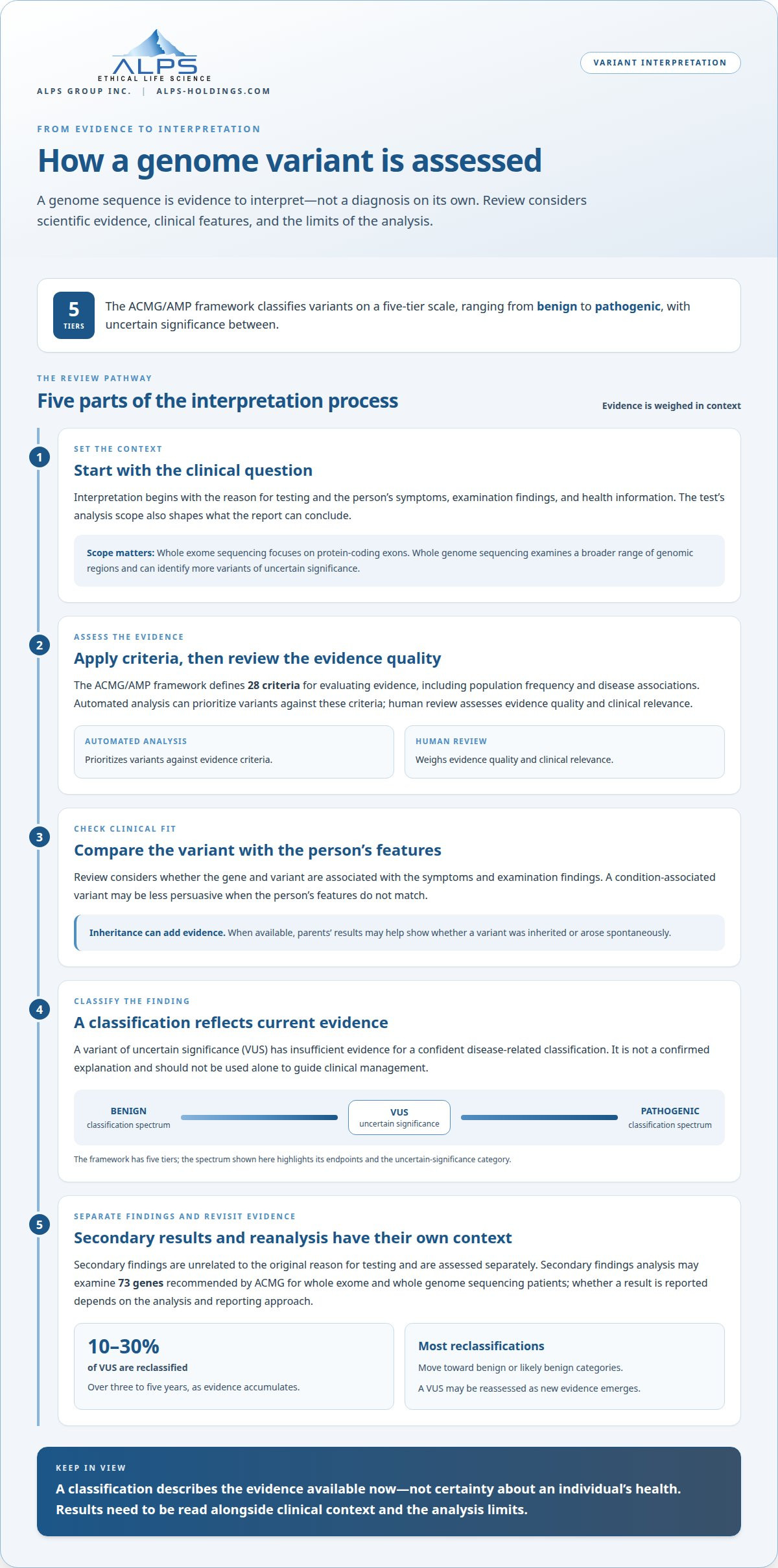
A genome sequence is evidence to interpret, not a diagnosis on its own. Interpreting whole genome sequencing results means assessing identified variants against scientific evidence, the person’s clinical features and the limits of the analysis. The ACMG/AMP framework recognizes five variant classification tiers, ranging from benign to pathogenic, with uncertain significance between them.
A report may identify a likely explanation, remain inconclusive, or find no relevant variant. Some analyses may also report secondary findings unrelated to the original reason for testing. As scientific evidence develops, reanalysis may reveal a possible explanation that was not apparent at first. This guide explains how variants are assessed, what different outcomes can mean, how secondary findings are considered, and when stored sequencing data may be reviewed again. Results need to be understood in clinical context, not as a simple list of genetic changes.
Key Takeaways
- Learn how variant classifications help distinguish established findings from uncertain ones, and why secondary findings are considered separately.
- Understand what clear communication of a confirmed finding should help you make sense of, including its relevance to the reason for testing.
- Read a genomic report with greater context by recognizing how analysis scope and technical limitations can shape its conclusions.
- See how stored sequencing data may be reanalysed as new evidence emerges, potentially offering further insight after an inconclusive result.
Is the variant returnable as a secondary or incidental finding?
A variant’s classification helps show whether it may explain symptoms or represents a separate finding. Interpretation considers the available evidence, clinical features, and the scope of the analysis.
Classification Criteria and Review
The ACMG/AMP framework applies evidence criteria to classify variants rather than treating every DNA change as a diagnosis. According to the American College of Medical Genetics and Genomics and Association for Molecular, the framework recognizes five variant classification tiers. It defines 28 criteria for evaluating evidence, including population frequency and disease associations. Automated analysis can prioritize variants against these criteria, while human review assesses evidence quality and clinical relevance. This distinction matters because a classification reflects current evidence, not certainty about an individual’s health.
Incidental Findings in Variant Interpretation
An incidental finding is a variant unrelated to the original reason for testing but potentially relevant to health. Secondary findings analysis may examine 73 genes recommended by ACMG for whole exome sequencing and whole genome sequencing patients. These findings are assessed separately from variants associated with the symptoms under investigation. Whether a result is reported depends on the analysis and the reporting approach used for the test.
A variant’s significance depends on clinical context. Laboratory analysis considers whether the gene and variant are associated with the person’s symptoms, examination findings, and health information. For example, a variant linked to a condition may be less persuasive if the person’s features do not match it. When available, parents’ results can help establish whether a variant was inherited or arose spontaneously, adding evidence to the interpretation.
A variant of uncertain significance (VUS) has insufficient evidence for a confident disease-related classification. It should not be treated as a confirmed explanation or used alone to guide clinical management. Whole genome sequencing can identify more VUS than whole exome sequencing because it examines a broader range of genomic regions. A VUS may be reassessed as evidence accumulates; reclassification occurs for 10-30% of VUS over three to five years, and most reclassifications move toward benign or likely benign categories.
Communicating confirmed findings to patients
A confirmed finding should be explained in relation to the reason for testing and the patient’s health information. Review a report identifying a disease-associated variant, an uncertain finding, or a secondary result with a genetic counselor. Counseling can help clarify the implications and possible next steps.
Secondary Findings and Their Return
A secondary finding is a potentially important genetic result unrelated to the condition that prompted testing. It may indicate a separate health risk for the patient or relatives, even if it does not explain current symptoms. Communication should distinguish it from the primary result, explain the evidence and associated condition, and clarify what the result can and cannot establish. For example, a secondary variant may prompt discussion of family history and whether relatives could share it.
Somatic and Germline Results
A somatic variant develops in particular cells during a person’s life. A germline variant is present from conception and may be inherited. The distinction matters: a finding in tumour tissue, for example, does not automatically mean the same variant is present throughout the body or can be passed to children. Interpretation depends on the sample type and purpose of testing. A clinician can explain whether testing another tissue may help clarify the pattern.
For a confirmed finding, a clear discussion links the gene and variant to the affected protein, the condition’s features, and the patient’s clinical pattern. It separates established evidence from uncertain implications. A result associated with a genetic disease may support a diagnosis, inform family discussions, or prompt a review of care with the treating clinician. On its own, it does not predict how severe the condition will be or when it may develop for a particular person.
Patients can ask for the report’s primary finding, its clinical significance, and any recommended follow-up to be explained in plain language. If parents’ results contributed to interpretation, the discussion should clarify how inheritance affected the conclusion. For additional context on the testing approach, review whole genome sequencing alongside the clinical report.
Reading genomic reports and understanding clinical implications
A genomic report addresses a defined clinical question, and its conclusions depend on the test’s scope and the patient’s features. Interpreting whole genome sequencing results starts with understanding what the analysis examined.
Clinical Report Structure and Limitations
A clinical report typically presents the indication, methods, findings, interpretation and technical limitations. Variant names follow Human Genome Variation Society nomenclature, while sequencing depth may appear as 50X or 100X. Coverage figures, such as 98.3% or 99.4%, indicate how much of a target region was read. These details help frame the findings; they do not independently establish a diagnosis.
Whole exome sequencing (WES) focuses on protein-coding exons, while whole genome sequencing (WGS) generates data across the genome. Clinical analysis may still focus on genes relevant to a patient’s features. Short-read methods can have difficulty with repetitive regions or pseudogenes, and WGS does not detect DNA methylation status. A negative result means no relevant variant was identified, not that a genetic cause has been ruled out.
Uses in Rare Disease and Cancer
Sequencing can support rare disease investigations when a suspected condition may be caused by a DNA change. More than 7,000 Mendelian conditions have been identified, involving variants in more than 4,000 genes. Clinical teams assess whether a finding fits the patient’s features. In cancer, sequencing may examine tumour-associated changes, with interpretation shaped by the clinical question and sample analysed.
Before testing, patients should understand the question guiding the analysis and the types of findings that may be reported. For clinicians interpreting whole genome sequencing results, the distinction between WES and WGS matters because each examines different genomic regions. Neither method detects every possible cause. Consider a report’s conclusion alongside symptoms, family history, and stated technical limitations. An inconclusive finding, for example, does not establish the suspected disease.
Reanalysis of genome sequencing results
Reanalysis means reassessing stored sequencing data using updated scientific evidence and the person’s clinical information. It may be relevant when an initial result leaves the suspected diagnosis unresolved, as a gene associated with the condition could become better understood later.
Reanalysis does not assume the original analysis was incorrect. Reviewers revisit the original clinical question, the person’s features, and the variants previously assessed. A gene newly linked to a rare disease may make a previously unexplained variant relevant. The team can then assess whether the variant fits the person’s symptoms and inheritance pattern.
Stored whole genome data can be reviewed again without automatically collecting a new sample. Reanalysis reassesses existing sequence data; resequencing involves a new test, which may be needed if the original data lack adequate coverage or cannot assess a relevant region. Technical limits therefore affect whether reanalysis alone can address the clinical question.
A practical review may involve several linked steps:
- Revisit the original indication, symptoms and family history.
- Assess whether new gene-disease associations relate to the person’s features.
- Re-evaluate relevant variants against current evidence and classification criteria.
- Determine whether the existing data can answer the revised question.
Exome sequencing and targeted gene panels can also be reanalysed if their stored data cover the relevant genes. Their narrower scope may leave other regions unexamined, while whole genome data can support a broader review. Neither approach guarantees a diagnosis: findings still need to fit the clinical presentation and available evidence.
Reanalysis is most informative when new evidence changes the interpretation of a specific finding or makes a previously unrecognised gene relevant. It may also leave the result unresolved if no variant is present in the data or the suspected cause lies beyond the method’s capabilities. For more information about whole genome sequencing, explore the testing approach and its role in generating genomic data for analysis.
ALPS Group: Whole Genome Sequencing
ALPS Group Inc. offers Whole Genome Sequencing for people seeking broad genomic data to investigate a health question. Results are considered in clinical context and in light of the analysis’s scope, with findings assessed according to the evidence available. This test may be relevant when a clinician is considering a genetic contribution to symptoms or a previous result has not resolved the question.
Depending on the investigation, ALPS Group Inc. also offers mRNA Testing, Biochemistry, Serology & Immunology Tests, and Microbial Tests. These are distinct testing options, not substitutes for interpreting a genomic report in clinical context. Contact ALPS Group Inc. to discuss whether Whole Genome Sequencing fits your testing needs.
Carry genomic insight into the next decision
A genomic result is valuable when its evidence informs a considered clinical discussion. As knowledge develops, its interpretation may warrant renewed attention, particularly if symptoms or family information change. Keep the report available for discussions with the healthcare professional overseeing the clinical question, so the findings can be considered alongside current health information.
For testing needs that call for genomic or complementary laboratory information, ALPS Group offers Whole Genome Sequencing, mRNA Testing, and Biochemistry, Serology & Immunology Tests. These options support distinct investigative approaches, chosen according to the question being considered. Discussing how to interpret whole genome sequencing results can clarify how genomic analysis relates to your testing needs.
Contact ALPS Group to discuss your needs. A well-informed next step begins with a clear question and a careful conversation.
Frequently Asked Questions
How does it work?
Whole genome sequencing reads DNA, and analysis identifies differences from a reference sequence. Interpretation then relates relevant variants to the clinical question, symptoms, and available family information. For example, if a patient has a feature associated with a particular gene, analysts can assess whether a variant in that gene fits the pattern. The result provides evidence for clinical discussion, not a diagnosis on its own.
What Is Genome Interpretation?
Genome interpretation assesses DNA variants to understand their possible biological and clinical significance. It considers evidence such as a variant’s effect on a gene, its association with disease, and how well it fits the person’s features. Interpretation also distinguishes findings that may explain the original concern from unrelated results. Conclusions depend on the available evidence and the scope of the analysis.
What gene(s) does the variant impact?
The report identifies the gene containing the variant and may describe its predicted effect. A variant could alter a protein, affect how a gene is expressed, or have no established harmful effect. Review the gene name alongside the associated condition and reported variant consequence. A gene appearing in a report does not prove that it caused symptoms; clinical fit and supporting evidence matter too.
How do you interpret a whole genome sequencing report?
Start with the report’s conclusion and the clinical question it addresses. Then review the variant description, classification, associated condition, and stated limitations. Check whether the finding matches the person’s symptoms and whether the outcome is positive, negative, or inconclusive. An inconclusive result, for example, means the evidence does not support a precise explanation; it does not confirm a suspected disease.
What do variants of uncertain significance mean in whole genome sequencing?
A variant of uncertain significance (VUS) means the available evidence cannot reliably establish whether the DNA change contributes to disease. It is not equivalent to a pathogenic result and should not be treated as a confirmed explanation for symptoms. The finding may be reviewed again if scientific evidence changes. Clinical management should rely on the overall clinical assessment, not a VUS alone.
How are pathogenic, likely pathogenic, and benign variants classified?
Classification weighs evidence about a variant’s relationship to disease, including its frequency in populations, functional evidence, and fit with clinical features. The ACMG/AMP framework uses categories from benign to pathogenic, with uncertain significance between them. Likely pathogenic indicates strong evidence of a disease-causing role; benign indicates evidence against that role. Classification describes the strength of the evidence, not a person’s overall health outlook.


