

The lowest quoted fee alone is not a sound basis for choosing a reference laboratory. A reference laboratory outsourcing contract checklist for private hospitals should help assess whether a provider’s capabilities, quality processes, personnel, equipment and service commitments match the hospital’s testing needs. The contract should then set out the scope, responsibilities, service expectations and pricing clearly, including how specimens and results will be handled.
Outsourcing can give a hospital access to expertise or capacity, free internal teams to focus on other priorities and add operational flexibility. Those benefits depend on a clear scope and effective coordination. The decision is not simply whether to outsource, but which work is suitable for an external partner and how the hospital will govern the arrangement.
This guide explains how to assess a provider’s fit, define contract terms and weigh potential benefits against operational risks. It also outlines how Malaysian hospitals can match testing requirements to laboratory capabilities, helping ensure the arrangement supports reliable diagnostic services and patient care.
Key Takeaways
- Build contract terms around the tests, specimen volumes and transport arrangements the hospital needs, then define measurable expectations for quality and turnaround.
- Weigh access to specialist capacity and expertise against the coordination, oversight and service-continuity risks outsourcing can introduce.
- Identify the operational reason for outsourcing before selecting a provider, so the arrangement addresses a defined capability or workflow need.
- For Malaysian private hospitals, align the outsourced testing scope and responsibilities with applicable regulatory and Ministry of Health requirements.
Laboratory outsourcing contract considerations
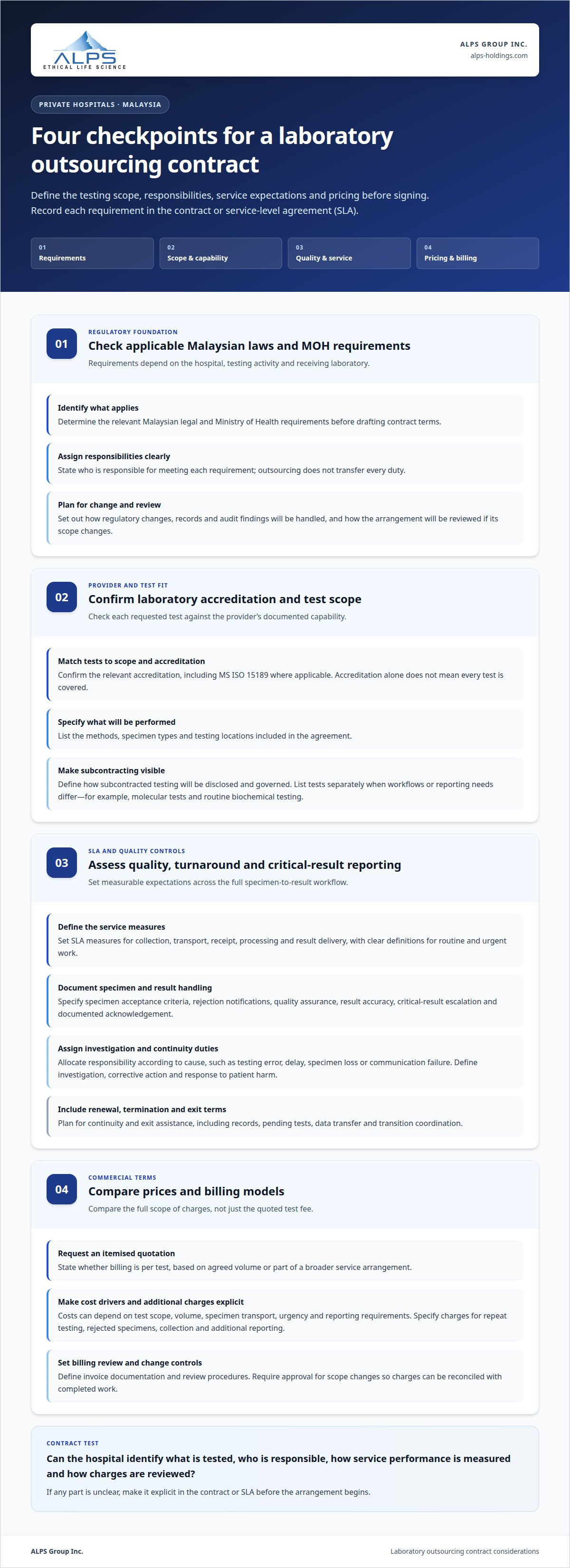
Use these steps to define the testing scope, responsibilities and service expectations before signing. Record each requirement in the contract or its service-level agreement (SLA).
-
Check applicable Malaysian laws and MOH requirements
Identify the Malaysian legal and Ministry of Health requirements relevant to the hospital, testing activity and receiving laboratory before drafting contract terms. Applicable requirements depend on the services and parties involved. The agreement should assign responsibility for meeting them rather than treating outsourcing as a transfer of every duty. Define how regulatory changes, records and audit findings will be handled, and set a process for reviewing the arrangement when its scope changes.
-
Confirm laboratory accreditation and test scope
Match each requested test to the laboratory’s documented scope and relevant accreditation, including MS ISO 15189 where applicable. Accreditation alone does not establish that every test is covered, so specify the methods, specimen types and testing locations included. Confirm how any test performed by a subcontracted laboratory is disclosed and governed. For example, list molecular tests separately from routine biochemical testing when their workflows and reporting needs differ.
-
Assess quality, turnaround, and critical-result reporting
Set SLA measures for collection, transport, receipt, processing and result delivery, with clear definitions for routine and urgent work. Specify specimen acceptance criteria, rejection notifications, quality assurance, result accuracy, critical-result escalation and documented acknowledgement. Allocate responsibility according to cause, such as testing error, delay, specimen loss or communication failure, and define who handles investigation, corrective action and response to patient harm. Include renewal, termination, continuity and exit-assistance terms for records, pending tests, data transfer and transition coordination.
-
Compare prices and billing models
Request an itemised quotation and state whether billing is per test, based on agreed volume or part of a broader service arrangement. Costs can depend on the test scope, volume, specimen transport, urgency and reporting requirements. Specify charges for repeat testing, rejected specimens, collection and additional reporting. Set invoice documentation and review procedures, and require approval for scope changes so the hospital can reconcile charges with completed work.
Potential benefits and downsides of outsourcing
- Define the operational problem before moving tests outside the hospital. Outsourcing may save staff time, free internal teams for higher-value work, or provide expertise and testing capacity that is unavailable in-house. For example, identify a specialist test causing delays and assess whether external capacity would address that specific constraint.
- Compare the full workflow, not just the laboratory’s test fee. Account for specimen preparation, collection, transport, result integration, follow-up and internal coordination. A lower direct charge may not reduce overall costs if staff spend more time resolving rejected specimens or transferring results into hospital systems.
- Weigh added flexibility against dependence on an external process. A partner may help the hospital respond to changing demand without expanding every internal capability. However, reliance on an external service can expose the hospital to transport disruption, changing turnaround times or limited access to service information. Set contingency procedures for urgent tests and service interruptions.
- Maintain internal quality oversight and clinical communication. Outsourcing transfers a defined task, not the hospital’s responsibility to understand how results inform care decisions. Assign owners to review service performance, investigate unusual delays and coordinate follow-up. For critical results, document who receives the notification and how receipt is acknowledged.
- Use a pilot or phased transition where operationally appropriate. Begin with a clearly bounded test group, measure specimen rejection, turnaround, reporting issues and staff workload, then decide whether to expand. This reveals workflow friction before broader reliance develops. For specialized molecular testing, review whole-genome sequencing capabilities as one example of an external testing requirement.
Reasons hospitals outsource laboratory services
Use outsourcing to address a defined operational need, not simply to transfer work. That need should guide the service scope, transition planning and performance reviews.
- Identify capacity constraints that affect access to testing. A hospital may outsource when its equipment, staffing or specialist expertise cannot support demand for a particular test. During the early days of the pandemic, laboratories facing closure used outsourcing partners to continue serving customers. This illustrates how an external laboratory can support continuity when internal operations are disrupted.
- Assess whether outsourcing can release staff for higher-value work. Routine or resource-intensive tasks may compete with activities that require internal teams’ direct attention. Hospitals can save 10%-20% annually by outsourcing hospital laboratory management services, though the financial case depends on the services and operating model. Compare expected savings with transition and coordination work.
- Consider whether a test requires capabilities that are difficult to maintain in-house. A private hospital may need a specialised test without maintaining the equipment, methods and technical expertise for regular internal testing. Outsourcing can also offer flexibility as demand changes. Define the missing capability and how the external service will fit into existing clinical workflows.
- Plan the transition to protect continuity. Before changing laboratories, map each test, specimen type, collection route, reporting pathway and responsible contact. Agree how pending specimens and results will be handled, then coordinate the changeover with clinical and laboratory teams. A staged transfer by test group can help identify workflow problems before the full service moves.
- Monitor the arrangement after launch. Track volumes, specimen acceptance, turnaround, reporting issues and service interruptions against the hospital’s agreed expectations. Assign an internal owner to review exceptions and coordinate corrective action with the laboratory. Reassess whether outsourcing still meets the original need as testing demand, hospital capacity or clinical priorities change.
What Malaysian laws and MOH requirements apply to outsourced laboratory testing by private hospitals?
- Map the proposed testing activity before drafting the contract. Record the test types, specimen pathway, receiving laboratory and any subcontracting arrangement. These details help identify the Malaysian requirements and Ministry of Health (MOH) policies that apply. Do not assume every outsourced test follows the same regulatory pathway.
- Consult applicable Malaysian policies and guidelines for complex laboratory services and commodities before procurement begins. Compare their requirements with the hospital’s proposed service scope, equipment and supplies. For example, a molecular testing arrangement may involve different operational considerations from routine chemistry testing. Record the documents considered and how the final scope addresses them.
- Distinguish legal requirements from contractual controls. The agreement can assign responsibility for maintaining required approvals, managing changes and reporting incidents without implying that outsourcing transfers every hospital responsibility. Name the party accountable for each activity, including specimen handling, testing, result communication and record retention.
- Specify the quality evidence relevant to the contracted tests. Where MS ISO 15189 is an applicable benchmark, state the laboratory scope and tests it covers rather than relying on a general accreditation reference. Include procedures for quality review, nonconforming results and corrective actions. This helps the hospital assess whether documented controls match the work being outsourced.
- Build a review process into the governance schedule. Reassess the arrangement when the test menu, laboratory location, subcontracting pathway or applicable MOH guidance changes. Keep the current service scope, responsibilities and escalation contacts together so clinical and procurement teams use the same version. Before awarding the contract, document how each relevant policy requirement is reflected in the specification and agreement.
Applicable requirements depend on the test types, specimen pathway, receiving laboratory and any subcontracting. Review relevant Malaysian policies and MOH guidelines for the laboratory services and commodities involved, then reflect each applicable requirement in the service specification and contract.
ALPS Group
ALPS Group Inc. can support hospitals assessing external testing for specific diagnostic needs. Its molecular laboratory meets MS ISO 15189:2022 standards, relevant when evaluating molecular testing scope and quality systems. Available testing includes Whole Genome Sequencing, mRNA Testing, Biochemistry, Serology & Immunology Tests, and Microbial Tests.
Hospitals can consider these capabilities when they need specialised testing beyond their internal scope or are planning a defined outsourcing arrangement. Specify the tests, specimen workflow and reporting expectations so the service fits clinical operations and contract governance.
For a discussion about testing needs, contact ALPS Group Inc.
Make the next decision part of ongoing governance
A reference laboratory outsourcing contract checklist for private hospitals should remain a working governance tool, not a document filed away after signing. Use it to guide changes in testing scope, workflows and clinical priorities, keeping decisions connected to patient care and operational responsibilities. Assign an internal owner to keep the agreed arrangements visible to procurement, laboratory and clinical teams.
As diagnostic needs evolve, a new testing requirement may call for capabilities beyond the hospital’s current internal scope. First define the requirement clearly, then consider how external testing can fit the hospital’s quality and service framework. This provides a considered basis for discussion without creating an open-ended commitment.
To discuss your laboratory testing needs, contact ALPS Group. A well-governed partnership can help your hospital pursue diagnostic capability with clarity and purpose.
Frequently Asked Questions
How can you choose the best service provider for your laboratory?
Choose a provider whose documented capabilities match the hospital’s tests and workflows. A reference laboratory outsourcing contract checklist for private hospitals can structure the assessment around method suitability, specimen requirements, reporting formats and technical communication. For an unfamiliar assay, consider how the provider explains its limitations and operational dependencies, and whether the planned workflow supports appropriate clinical interpretation.
How can you ensure a successful partnership?
Establish shared operational ownership before testing begins. Name a hospital contact for routine coordination and a separate escalation route for urgent operational issues. Use a joint review process to examine recurring specimen rejections, reporting discrepancies and workflow changes. When the hospital adds a test, document the revised specimen instructions and result-routing process so clinical teams and laboratory personnel work from consistent information.
What are the key benefits of outsourcing?
Outsourcing can give a hospital access to testing capabilities, expertise or capacity that would be difficult to maintain internally. It may also allow internal laboratory teams to focus on work requiring immediate hospital coordination. The greatest value comes when the external service meets a defined need, such as specialist testing or a temporary capacity constraint, rather than adding complexity without a clear operational purpose.
What is outsourcing lab services?
Laboratory outsourcing means assigning defined laboratory work to an external organisation, or bringing external personnel into a laboratory to perform or manage a process. A hospital might send selected specimens elsewhere for analysis while retaining other tests in-house. The agreement should distinguish the outsourced task from the wider clinical workflow, including how results reach the appropriate care team and who coordinates follow-up.
What clauses should a private hospital include in a reference laboratory outsourcing contract?
A reference laboratory outsourcing contract checklist for private hospitals should cover the service scope, test menu, specimen acceptance criteria, reporting format and approval of changes. Include terms for subcontracting, quality incidents, corrective actions, invoicing disputes and responsibility for communicating amended results. For example, define how both parties will handle a result corrected after its initial release, alongside renewal, termination and transition arrangements for pending work.
What contract terms should address patient data privacy, consent, cybersecurity, and record retention under Malaysian law?
Define each party’s role in handling patient information, permitted uses, access controls and secure transfer methods. Set procedures for consent documentation where applicable, incident notification, investigation, cooperation, and the secure return or disposal of records. Specify retention responsibilities by record type and applicable Malaysian requirements. The contract should also govern subcontractor access and set confidentiality and security controls throughout the testing workflow.


