

A change in gene activity is not the same as a change in genetic code. In Malaysia, mRNA testing examines RNA molecules to profile which genes are active and to what extent, while DNA testing analyses the underlying genetic sequence. These expression patterns may support early detection research or clinical assessment, but they are interpreted alongside other relevant evidence rather than treated as a diagnosis on their own.
For clinics, hospitals and research teams, the distinction matters: DNA describes genetic information, while mRNA offers a snapshot of how cells use some of that information. The value of an mRNA profile depends on the biological question, the sample and how results will inform the next stage of assessment.
This article explains what mRNA gene expression profiling can show, how it differs from DNA testing and where its role in early detection has limits. It also outlines practical considerations when selecting a testing service, including sample requirements, reporting and factors that affect cost and turnaround time.
Key Takeaways
- Distinguish gene expression profiling from DNA sequencing by identifying whether your question concerns active cellular signals or genetic sequence.
- Clarify the clinical or research purpose of testing and how referral information will guide interpretation and reporting.
- Align sample type, collection and handling requirements with the laboratory’s protocol to support usable results.
- Plan around the factors that affect processing and reporting time, and consider whether expression profiling or another test better fits the question.
Which Malaysian laboratories offer mRNA tests, and what tests are available?
Malaysia’s publicly described mRNA activity includes vaccine research, which is different from ordering a gene expression test. TIDREC’s Vaccine Research Unit is supported by Malaysia’s Ministry of Higher Education and Ministry of Science, Technology and Innovation. This identifies a research unit, not a public catalogue of diagnostic assays.
A separate national vaccine project involved the Institute for Medical Research Malaysia and Universiti Putra Malaysia. On June 13, 2021, Malaysia announced development of an mRNA vaccine and an inactivated vaccine. The mRNA project was still in the cloning stage in June 2021. Its planned next step was pre-clinical testing in small and large animals after cloning. These are vaccine-development milestones, not evidence of a patient-facing mRNA test.
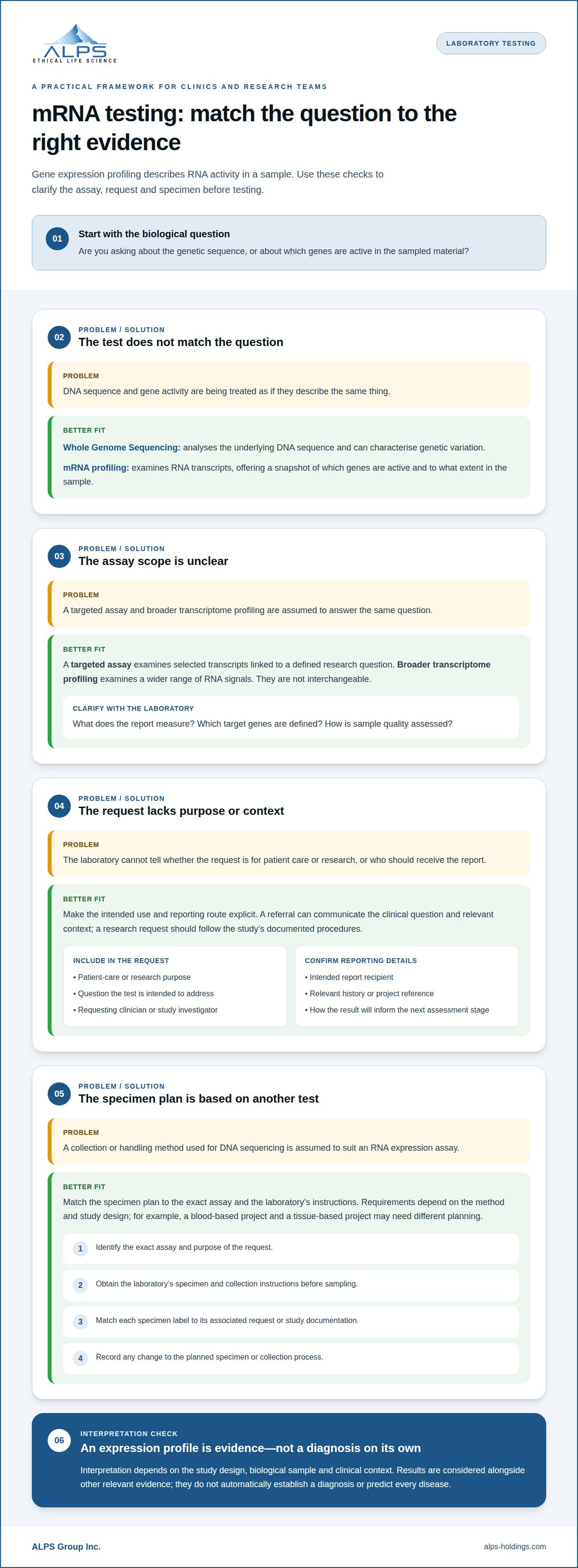
For clinics and research teams evaluating mRNA testing in Malaysia, the key distinction is the intended output. Gene expression profiling measures RNA transcripts, which reflect gene activity in a sample. A targeted assay examines selected transcripts linked to a defined research question, while broader transcriptome profiling examines a wider range of RNA signals. These approaches answer different questions and are not interchangeable.
By contrast, Whole Genome Sequencing analyses DNA sequence. It can characterise genetic variation, while mRNA profiling describes gene activity in the sampled material. Neither result automatically establishes a diagnosis or predicts every disease. Interpretation depends on the study design, biological sample and clinical context.
When assessing mRNA testing in Malaysia, establish whether the service is a research assay or a clinical test, what the report measures and whether its scope matches the intended question. Ask how the laboratory defines target genes, assesses sample quality and presents findings. A clearly specified assay and report help the referring team judge whether results suit research analysis or clinical decision support.
COVID-19 vaccination is available at public health clinics in Malaysia, but vaccination availability does not identify a laboratory offering mRNA testing or establish that a diagnostic assay is offered there.
Do I need a referral for mRNA testing in Malaysia?
Whether a referral is needed depends on the testing pathway and laboratory process. A clinician may initiate testing as part of a patient assessment, while a research team may submit a request under its study protocol. The key is to identify who defines the purpose, authorises the request and receives the report.
A referral can communicate the clinical question and provide context for interpreting results. It may identify the requesting clinician, relevant history and intended use of the result. A prescription is different: it concerns medicines, not a request for laboratory analysis. An mRNA result does not itself prescribe treatment.
Clinics and hospitals arranging a request can prepare these details:
- State whether the request relates to patient care or research.
- Describe the question the test is intended to address.
- Identify the requesting clinician or study investigator.
- Specify who should receive the report and any relevant project reference.
For a research project, the investigator should ensure the request follows the study’s documented procedures. For patient care, the clinician coordinating the assessment can determine how testing fits the case and how to interpret findings. A clear request helps the laboratory understand the purpose and route the report appropriately.
Patients can raise testing with their treating clinician and discuss its purpose before a sample is arranged. Healthcare teams seeking administrative guidance can use the laboratory testing enquiry channel to discuss the appropriate request pathway. The information provided should connect the requested analysis with its intended clinical or research use.
How do I prepare for an mRNA test and provide a sample?
Preparation starts with matching the specimen plan to the specific assay. An mRNA analysis may use a defined specimen type, but requirements depend on the laboratory method and study design. Before collection, the clinical or research team should obtain the applicable instructions from the laboratory. A blood-based project and a tissue-based project, for example, may need different planning.
Prepare the request details alongside the specimen plan. For clinical work, include the clinical question and relevant context. For research, record the study identifier, protocol reference and intended analysis. Clear documentation helps distinguish samples from different participants or study groups and link each specimen to its request.
Follow the laboratory’s instructions for identifying and submitting the sample. Do not apply a collection or handling method from another test without approval. For example, a procedure used for DNA sequencing should not automatically be assumed suitable for an RNA expression assay. The laboratory’s stated criteria determine whether the planned specimen fits the requested analysis.
- Identify the exact assay and purpose of the request.
- Obtain the relevant specimen instructions from the laboratory.
- Prepare the required request and study information.
- Match each specimen label to its associated documentation.
Patients should follow the collection directions provided for their specific test. Do not assume fasting, medicine changes or a particular collection setting are required. Research teams should document the protocol used for each participant so the study record accurately reflects the sample plan.
If the planned specimen or collection process changes, record the change in the request information. The laboratory can assess the details against the assay requirements. Clear records help the clinical or research team interpret the eventual report in the context of how each sample was obtained.
How long do mRNA test results take in Malaysia?
There is no single turnaround period for every mRNA test in Malaysia. The reporting schedule depends on the assay, sample condition, laboratory workflow and analysis required. A targeted assay examining selected transcripts differs from broader expression profiling, which involves more extensive data processing and interpretation.
The turnaround process begins when the laboratory receives the specimen and accompanying request. Intake checks establish whether the sample and documentation match the requested analysis. Missing identifiers, incomplete study details or a specimen requiring further assessment can delay progress. The reporting timeline should therefore be understood in relation to sample receipt and acceptance, not collection alone.
Processing also depends on the assay workflow. RNA extraction, quality assessment and measurement come before interpretation. A targeted panel and a broader profile require different analytical work. If the laboratory processes samples in batches, the schedule may also depend on when a sample enters the relevant run. These workflow factors shape how quickly analysis can proceed.
After measurement, the report needs to present results in a form suited to the request. A research report may require analysis against a study design, while a clinical report needs to address the stated clinical question. Reviewing findings and completing the report are part of the overall timeline.
For planning, clinics and research teams should provide the test scope, sample details and reporting purpose together. Ask for the expected timeline after the laboratory has reviewed those details, and clarify which event starts the estimate. If a project has a submission deadline, include it with the request so the laboratory can assess the workflow against it.
For an estimate based on your assay and sample plan, request a testing quotation.
Project milestones should not be confused with an individual laboratory report’s turnaround. Human pre-clinical trials for Malaysia’s mRNA vaccine project were planned to take place a few months after animal testing, but that planning interval does not establish how long a particular test result takes. Long COVID involves symptoms persisting 12 to 16 weeks after the initial infection; this describes symptom duration, not a laboratory reporting schedule. For an estimate, rely on the laboratory’s review of the specific assay and sample.
ALPS Group: mRNA Testing
ALPS Group Inc. provides mRNA Testing for Malaysian clinics, hospitals and research organisations assessing gene expression. The service is relevant when a project or clinical question calls for analysis of RNA activity rather than DNA sequence alone.
Before arranging testing, teams can define the intended use, sample plan and reporting requirements. These details help align the requested analysis with the purpose of the work. Where the question concerns genetic sequence rather than gene activity, Whole Genome Sequencing may be more appropriate. Other laboratory needs may call for Biochemistry, Serology & Immunology Tests or Microbial Tests.
ALPS Group Inc.’s molecular laboratory meets MS ISO 15189:2022 standards. To discuss the suitability of mRNA Testing for your requirements, contact ALPS Group Inc.
Set a clear direction for your next testing decision
For teams considering mRNA testing in Malaysia, first define the biological question and intended use before selecting an analysis. A well-framed request helps align the test, sample plan and reporting expectations, while keeping research findings distinct from established clinical conclusions. The right testing pathway depends on whether the priority is gene activity, genetic sequence or another laboratory question.
ALPS Group provides mRNA Testing, Whole Genome Sequencing, and Biochemistry, Serology & Immunology Tests. These services address different testing needs, and the appropriate choice depends on the question being investigated. Interpret results in the context of relevant clinical or research information, not as a standalone prediction.
For a considered discussion of testing suitability and next steps, contact ALPS Group about mRNA testing. A clearly defined question is a strong foundation for responsible laboratory planning.
Frequently Asked Questions
What does mRNA testing mean in Malaysia?
In Malaysia, mRNA testing analyses RNA molecules in a sample to assess gene activity. The result reflects the material collected and the assay’s defined targets; it is not a complete account of every gene or a standalone diagnosis. For example, a research team studying a selected biological pathway would interpret the measured transcripts against its study question and other relevant findings.
Where can I get mRNA testing in Malaysia?
ALPS Group Inc. offers mRNA Testing for clinics, hospitals, healthcare professionals and research organisations. To plan an enquiry, specify whether the work is for patient care or research, describe the intended question, and share relevant sample and reporting information. This helps focus the discussion on the service’s suitability and the requirements for the particular request.
How does mRNA testing compare with DNA, PCR, and other tests in Malaysia?
mRNA testing examines RNA expression, while DNA testing examines genetic sequence; each method answers different questions. PCR is a laboratory technique that amplifies targeted genetic material for detection or measurement, not a single test purpose. Other tests measure different biological features: for example, biochemistry tests assess chemical components, while serology examines antibodies or antigens. The appropriate approach depends on the question being investigated.


