

Reliable follow-up depends on a defined process, not simply on receiving a laboratory report. A sound send-out laboratory testing workflow for outpatient medical centres brings together four controls: clear acknowledgement of abnormal results, dependable result transfer, deliberate decisions about which tests to perform in-house, and ongoing quality monitoring.
Send-out testing can extend diagnostic access, but each hand-off between ordering, processing and reporting creates an opportunity for a result to be delayed or overlooked. A structured workflow makes responsibilities clear and connects result follow-up with patient care.
This article outlines four practical ways to strengthen the process in Malaysian medical settings. It covers abnormal-result notifications, report integration into clinical records, decisions about in-house testing and monitoring indicators such as reporting delays and corrected results. Together, these measures support continuity and oversight across send-out testing.
Key Takeaways
- Assign clear responsibility for reviewing abnormal send-out results, and create a process to follow up when acknowledgement is missing.
- Use electronic interfaces to transfer reports into clinical systems; where direct transfer is not feasible, establish a consistent scanning and filing process.
- Review test orders and volumes to decide which tests may be appropriate for in-house testing and which should remain send-outs.
- Monitor result-entry delays and corrected reports to identify where the workflow needs stronger controls.
1. Abnormal-result notification
Send-out results may take several weeks or months, leaving a gap between specimen collection and clinical review. Without assigned responsibility for retrieving and acknowledging reports, a result can remain unseen. In a reliable workflow, each order has a named clinician or covering role responsible for review, action and documentation.
Patient identification, specimen collection, labelling and packaging should follow the requirements for the specific test and receiving laboratory. At collection, match the patient’s identity to the request, use the specified container, label the specimen clearly, and package it according to handling instructions. For example, the laboratory guide lists an 8-hour stability period for HbA1c whole blood collected in an EDTA tube.
Results can arrive through an electronic interface, a laboratory portal or a report requiring manual entry. Route each report to the ordering clinician’s inbox, flag abnormal values, and record review, communication and follow-up in the patient record. The [medical laboratory service](https://mygenome.asia/medical-lab/) forms part of a wider diagnostic pathway in which accurate reporting supports clinical review.
For a critical result, use a defined escalation pathway: contact the responsible clinician promptly, confirm receipt, and document the time, recipient and agreed action. Routine abnormal results also need acknowledgement. Laboratories can audit unacknowledged reports and follow up when no review is recorded. This provides visibility beyond simply sending a report.
If a specimen is rejected, delayed or unsuitable, record the reason and notify the ordering team. Explain whether recollection is needed, which sample issue must be corrected, and how a new collection affects the pending result. For delayed reports, update the clinician and patient, then document the communication and next review point. Clear ownership prevents rejected samples and pending reports from being lost between teams.
Because send-out results can take several weeks or months, keep retrieval and acknowledgement active throughout the wait. Do not let the process end when the specimen is sent. Laboratories can flag abnormal results in physicians’ electronic inboxes as an additional prompt, but the assigned clinician still needs to retrieve and acknowledge the report and record any required follow-up.
2. Electronic interfaces between laboratories
An electronic interface transfers send-out results from a reference laboratory into the ordering centre’s laboratory information system (LIS). Results can then appear in the electronic medical record (EMR) for clinician review. This reduces reliance on separate reports and manual transcription while keeping results connected to the relevant patient record.
Map the data pathway before connecting systems. Include patient identifiers, order details, test names, result values, units, reference ranges and abnormal flags. Agree how the interface will handle pending, final and amended reports. A corrected report, for example, should be distinguishable from the earlier result so staff do not act on superseded information. Test the pathway with representative records before routine use.
For Malaysian centres, follow internal information-handling procedures and the receiving laboratory’s documented submission and reporting instructions. Assign responsibility for interface oversight, access and exception handling. These controls help direct results to the intended record and detect failed transfers rather than allowing them to go unnoticed.
When electronic transfer is not feasible, scan the send-out report into both the LIS and EMR, then match it to the correct patient and test order. A designated staff member can check that the uploaded document is legible, complete and filed in the correct record. Retain the original report according to the centre’s record procedures.
Monitor interface exceptions such as missing reports, mismatched identifiers, duplicate results and delayed transfers. Assign each exception to a named role for resolution and record the action taken. These checks help pinpoint whether a problem lies in order mapping, data transfer or manual filing, so the workflow can be improved accordingly.
Outsourced testing costs depend on factors such as test type, sample handling, transport and reporting. For ALPS Group Inc. testing services, pricing depends on the case and is provided after a quotation request. Centres can discuss laboratory testing requirements to support service planning.
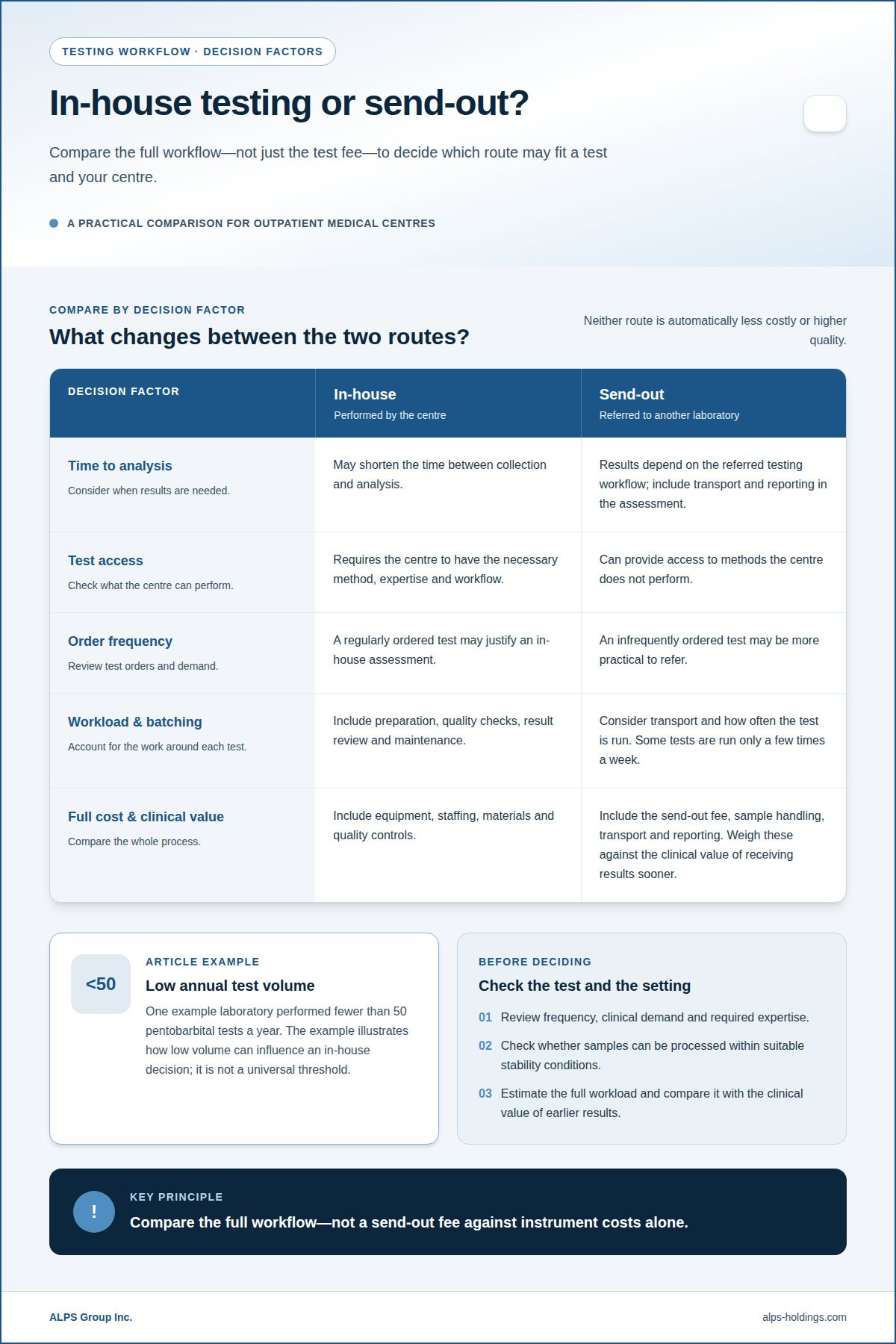
In-house testing decisions
In-house testing can shorten the time between collection and analysis, while send-out testing provides access to methods a centre does not perform. Neither route is automatically less costly or higher quality. Compare the full workflow, including equipment, staffing, materials, transport, reporting, quality controls and the clinical value of receiving results sooner.
Start with order data. Review test frequency, clinical demand, required expertise and whether samples can be processed within suitable stability conditions. A test ordered regularly may justify an in-house assessment; a test ordered infrequently may be more practical to refer. One example laboratory performed fewer than 50 pentobarbital tests a year, illustrating why low volume can influence the decision.
Batching also affects the calculation. Some tests run only a few times a week, influencing staff schedules and the wait before analysis. Estimate the full workload, including preparation, quality checks, result review and maintenance, rather than comparing the send-out fee with instrument costs alone.
Clinicians should order a test that addresses the clinical question, provide the required patient and specimen details, and follow the laboratory’s collection instructions. A test formulary can clarify available options and referral pathways. For genetic orders, a genetic counsellor can review requests; an on-call doctoral-level consultant is another test-utilisation measure.
When evaluating a reference laboratory in Malaysia, check whether its accreditation is relevant to the specific test and within the stated scope. Review documented specimen requirements, analytical method, reporting format, result-interpretation support and arrangements for amended reports. Accreditation alone does not establish whether a particular service suits the clinical question.
Outsourcing costs depend on the test, sample handling, transport, batching and reporting arrangements. Assess these alongside in-house staffing and quality-control needs. Track volume and turnaround experience over time, and revisit the decision when demand or workflow changes. A written review makes the rationale clear to clinicians and laboratory staff.
4. Quality metrics for send-out testing
Measure performance across the send-out pathway, not just the time taken to issue a final report. Track specimen rejection, reporting delays, manual result-entry time and corrected reports caused by transcription errors. Define every measure consistently. For example, record manual-entry time from receipt of the external report until the result appears in the EMR.
Turnaround expectations depend on the test and its clinical purpose. A laboratory guide lists a 2-hour turnaround time for serum TSH testing. A drug result taking four days may make dosing decisions suboptimal, while 3 to 4 days for pentobarbital results was considered unacceptable in an example. These cases show why quality review should consider clinical relevance, not just elapsed time.
Specimen stability also affects workflow measurement. Follow the receiving laboratory’s test-specific storage and transport instructions, and record collection, dispatch and receipt times. For example, a laboratory guide lists an 8-hour stability period for HbA1c whole blood collected in an EDTA tube. This provides a concrete point for assessing whether transport and processing occurred within the stated stability period.
Separate analytical turnaround from total elapsed time. A sample may wait before dispatch, during transport or before processing. Recording each stage helps identify where delays occur. Review rejected specimens by reason and determine whether a pattern relates to collection, labelling, packaging or another documented issue. Track corrected reports separately, especially when transcription errors prompted an amendment.
Review trends at scheduled intervals and assign an owner to follow each identified issue. A rise in manual-entry time or corrected reports can prompt a review of result-entry controls. Abandoned-call rates and time to first answer can also indicate whether send-out testing queries receive timely attention. Discuss send-out testing quality and reporting needs with ALPS Group Inc. to support service planning.
ALPS Group: mRNA Testing
ALPS Group Inc. offers mRNA Testing for organisations evaluating laboratory requirements. Messenger RNA, or mRNA, carries information involved in gene expression. Select a testing approach according to the intended question, specimen requirements and reporting needs.
For outpatient centres planning send-out pathways, define the requested test, collection process and result destination before placing an order. Testing needs beyond mRNA should be assessed in light of the clinical or research purpose and the information required from the result. These testing categories can inform diagnostic planning, while the appropriate service depends on the clinical or research purpose and the information required from the result.
Contact ALPS Group Inc. to discuss mRNA Testing suitability, service requirements or a quotation.
Strengthen the pathway as testing needs evolve
A dependable send-out laboratory testing workflow for outpatient medical centres should develop alongside clinical priorities and reporting needs. The next step is to identify where the current pathway creates uncertainty for staff or delays decisions, then define an improvement that can be monitored in routine work. This keeps process development focused on continuity of care rather than technology for its own sake.
For teams evaluating laboratory services, let the testing purpose guide the discussion. ALPS Group Inc. offers Whole Genome Sequencing, mRNA Testing, and Biochemistry, Serology & Immunology Tests. These services may be relevant when a centre is assessing its testing needs and planning how results will fit into its clinical or research workflow. Clear requirements for the test, specimen and report make that discussion more useful.
Contact ALPS Group Inc. to discuss your testing requirements and consider a suitable next step. A carefully designed pathway can support more consistent laboratory coordination as needs change.
Frequently Asked Questions
What is the end-to-end workflow for send-out laboratory tests in outpatient medical centres?
Start by selecting the requested test and recording the clinical question it must address. The external laboratory determines whether the order is clear enough for processing and assigns it within its system. After analysis, the laboratory issues a report through the agreed channel. The centre can use the report’s method, units and interpretive information to support its clinical decision.
Which tests should be sent to an external laboratory rather than performed on site?
Send a test externally when the exact assay requested is not on the centre’s local test menu. Whole Genome Sequencing is one distinct molecular testing service. Before referral, confirm that the selected test name matches the clinician’s request and that the resulting report will address the specific question. This helps avoid substituting a broadly similar test for the intended analysis.
What quality, privacy, biosafety and infection-control risks apply to send-out testing?
Quality risks include delayed or missed results, transcription or transfer errors, mismatched records, and rejected or unsuitable specimens. Follow internal information-handling procedures and the receiving laboratory’s test-specific instructions for collection, labelling, packaging, storage and transport.


