

A diagnostic test price is meaningful only when its scope is clear. This clinical diagnostic test pricing guide for general practitioners in Malaysia starts with a practical distinction: relative values in the fee schedule are guidance for calculating fees, not “MMA-recommended fees” for billing. A useful estimate identifies the test category and explains what the quoted service covers.
For clinics, transparent pricing supports informed financial decisions and makes referrals and cost discussions clearer. Fees can depend on the requested test and the scope of the service, so comparing by category is more useful than treating all diagnostics as one price.
This guide outlines common blood test and diagnostic service categories, explains factors that affect cost and turnaround time, and sets out what to clarify about samples and reporting. It also describes how ALPS Group’s laboratory testing services relate to the needs of Malaysian clinics and healthcare professionals.
Key Takeaways
- Separate laboratory test categories from procedures and consultations when assessing diagnostic costs, since each covers a different service.
- Interpret Malaysian Medical Association schedule values as guidance for calculating fees, not as MMA-recommended fees for billing.
- Clarify what a quoted service includes, along with sample requirements and reporting, to make cost discussions more transparent.
- Compare diagnostic options by service scope and setting, rather than assuming clinic, private laboratory and government facility prices are directly equivalent.
Blood tests and diagnostic services
Blood tests sit alongside diagnostic procedures, consultations and point-of-care tests in a clinic’s service mix. Each has a different scope, so a fee should be read against the specific test or procedure. For example, the Malaysian Medical Association schedule lists a Pap smear at RM80 and diagnostic electron microscopy at RM320-380. These are distinct services, not blood-test prices.
For fees, the Malaysian Medical Association schedule describes relative values as guidance for calculating fees, not as “MMA-recommended fees” for billing. It also says practitioners should, where practicable, give patients or financially responsible third parties enough fee information to make an informed financial decision. Reports should clearly identify the test performed and its findings, with relevant units and reference intervals where supplied.
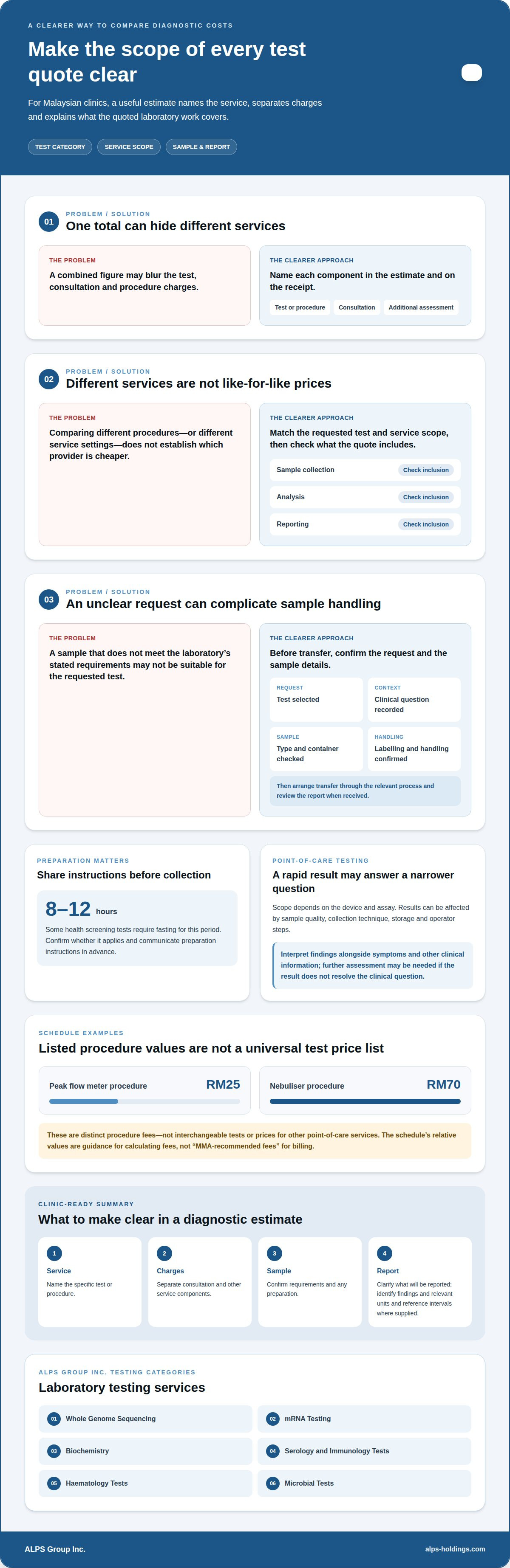
To order an external laboratory test, the GP selects the requested test, records the clinical question, and completes the laboratory’s request documentation. The sample must match the laboratory’s stated requirements for type, collection container, labelling and handling. The clinic then arranges transfer through the relevant process and reviews the report when received. For gene-expression work, the gene-expression profiling test is a distinct molecular testing category, not a routine blood count.
Point-of-care tests provide results near the patient, but their scope depends on the device and assay. Sample quality, collection technique, storage and operator steps can affect results. A rapid reading may answer a narrower question than a laboratory test. GPs should interpret findings alongside symptoms and other clinical information, then arrange further assessment if the result does not resolve the clinical question.
Preparation can affect sample suitability. Some health screening tests require patients to fast for 8 to 12 hours, so clinics should communicate preparation instructions before collection. A practical workflow records the requested test, relevant preparation, sample details and reporting route, reducing ambiguity between the clinic and laboratory.
Pricing transparency and service categories
A clinical diagnostic test pricing guide for general practitioners in Malaysia should distinguish the test from consultation, procedure and reporting charges. A meaningful comparison depends on what each quoted service includes.
Prices Across Service Providers
Compare GP clinics, private laboratories and government facilities by matching the same test and service scope. The Malaysian Medical Association schedule lists a peak flow meter procedure at RM25, a diagnostic biopsy at RM110-130 for one paraffin block, and ultrasound at RM40. These examples cover different procedures, so they do not establish a price ranking across facilities. Check whether each quoted amount covers sample collection, analysis and reporting.
Receipts and Out-of-Pocket Payments
Receipts help patients identify the service charged and document payment. For diagnostic testing, the receipt should distinguish the test or procedure from consultation fees. Patients can review their insurance policy for requirements concerning eligible tests, referrals, pre-authorisation and claim documents. The amount they pay themselves depends on policy terms and any portion the insurer does not cover.
Clinics can explain the requested category, expected charges and any separate consultation or procedure component before testing. The Malaysian Medical Association schedule says practitioners should, where practicable, provide enough fee information for an informed financial decision. A clinical diagnostic test pricing guide for general practitioners in Malaysia can help structure this discussion by identifying the service being priced, rather than combining a blood test, consultation and other procedures into one unexplained total.
For example, a patient comparing a diagnostic biopsy with an ultrasound needs the test name, service scope and any separately charged consultation. A clinic can record these details in its estimate and itemise them on the receipt. This supports clearer discussions about out-of-pocket costs and insurance claims.
What are the typical patient prices for common point-of-care tests in Malaysia?
Point-of-care testing gives a result near the patient, while its price depends on the specific test and service. Malaysian Medical Association schedule examples include a peak flow meter procedure fee of RM25 and a nebuliser procedure fee of RM70. These are procedure fees, not a universal price list for point-of-care diagnostic tests.
The distinction matters when clinics explain charges. A peak flow measurement assesses airflow, while nebulisation delivers medicine as a mist. The listed fees therefore cover different procedures, not interchangeable tests. A patient estimate should name the service and distinguish it from any consultation or additional investigation.
For a practical comparison, separate charges by service component:
- Test or procedure: identify the specific point-of-care service, such as peak flow measurement.
- Consultation: show the consultation separately when it forms part of the visit.
- Additional assessment: identify a separate test or procedure rather than folding it into an unclear total.
The Malaysian Medical Association schedule says its relative values are guidance for calculating fees. They should not be described in billing as MMA-recommended fees. Its RM25 peak flow meter and RM70 nebuliser entries are useful examples of listed procedure values, but they do not establish prices for other point-of-care tests.
For an individual service, the charge can reflect the test method, device or consumables required, sample collection and interpretation. These components explain why two services performed near the patient may have different costs. Clinics can improve clarity by naming each service, itemising its fee and explaining whether the patient receives a result during the visit or in a later report.
Preparation can also affect the service pathway. Some health screening tests require fasting for 8 to 12 hours, so clinics should distinguish those laboratory-based tests from immediate point-of-care procedures when discussing patient charges.
The examples given are RM25 for a peak flow meter procedure and RM70 for a nebuliser procedure. These are listed procedure values, not typical prices for point-of-care diagnostic tests generally, and consultation or other services may be charged separately.
Diagnostic Test Price Comparison in Malaysia
Comparing GP clinics, private laboratories and government facilities requires matching the same test and service scope. A quoted amount may cover a consultation, procedure, sample analysis or combined service, so the setting alone does not make two prices comparable.
For example, the Malaysian Medical Association schedule lists an initial consultation for a minor case during normal working hours at RM35. Follow-up consultations are listed at RM25 for a minor case, RM45 for an intermediate case and RM80 for a complex case. These are consultation fees, not diagnostic test prices. Keeping consultation separate helps prevent misleading comparisons.
For a GP clinic, identify whether the estimate covers the consultation, sample collection, test processing and report. For a private laboratory, compare the named test and sample requirements, then establish whether collection or reporting is included. For a government facility, compare the same items and service pathway. This avoids assuming that one setting is consistently less expensive.
A comparison record can help clinics assess quotations consistently:
- Test requested: record the exact test name and method.
- Service components: distinguish consultation, collection, analysis and reporting.
- Specimen pathway: note where collection occurs and how the sample reaches the testing laboratory.
- Result delivery: record how findings are returned to the referring clinic.
The Malaysian Medical Association schedule describes relative values as guidance for calculating fees, not as MMA-recommended fees for billing. Its consultation entries provide context for distinguishing clinical assessment from laboratory charges; they do not directly compare diagnostic tests across sectors.
When reviewing quotations, clinics can use the recorded test name and service components to identify differences in scope. A request specifying the intended test, specimen and reporting needs gives each facility a consistent basis for describing its service. This supports clearer comparisons for clinics and more precise explanations to patients.
ALPS Group Inc.: mRNA Testing
ALPS Group Inc. provides mRNA Testing for healthcare professionals and organisations assessing molecular testing needs. Clinics considering the service can discuss the testing requirement, sample arrangements and reporting needs while planning a referral. A clearly defined scope helps align a laboratory quotation with the work requested.
ALPS Group Inc. also offers Whole Genome Sequencing, Biochemistry, Serology & Immunology Tests, and Microbial Tests. These are distinct service categories, so the appropriate option depends on the testing question and required scope. For mRNA testing details, review the gene-expression profiling and mRNA testing service.
The quotation depends on the requested service and its requirements, including test scope and sample arrangements. Contact ALPS Group Inc. through its contact page to discuss mRNA Testing or request a quotation.
Make the Next Testing Decision with Clarity
A clinical diagnostic test pricing guide for general practitioners in Malaysia is most useful when it informs the next referral decision, not just the initial cost discussion. Define the clinical question, identify the required testing category and align the referral with sample and reporting needs. This gives clinics a consistent basis for coordinating laboratory services and communicating with patients.
ALPS Group Inc. offers Whole Genome Sequencing, mRNA Testing, and Biochemistry, Serology & Immunology Tests for organisations seeking laboratory testing services. The right service depends on the testing requirement and scope. A clear discussion at the outset helps establish whether the requested service fits the intended work.
For Malaysian clinics planning a referral or assessing a laboratory requirement, contact ALPS Group Inc. about diagnostic testing suitability or a quotation. A well-defined testing request is a constructive starting point for informed decisions and coordinated care.
Frequently Asked Questions
What clinical diagnostic tests are commonly available in Malaysian GP clinics?
GP clinics may provide or arrange tests across haematology, biochemistry, serology, immunology and microbial testing. Examples include blood counts, glucose or lipid testing, urine analysis and pregnancy testing, depending on the clinic’s services and the clinical request. Some assessments are performed near the patient, while others require laboratory testing. The requested test should match the clinical question and sample type.
How much do CBC, glucose, lipid, HbA1c, urine, and pregnancy tests cost at Malaysian private clinics?
Patient charges for CBC, glucose, lipid, HbA1c, urine and pregnancy tests depend on the assay and service scope. A clinic’s estimate may distinguish the test from consultation, sample collection or other services. For a useful cost discussion, identify the exact test requested and whether the quoted amount covers analysis alone or additional components. The Malaysian Medical Association schedule’s listed procedure values are not prices for these named tests.
What are the prices of common laboratory tests at private diagnostic labs in Malaysia?
Private laboratory charges vary with the test method, requested panel, specimen requirements and reporting scope. A single test and a panel covering several measurements are different requests, even if both use a blood sample. For budgeting, describe the intended test precisely and establish which service components the quotation includes. Laboratory testing categories include haematology, biochemistry, serology, immunology and microbial testing.
What factors affect diagnostic test pricing in Malaysian GP clinics, including consultation and sample collection fees?
Pricing can reflect the requested assay, whether testing is performed at the clinic or laboratory, sample collection, processing and reporting. A consultation is a separate clinical service and may be charged independently of the test. For example, when a blood test request includes a consultation, itemise each service so patients can distinguish the clinician’s assessment from laboratory work and understand the total charge.


