

A tumour’s DNA contains the genetic instructions in its cells; an mRNA test for gene activity examines which instructions are being used. Gene expression is the process by which information in a gene is transcribed into RNA. Measuring mRNA can reveal activity patterns associated with tumour biology, adding functional information rather than simply listing genetic changes.
It is understandable to expect a molecular test to answer directly whether cancer is present. In practice, mRNA findings show patterns that must be interpreted in context. Gene activity can vary across cells and tissues, and an expression result is not a diagnosis.
This article explains gene expression and how mRNA testing can detect tumour-related activity, including the roles of sample type and laboratory method. It compares mRNA analysis with DNA testing and tumour marker tests, helping Malaysian healthcare and research professionals understand what each approach measures and where it may inform further investigation.
Key Takeaways
- Understand how measuring RNA levels reveals which genes are active, and why comparisons between conditions depend on consistent samples and analysis.
- See how qPCR, digital PCR and RNA sequencing differ, so you can connect the research question with an appropriate testing method.
- Distinguish the information provided by DNA, RNA and tumour marker tests, each of which measures a different aspect of biology.
- Learn how tumour-related RNA patterns can provide insight into cell activity and how ALPS Group’s mRNA Testing may fit laboratory testing needs.
What is Gene Expression?
Gene expression describes how cells use genetic instructions to produce RNA and, for coding genes, proteins. An mRNA test for gene activity measures selected transcripts in a sample.
The National Human Genome Research Institute states that the human genome contains around 20,000 protein-coding genes. During RNA processing, introns are removed and exons joined; the National Center for Biotechnology Information describes this splicing process as part of producing mature messenger RNA. RNA analysis can also examine functional transcripts that do not code for proteins.
Expression Changes Across Conditions
Comparing expression involves measuring RNA levels across experimental conditions, such as treated and untreated cells. Researchers can assess thousands of genes at a time and identify patterns that differ between groups. A change may indicate an altered cellular response rather than a change in DNA sequence. Using consistent sample types and analysis methods helps make comparisons informative.
Pathways, Tissues, and RNA Expression
A biological pathway is a connected set of cellular processes. Expression analysis can show how genes within a pathway vary together. Tissue selection matters because blood, skin and biopsy tissue contain different cell populations. The US National Library of Medicine’s PubMed database indexes research on long non-coding RNA expression in thyroid cancer. Such studies examine expression patterns, not standalone clinical conclusions.
Lifestyle and environmental exposures can influence gene regulation. The National Institute of Environmental Health Sciences describes how environmental factors may affect gene expression, so researchers consider relevant exposures when interpreting sample patterns. Follow the collection instructions for the specific test: sample type and handling requirements depend on the analysis.
For studies focused on expression profiling, gene-expression profiling examines RNA patterns relevant to the selected sample and research question.
QPCR, digital PCR and next-generation sequencing
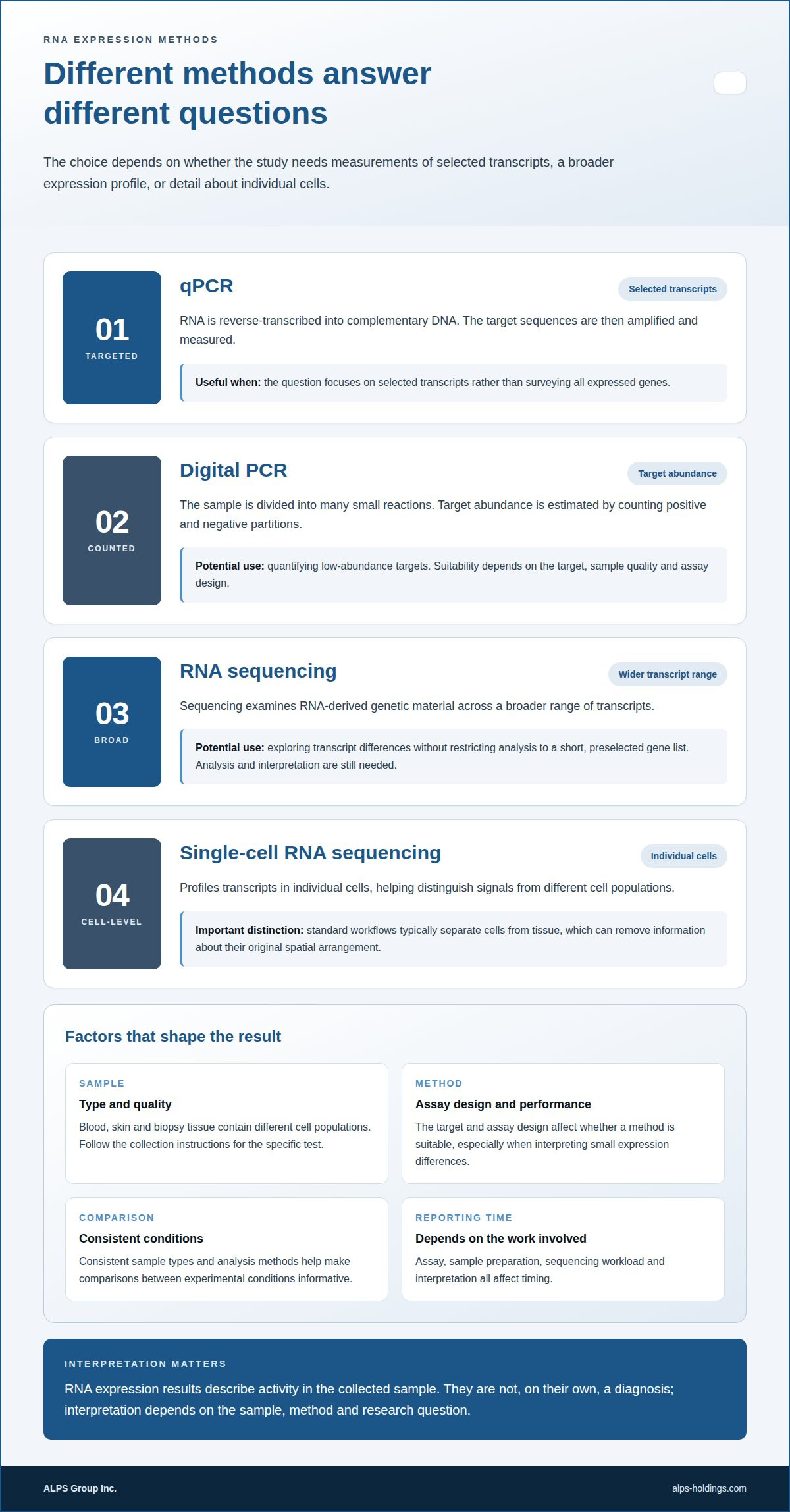
These methods vary in how broadly they measure RNA expression. In quantitative polymerase chain reaction (qPCR), RNA is reverse-transcribed into complementary DNA, then target sequences are amplified and measured. The MIQE guidelines, developed to improve qPCR study reporting, emphasise documenting assay design and validation. This targeted method suits questions about selected transcripts, rather than a survey of all expressed genes.
Digital PCR divides a sample into many small reactions and estimates target abundance by counting positive and negative partitions. The dMIQE Group’s reporting guidelines describe key considerations, including partition measurement and assay performance. This approach can help quantify low-abundance targets, but suitability depends on the target, sample quality and assay design. These methodological factors matter when interpreting small differences in expression.
RNA sequencing uses sequencing technology to examine RNA-derived genetic material across a broader range of transcripts. The National Cancer Institute describes it as a method for measuring RNA and studying gene activity. Unlike targeted PCR, sequencing can identify transcript differences without restricting analysis to a short, preselected gene list. Its broader scope can support exploratory research, with appropriate analysis and interpretation.
Single-cell RNA sequencing profiles transcripts in individual cells, helping distinguish signals from different cell populations. Standard workflows typically separate cells from tissue before analysis, which can remove information about their original spatial arrangement. Methods that preserve tissue location address a different research question. The choice between bulk and single-cell approaches depends on whether a study needs an overall expression profile or cell-level detail.
How long do mRNA test results take? Timing depends on the assay, sample preparation, sequencing workload and interpretation required. Targeted PCR and broad sequencing involve different laboratory and analysis steps, so the method and project scope affect the reporting schedule.
Differences between DNA, mRNA and tumor marker tests
DNA, mRNA and tumour marker tests measure different biological information. The National Human Genome Research Institute describes DNA as the molecule that carries genetic instructions; RNA is produced from DNA during gene expression. Whole Genome Sequencing assesses DNA sequence information, while an mRNA test for gene activity measures selected RNA transcripts. These approaches address distinct questions: which genetic instructions are present, which genes are active, or whether a particular marker is detected.
An mRNA test for gene activity measures transcripts in the collected sample, not the proteins those transcripts may help produce. The National Center for Biotechnology Information explains that gene expression involves multiple regulatory steps, so RNA abundance does not necessarily correspond directly to protein abundance. Results may also depend on the sampled tissue and its cellular composition. Environmental or lifestyle context can be relevant when interpreting expression patterns.
Tumour marker tests assess substances associated with cancer, including certain proteins. The National Cancer Institute notes that tumour markers may be produced by cancer cells or by other cells in response to cancer, and that results are used alongside other clinical information. A marker test therefore differs from DNA sequencing or mRNA measurement. Each method has a defined scope, and the appropriate choice depends on the biological question and information needed.
How accurate and reliable are mRNA expression tests? Reliability depends on sample quality, assay design and how results are analysed against suitable comparisons. The National Center for Biotechnology Information describes RNA and protein abundance as distinct measurements. Expression results should not be treated as a direct measure of protein function or a standalone cancer diagnosis. If the question concerns genetic variants rather than active transcription, DNA analysis addresses a different aspect.
How mRNA testing detects tumor-related gene activity
An mRNA test measures selected RNA transcripts in a sample and assesses their expression patterns. Tumour-related signals may indicate active biological processes rather than simply showing which DNA variants a cell carries. For example, the research method RARE-seq detected mechanisms associated with resistance to EGFR tyrosine kinase inhibitors in lung cancer. This illustrates a research application, not a general diagnostic conclusion.
How does mRNA expression testing work? A laboratory extracts RNA from the submitted sample, measures selected transcripts and interprets their levels according to the test’s analysis approach. The resulting pattern can indicate which genes were active in the sampled material; it cannot show every process occurring throughout the body.
What conditions can mRNA gene activity tests help diagnose? No single condition is diagnosed by all expression tests. Interpretation depends on the assay and clinical context. Research has examined tumour-related expression, including signals associated with lung cancer and treatment resistance.
What are the risks and limitations of mRNA testing? Results depend on the tissue sampled, RNA quality and the transcripts measured. Different cell populations can produce different signals, and a change in expression does not necessarily correspond to a change in protein levels. Results therefore need interpretation alongside other relevant clinical information.
Are mRNA gene activity tests regulated or covered by insurance in Malaysia? Regulatory requirements and reimbursement are separate considerations, and coverage depends on the specific test and insurance policy. An mRNA result alone establishes neither regulatory status nor insurance eligibility.
For a discussion of mRNA testing and its suitability for a research or clinical question, contact the laboratory team.
ALPS Group: mRNA Testing
ALPS Group Inc. provides mRNA Testing for organisations assessing gene-expression patterns in a sample. It may be relevant when a clinic, hospital or research team has a defined question about RNA activity and needs laboratory testing to investigate it.
Before testing, clarify the biological question, sample type and intended interpretation. These details help determine whether mRNA analysis fits the project or whether another molecular approach is more appropriate. Whole Genome Sequencing examines DNA sequence information, while mRNA testing focuses on expressed RNA. The methods address distinct questions.
For Malaysian healthcare professionals and research organisations, a clear request can support discussion of sample requirements, analysis scope and reporting needs. Contact ALPS Group Inc. to discuss mRNA Testing and its suitability for your work.
Define the question that will guide testing
For Malaysian clinical teams and research organisations, start by defining the decision or investigation the test should inform. An mRNA test for gene activity is most useful when the biological question, sample type and intended interpretation align. Establishing these parameters early helps clarify what the analysis should measure and how the findings will be used.
ALPS Group Inc. offers mRNA Testing and Whole Genome Sequencing, alongside Biochemistry, Serology & Immunology Tests. These services address different testing needs: the appropriate approach depends on whether the question concerns RNA expression, genetic sequence or other laboratory findings. A clear project scope can help establish the relevant testing pathway and reporting needs.
For a referral or research project, prepare a concise summary of the question, sample and intended use of the results. Contact ALPS Group Inc. to discuss testing and the requirements for your work. A well-defined starting point supports a more focused laboratory discussion.
Frequently Asked Questions
From DNA to mRNA: What’s the Connection?
DNA provides instructions that a cell can transcribe into RNA. For protein-coding genes, the initial RNA transcript is processed: introns are removed and exons joined to form mature mRNA. This connects genetic information to cellular activity. Changes in transcription or RNA processing can alter the mRNA produced, even when the underlying DNA sequence remains unchanged.
What is RNA testing?
RNA testing examines RNA molecules in a biological sample to address a defined research or clinical question. Depending on the assay, analysis may measure transcript abundance or examine sequence and splicing patterns. For example, a study may assess whether a particular transcript is present or how its level differs between sample groups. Interpretation depends on the target and method.
What is RNA?
RNA, or ribonucleic acid, is a molecule that cells use to carry out several functions. Messenger RNA carries a transcribed copy of genetic instructions, while other RNA types contribute to processes such as protein production or gene regulation. RNA is chemically distinct from DNA and occurs in different forms. Its type and role determine what an RNA analysis can assess.
What is an mRNA gene activity test?
An mRNA gene activity test measures selected messenger RNA transcripts to assess which genes are being expressed in a sample. The test’s targets determine the biological activity it can examine. For a project studying tumour-related signals, for instance, researchers may focus on transcripts relevant to their question. The result describes measured expression, rather than providing a complete account of every cell process.
What samples are needed for mRNA testing?
The required sample depends on the test’s purpose and which tissue is expected to contain the RNA of interest. Research studies may use blood, urine, skin or biopsy tissue, but these examples do not mean every test accepts all sample types. Collection, preservation and transport requirements also vary. Follow the instructions for the specific test rather than assuming samples are interchangeable.
How does mRNA testing compare with DNA genetic testing?
DNA genetic testing examines sequence information, while mRNA analysis measures RNA transcripts produced from genes. A DNA result can identify a sequence difference; an mRNA result can show whether a selected transcript is present or altered in the sample. The methods answer different questions. In some investigations, researchers consider both types of evidence to examine how a DNA change may affect RNA processing or expression.


