

Molecular tests for personalized medicine examine DNA or RNA, providing information that can be considered alongside clinical history, genetic and genomic profiles, and environmental factors. Results can inform care decisions, but do not determine a diagnosis or treatment outcome on their own.
The National Human Genome Research Institute describes next-generation sequencing as a method for analysing many DNA fragments in parallel. In oncology and haematology, molecular findings can be considered alongside other clinical information when assessing care.
This article explains how molecular testing contributes to individualized care, how sequencing fits into oncology and haematology, and how testing workflows shape access and results in Malaysia. It also covers practical considerations for clinics, hospitals, and research organisations, including sample requirements, reporting, and factors that influence cost and turnaround time.
Key Takeaways
- Interpret molecular findings alongside clinical history, genetic and genomic information, and environmental factors to understand their relevance to care.
- Recognise how testing workflows can affect access to biomarker results, and where coordinated processes may help reduce delays.
- Understand how next-generation sequencing analyses many DNA fragments in parallel and may support oncology and haematology assessment.
- Match the testing approach to the question being investigated, then consider how sample requirements and reporting shape the usefulness of the result.
Personalized medicine using individual clinical, genetic, genomic and environmental data
Personalized care interprets molecular findings alongside clinical history, inherited variation, genomic patterns, and environmental context. Each type of information contributes different evidence to a specific care decision.
Clinical, Genetic, Genomic, and Environmental Data
Clinical records describe a person’s health and treatment history. Genetic tests examine selected inherited variants, while genomic analysis can assess broader DNA patterns. Environmental context may help explain why people with similar genetic findings experience different outcomes. The National Human Genome Research Institute describes genetics and genomics as sources of information relevant to health and medical care. Combining these inputs helps put a result in context rather than treating a sequence as a complete clinical picture.
Genetic Profiles in Medical Decisions
Genetic profiles can inform assessment of disease risk or medicine response when evidence supports a specific use. The National Human Genome Research Institute notes that genetic information can help guide some medical decisions, but interpretation depends on the variant and clinical context. In Malaysia, the Personal Data Protection Act 2010 provides a framework for personal data processing in commercial transactions. Before testing, patients should receive clear information about purpose, access, sharing and data handling. Insurance coverage and public healthcare access depend on policy terms and the relevant care pathway; there is no single coverage answer for every test.
Genetic Variation and Adverse Drug Reactions
Inherited differences can affect how a person processes a medicine, potentially influencing treatment response or side-effect risk. Pharmacogenomic evidence links a genetic result to a particular medicine, not to every treatment. Clinicians consider the result alongside diagnosis, current medicines, and medical history before changing care. Patients should understand what the test can inform and which medicines its analysis covers. Findings outside that scope cannot guide the same decision.
Molecular Test Accuracy and Limitations
Sensitivity describes how often a test detects its target when present; specificity describes how often it returns a negative result when the target is absent. The National Cancer Institute uses these concepts to explain diagnostic test performance. Accuracy varies by assay and sample, and uncertain findings may not clarify symptoms. When assessing a laboratory, consider its test scope, quality standards, sample procedures, interpretation support, and report clarity. These details help clinics judge whether a result suits the clinical question.
Biomarker testing disparities and workflow improvements
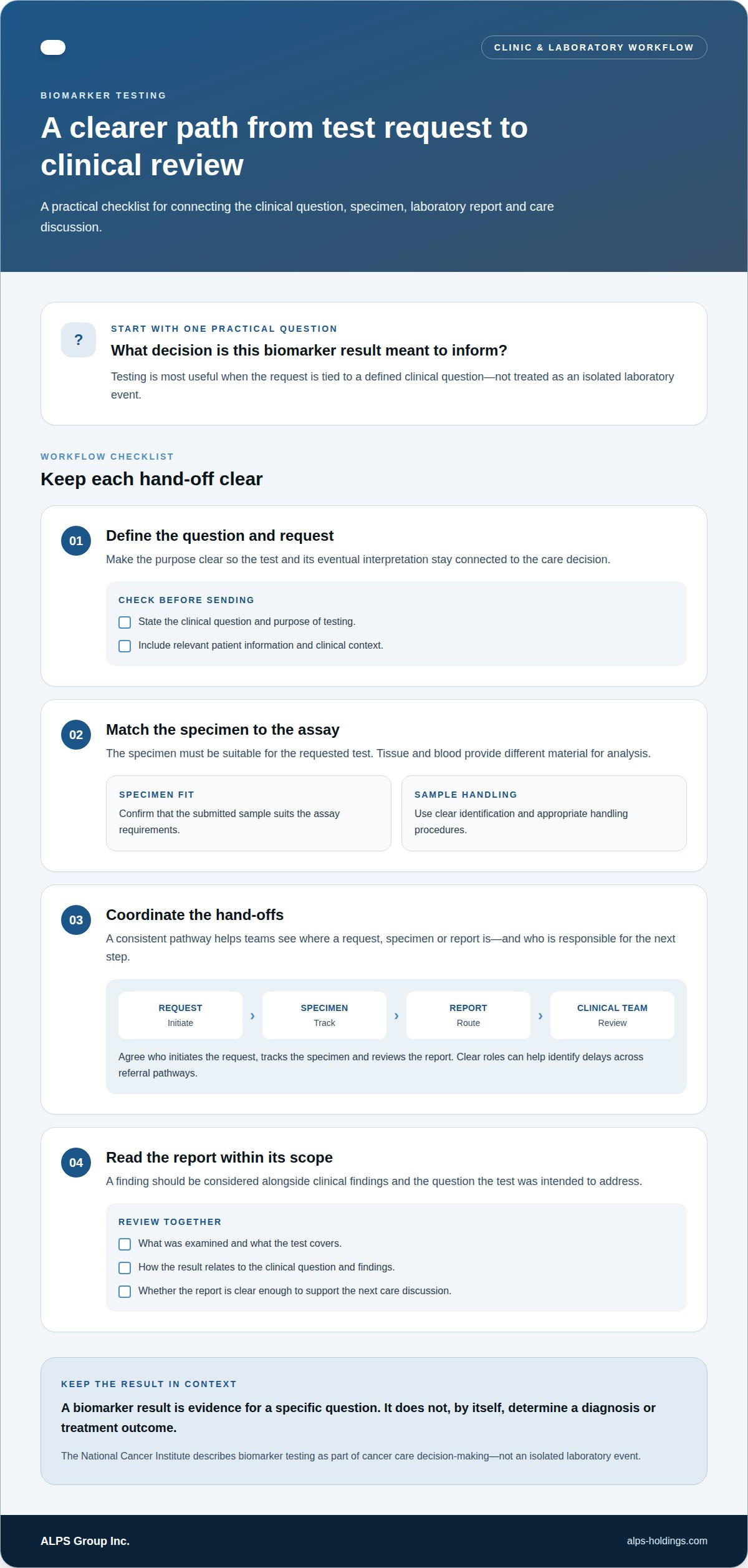
Biomarker testing is most useful when its result addresses a defined clinical question. Access also depends on how requests, samples, and reports move through the care pathway.
Biomarker Testing Methods and Sample Collection
A biomarker assay measures a biological feature, such as a selected DNA sequence, to provide evidence relevant to a clinical question. The National Cancer Institute explains that biomarker testing can help inform cancer care decisions. The specimen must suit the assay: tissue and blood provide different material for analysis. Clear identification, appropriate handling, and complete clinical details help the laboratory process the requested test and report findings within its scope.
Molecular Test Ordering and Interpretation
Ordering and interpretation form a connected process, from defining the clinical question to reviewing the report. The ordering clinician specifies the purpose and provides relevant patient information; the laboratory assesses the request and specimen against the test requirements. After analysis, the report is considered alongside clinical findings. This process helps teams understand what was examined and how the result may inform the next care discussion.
Disparities can arise when eligible patients are not considered for testing, requests are incomplete, or reports do not reach the relevant team in time. The National Cancer Institute’s biomarker-testing resources describe testing as part of cancer care decision-making, rather than an isolated laboratory event. Clinics can improve coordination by defining who initiates a request, tracks the specimen, and reviews the report. Clear roles can also help identify delays across referral pathways.
For haematology referrals, the test request should state the clinical question and relevant context so the result can be interpreted appropriately. Precision medicine depends on linking a biomarker finding to the decision it is intended to inform, rather than assuming every finding changes care. A consistent request and reporting pathway can make that connection clearer for the treating team.
Discuss molecular testing requirements for a referral or workflow with ALPS Group Inc.
Workflow resources include the Optimizing Biomarker Testing Workflows to Address Disparities in Early Breast Cancer Care 1-pager, a 286 KB PDF, and the Addressing Disparities in Care - Biomarker Testing in Breast Cancer brochure, a 4.22 MB PDF. The Biomarker Testing Reimbursement brochure is a 0.8 MB PDF. In the cited NSABP study, only 4% of patients who received chemotherapy had improved outcomes.
Next-generation sequencing in oncology and haematology
Next-generation sequencing (NGS) analyses many DNA fragments in parallel, enabling broad molecular assessment. In oncology and haematology, its value depends on whether the findings address a defined clinical question.
Germline Testing and Tumor Molecular Profiling
Germline testing examines inherited genetic variation, while tumour molecular profiling examines changes within cancer cells. This distinction matters because inherited findings and tumour-specific changes can have different implications. For example, a tumour result may describe the disease’s molecular features, whereas a germline result may inform assessment of inherited risk. The sample type and scope stated in the report help clarify what the findings represent.
Molecular Tests for Selecting Targeted Cancer Treatments
Molecular testing can identify tumour biomarkers that clinicians consider when assessing targeted treatment options. A biomarker may indicate a biological feature relevant to a therapy, but its presence alone does not establish that the treatment is suitable. The decision also depends on the cancer diagnosis, clinical context, and evidence supporting the biomarker’s use. The result contributes information to a treatment discussion; it does not prescribe therapy.
NGS works by dividing genomic DNA into millions of fragments and sequencing them in parallel. Compared with Sanger sequencing, NGS is dramatically faster and more cost-efficient in most cases. This breadth can help assess multiple genomic regions in one analysis, although the assay design determines which regions are examined. For oncology, the practical question is whether the analysis covers the markers relevant to the clinical purpose.
In haematology, molecular findings may add detail to the assessment of a blood-related disease. They need to be interpreted alongside the diagnostic question and other clinical information, not treated as a complete picture on their own. Technologies differ in scope, and a focused assay may answer a narrower question than broad sequencing. Clear reporting should identify the findings assessed and explain the limits of interpretation.
For monitoring, clinicians consider whether a molecular result can meaningfully inform a later assessment. The approach depends on the disease and test design. NGS supports personalized care most effectively when the clinical question, specimen, and analysis scope align. A result may inform consideration of targeted options, but cannot guarantee a response or outcome.
What molecular tests are used in personalized medicine?
Molecular assays examine DNA or RNA to identify selected sequences or broader genomic patterns. For Malaysian clinical teams, molecular tests for personalized medicine can include targeted assays or wider sequencing approaches. The appropriate method depends on the clinical question, the sample and the information needed for care.
Polymerase chain reaction (PCR) amplifies selected nucleic acid sequences, producing billions of copies for analysis. This makes it useful when a test targets a defined genetic sequence or microorganism. The result addresses the assay’s specific target, rather than surveying every part of a person’s genome. Defining the target clearly helps align testing with the reason for investigation.
Real-time PCR generates, detects, and quantifies DNA or RNA sequences during amplification. It can support identification of disease-causing viruses, bacteria, fungi, and parasites, and quantify viruses such as HIV, HCV, and HBV in blood. In personalized care, identifying a microorganism can contribute information to treatment decisions when interpreted alongside clinical findings.
Microarrays test many selected genetic markers at once. A microarray can probe hundreds of thousands of distinct DNA sequences, making it suited to questions involving multiple known markers. Its design determines the range assessed. It does not provide an unrestricted reading of the genome, so findings must be understood in the context of the markers included in the assay.
Sequencing reads genetic material to identify its sequence. Whole-genome approaches assess a broader range of DNA than tests designed for selected targets or markers. This scope can produce extensive data, so interpretation depends on the clinical question and the regions analysed. Findings need context: sequencing does not independently establish every diagnosis or predict all future disease.
Selecting molecular tests for personalized medicine means matching the method’s target and scope to the decision under consideration. PCR may address a defined sequence, microarrays examine selected markers, and sequencing reads broader genetic material. Sample suitability and intended report use also shape selection. Discuss molecular testing requirements for a clinical or research workflow.
Real-time PCR is used to diagnose cancer by identifying low levels of malignant cells and to diagnose genetic disorders. Molecular diagnostic technologies can quickly identify microorganisms and inform treatment choices for individual patients.
ALPS Group Inc.
ALPS Group Inc. supports Malaysian healthcare and research teams seeking laboratory testing relevant to individualized care. Its molecular testing services include Whole Genome Sequencing and mRNA Testing, while Biochemistry, Serology & Immunology Tests and Microbial Tests address other clinical or research questions.
For a referral or project, begin with the question the test needs to inform. The intended use, sample requirements and reporting needs help shape a suitable testing request. ALPS Group Inc.’s molecular laboratory meets MS ISO 15189:2022 standards.
Clinics, hospitals and research organisations can contact ALPS Group Inc. to discuss testing suitability or request a quotation.
Shape the next testing decision
Start by defining what the result needs to contribute to a care or research decision. A focused question helps teams consider whether molecular analysis is appropriate, what information the report should contain, and how findings will be reviewed alongside other clinical data. This preparation can make referrals more purposeful and align laboratory workflows with the needs of Malaysian healthcare teams.
ALPS Group Inc. offers Whole Genome Sequencing, mRNA Testing, and Biochemistry, Serology & Immunology Tests. These services provide options for teams assessing different kinds of laboratory information; the intended question should guide the discussion. Molecular tests for personalized medicine contribute most meaningfully when their scope and interpretation match the decision they are intended to inform.
Contact ALPS Group Inc. to discuss testing suitability and your requirements. A clear conversation can help you plan an appropriate next step for your clinical or research work.
Frequently Asked Questions
How do pharmacogenomic tests guide medication choice and dosing?
Pharmacogenomic tests identify genetic variants that may influence how a person responds to particular medicines. For example, a result may indicate that a drug is likely to be processed differently, prompting a clinician to consider another medicine or adjust its dose. Interpretation depends on the medicine tested, the patient’s current treatment, and clinical context; a genetic result does not prescribe a dose on its own.


