

An AI-designed vaccine for tomorrow has entered human testing, but early results do not establish that it protects people. The trial, reported in the Journal of Infection, found that the DNA vaccine stimulated antibodies able to recognise different sarbecoviruses. The immune responses were modest, and how long they might last remains uncertain.
That distinction matters: detecting an immune response does not show that a vaccine prevents infection in real-world conditions. Artificial intelligence can help researchers analyse viral genetic patterns and select potential immune targets. But predictions are harder when a virus is unfamiliar and relevant biological data are limited.
This article explains what human testing can reveal about an AI-designed vaccine, what evidence is still needed to assess protection, and how similar technology may support vaccine research for other diseases. It also explores why unknown viruses are difficult to anticipate, even as computational methods strengthen research into emerging threats.
Key Takeaways
- AI can help researchers prioritise bacterial vaccine targets, but computational predictions still need experimental and clinical evaluation.
- Predictions about unfamiliar viruses are constrained by limited biological data and the difficulty of anticipating how pathogens will evolve.
- AI can speed up data analysis and candidate selection, while testing, manufacturing and regulatory evaluation remain essential parts of vaccine development.
- Vaccine development costs reflect more than computational work; research, clinical studies, production and deployment all shape the overall investment.
And could this vaccine technology help against other diseases?
Artificial intelligence could help researchers organise bacterial data and prioritise questions for laboratory study. For example, comparing bacterial strains may help identify shared features for investigation as vaccine targets. This is a research strategy, not evidence that an AI-designed bacterial vaccine is effective. Candidate targets still require experimental evaluation before researchers can draw conclusions about immune protection.
Literature analysis can help experts organise findings across studies of a pathogen. Researchers can use computational tools to group reported targets, compare study methods, and identify questions for further investigation. Screening can then rank candidate targets for laboratory work. These steps help structure research, but do not establish that a candidate will work in people.
Rotavirus and respiratory syncytial virus (RSV) are examples of pathogens researchers could examine through sequence or protein comparisons. A team might compare strains, identify features to investigate, and test selected candidates experimentally. Whether a target is useful depends on the biological evidence. The analysis alone does not demonstrate protection against either disease.
For Malaysian research organisations, the practical distinction is between computational research and a vaccine approved for use. An AI-generated design is a research candidate, not proof of safety or efficacy. The human trial reported in the Journal of Infection found that the DNA vaccine stimulated antibodies able to recognise different sarbecoviruses. That finding does not establish real-world protection.
Research institutions and companies can apply AI methods to vaccine research when they have relevant data and experimental capacity. The work depends on the organisation and project. Computational analysis may help prioritise targets, while laboratory studies assess the resulting candidates.
In Malaysia, AI-assisted screening could shape early research, but it does not determine the eventual cost or availability of a vaccine. Manufacturing, clinical evaluation, distribution, and procurement also affect access. A faster research step alone cannot establish lower prices or broader supply.
Limits of predicting unknown viruses
Artificial intelligence identifies patterns in the data it receives; it cannot directly describe a pathogen when relevant data do not exist. A model trained on known viral sequences may help compare a newly detected virus with familiar relatives. If the pathogen has distinct features, those comparisons offer less guidance. Predictions depend on the breadth, quality, and relevance of available evidence.
Even a close genetic match cannot answer every biological question. Researchers need to assess whether a potential target is produced in infected cells, accessible to immune recognition, and sufficiently stable across the virus being studied. Sequence-based predictions can help prioritise these questions, but experiments are needed to investigate them. Changes in a target can also affect how well a candidate applies to different strains.
Human immune responses add further variability. A computational model may rank vaccine candidates, but that ranking cannot establish how people will respond or whether protection will last. Laboratory studies and human trials answer different questions and generate evidence that a model cannot provide on its own. Researchers must interpret computational predictions alongside these observations.
Safety is another boundary. An AI-generated design does not demonstrate that a vaccine is safe, and predictions cannot replace assessment of adverse effects in studies. Researchers evaluate candidates through appropriate experimental stages, then examine safety and immune responses in human clinical trials. The design method does not remove the need for this evidence.
When a new infectious threat emerges, scientists first need biological information about the pathogen. They can then use it to refine comparisons and research hypotheses. New observations may change which targets appear relevant. This iterative process explains why a model cannot reliably describe every virus yet to emerge. AI can organise available evidence and help prioritise candidates, but it cannot replace data collection, experimental testing, or clinical evaluation.
How much faster can AI help develop vaccines compared with traditional methods?
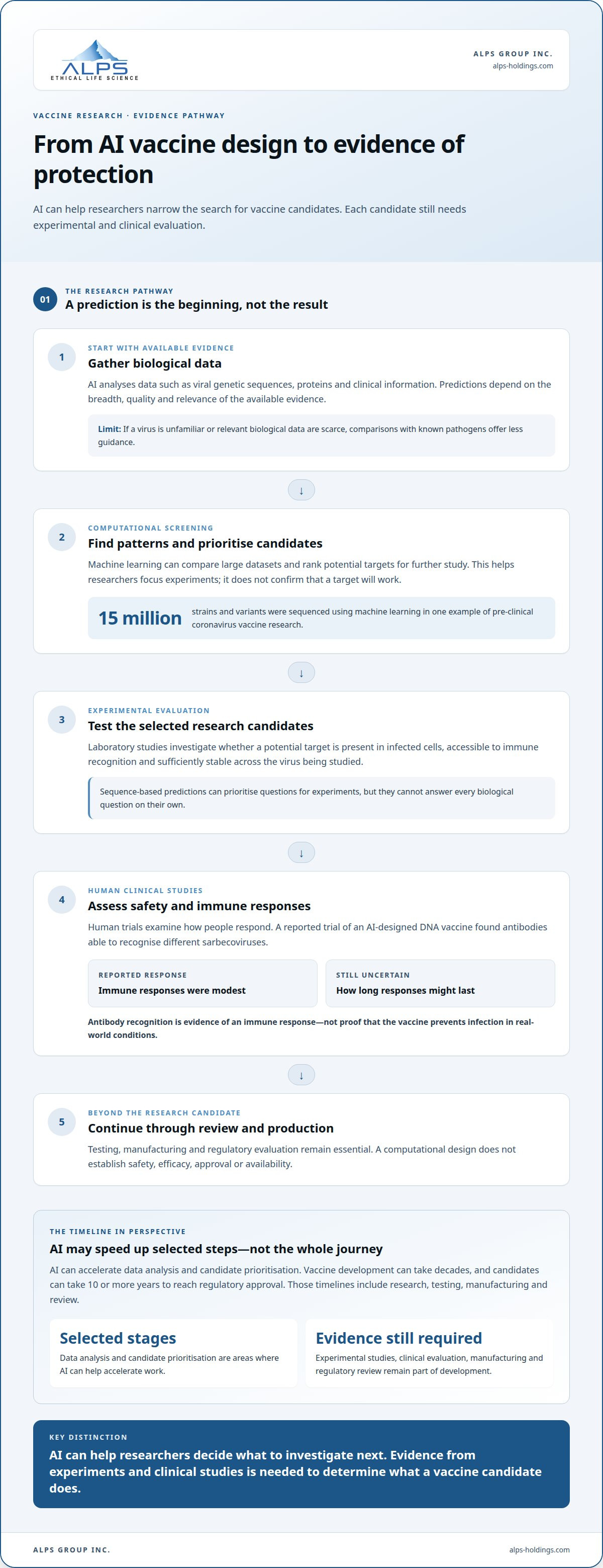
Artificial intelligence can accelerate selected stages of vaccine development, especially data analysis and candidate prioritisation. It does not compress every stage equally. Vaccine development can take decades, while candidates can take 10 or more years to reach regulatory approval. Those timelines include research, testing, manufacturing, and review, not only the search for a suitable design.
One example shows the scale of computational screening. During pre-clinical coronavirus vaccine research, researchers used machine learning to sequence 15 million strains and variants. Analysing such extensive genetic data can help identify patterns and narrow the targets researchers examine experimentally. The value lies in prioritising work, not replacing laboratory studies or clinical trials.
Traditional development has relied heavily on trial-and-error experiments and extensive testing in living systems. AI models can process genomic, proteomic, and clinical datasets to rank candidate targets before researchers invest in further evaluation. This may reduce time spent examining less promising options. However, any time saved depends on data quality, the biological question, and how quickly experimental results can be generated and interpreted.
The remaining stages still matter. Researchers must assess whether a candidate produces an appropriate immune response, evaluate safety, and test performance in people. Clinical evidence takes time to collect and analyse, while manufacturing requires its own planning and quality controls. AI can support decisions along this process, but it cannot turn a computational prediction into evidence of safety or efficacy.
Influenza illustrates the difference between faster research and faster deployment. Pharmaceutical companies need at least six months to produce enough doses of the annual influenza vaccine. AI may inform candidate selection, but production still depends on manufacturing processes and supply capacity. The practical answer is task-specific: AI can shorten parts of research and screening, while an approved, deployable vaccine still depends on evidence, testing, and production requirements.
What are the costs of AI vaccine development and deployment?
There is no single development cost for an AI-designed vaccine. The total depends on the pathogen, candidate design, evidence required, and production scale. Artificial intelligence can support data analysis and candidate selection, but these activities are only part of the investment. Laboratory validation, preclinical research, clinical trials, manufacturing, and distribution each require separate resources.
At the computational stage, costs can include preparing reliable datasets, developing models, and maintaining the infrastructure needed to analyse genomic or clinical information. Incomplete or inconsistent records may need additional curation before modelling. Researchers must also assess whether predictions match laboratory findings. A promising computational result therefore leads to further experiments, not directly to a vaccine ready for use.
Experimental and clinical work bring different cost drivers. Laboratory studies evaluate selected candidates, while preclinical research assesses biological effects before human testing. Clinical trials then examine safety and immune responses in people. Their scope depends on the candidate, study design, recruitment, monitoring, and the evidence required at each stage. AI may help prioritise candidates, but it does not remove these evidence-generating steps.
Deployment brings manufacturing and access considerations. Production capacity, quality processes, packaging, storage, distribution, and procurement can affect the resources needed to deliver doses. The annual influenza vaccine illustrates why manufacturing takes planning: producing enough doses requires at least six months. That is not a cost estimate, but it shows why faster computational screening alone cannot determine deployment expenses.
For Malaysian research organisations, a meaningful budget assessment should separate model development, laboratory validation, clinical evaluation, production, and delivery. The balance shifts with the vaccine target and project scope. Contact ALPS Group Inc. to discuss a vaccine research enquiry and the testing requirements relevant to its scope.
ALPS Group Inc.: laboratory testing for vaccine research
ALPS Group Inc. offers Whole Genome Sequencing, mRNA Testing, Biochemistry, Serology and Immunology Tests, Haematology Tests, and Microbial Tests. Their suitability for a vaccine research project must be confirmed based on the project’s requirements.
ALPS Group Inc.’s Whole Genome Sequencing and mRNA Testing provide molecular testing options, while Biochemistry, Serology and Immunology Tests add other laboratory testing disciplines. The appropriate service depends on the research question, intended sample, and information the study needs to generate. These tests support research workflows; results should be interpreted within the project’s scientific and clinical context, rather than treated as a guarantee of vaccine efficacy or patient outcome.
For Malaysian clinics, hospitals, healthcare professionals, and research organisations, discussing the project scope can help clarify which testing service may be relevant and what information is needed to assess suitability. Contact ALPS Group Inc. to discuss service availability or suitability for a vaccine research project.
Turn predictive research into a defined next step
The next stage for an AI vaccine for tomorrow is a clearly framed research question: which biological target needs investigation, what evidence would address it, and which laboratory methods suit the project? This focus helps Malaysian research teams connect computational hypotheses with a disciplined experimental plan, while distinguishing research findings from established clinical applications.
ALPS Group Inc. offers Whole Genome Sequencing, mRNA Testing, and Biochemistry, Serology & Immunology Tests. These are testing services, but their suitability for a particular vaccine research programme should not be assumed. Confirm service availability and suitability with ALPS based on the scientific question and study design.
Research organisations, hospitals, and healthcare professionals can take a practical next step by outlining their project aims and testing requirements. Contact ALPS Group Inc. to confirm testing-service availability or suitability, or request a quotation. A carefully defined question is a strong foundation for responsible scientific progress.
Frequently Asked Questions
‘World-first’ vaccine designed by AI tested on humans: Will it live up to the hype?
The human trial is an important research milestone, but it does not yet show whether the vaccine prevents illness. The DNA vaccine prompted antibodies that recognised different sarbecoviruses, while measured immune responses were modest and their duration uncertain. Further studies must establish whether it reduces infection or disease in real-world conditions. Its significance is that an AI-designed component has progressed to human testing.
Could it protect against future pandemics?
It could inform research aimed at broader protection, but it cannot be assumed to prevent a future pandemic. The design sought to target coronaviruses, including variants and animal viruses with pandemic potential. A future outbreak could involve a different pathogen or biological features absent from the model’s data. Researchers would need to assess the new virus and test whether any existing vaccine candidate offers relevant protection.
Can scientists design a vaccine for a virus that does not yet exist?
Scientists cannot identify the precise features of a virus that has not emerged, but they can study known virus families for shared targets. For coronaviruses, researchers identified 10 of the virus’s 29 proteins as constant across all coronaviruses. Such conserved features can guide broad vaccine research. They do not reveal every future mutation or guarantee that a candidate will protect against a novel virus.
Given global resistance to mRNA vaccines during COVID-19, how might the public accept an AI-designed vaccine?
Public acceptance depends on clear evidence and communication, not on the use of AI alone. Researchers and health authorities can explain AI’s role in the design, what the vaccine contains, and what human studies have established about safety and efficacy. The candidate discussed here is a DNA vaccine, not an mRNA vaccine. That distinction helps address concerns without treating different platforms as interchangeable.
What does “AI vaccine for tomorrow” refer to?
An AI vaccine for tomorrow refers to vaccine research in which computational models help identify or design candidate components. It describes an approach to development, not a guarantee that a vaccine exists for every future disease. Researchers still need to evaluate candidates in experiments and in people. The useful distinction is between an AI-assisted research design and evidence that a vaccine prevents disease.
How is artificial intelligence being used in vaccine research and development?
Artificial intelligence can analyse genetic and other biological data to identify patterns, prioritise targets, and rank vaccine candidates for further study. Researchers can also use computational models to examine likely immune responses and inform clinical-trial planning. For example, sequence comparisons can help assess whether a target is shared across related strains. Laboratory and human studies then test whether those predictions correspond to biological effects.


