
AI can help construct new drug and vaccine candidates by analysing biological data, identifying promising targets and modelling how candidate molecules may interact with the immune system. During COVID-19 vaccine research, these methods supported antigen selection and computational assessment, but their contribution to development timelines should not be overstated.
The speed of computational screening does not replace laboratory experiments or clinical evaluation: predictions must be tested to establish whether a candidate is safe and effective. This article explains how AI contributed to COVID-19 vaccine research and delivery, how its role compares with traditional development methods, and where its limitations remain. It also examines in-silico immune simulation, which models molecular configurations to assess their potential to prompt an immune response, and why those results require careful validation before they can inform real-world use.
Key Takeaways
- Understand how AI can help researchers identify vaccine targets and prioritise candidates for laboratory testing.
- Assess AI’s contribution to COVID-19 vaccine research and delivery alongside the continuing role of conventional development methods.
- Recognise why computational predictions about immune responses and safety require experimental validation.
- Explore how ALPS Group’s confirmed testing services may support research and healthcare needs.
Data, ethical, regulatory and infrastructure challenges
In Malaysia, teams developing an AI-assisted medicine or vaccine need to establish the appropriate regulatory pathway before human use. AI-generated status alone does not mean a candidate is ready for clinical application; its intended use and development stage matter.
Data volume can accelerate screening, but does not guarantee reliable inputs. One COVID-19 discovery collection contains 59,107 antiviral entries, including 50,000 in-silico small molecules classified as antiviral. Separate toxicity datasets include 11,800 molecules from Tox21 and ToxCast, and 13,533 molecules identified as toxic to HepG2 cells. These collections serve different purposes. Their labels, methods, and relevance need careful interpretation before researchers combine them.
Data quality also affects bias. Training examples may over-represent particular populations, viral variants or laboratory methods, limiting how well predictions apply elsewhere. Researchers can document data provenance, remove duplicates, assess missing information and test performance across independent datasets. For example, an antigen prediction based on coronavirus data needs evaluation against relevant proteins and experimental evidence, not just a model score.
The WHO Global Influenza Surveillance and Response System provided 20 years of data from 166 institutions across 136 countries. Differences in sampling, reporting, and laboratory capacity can influence how well those records represent viruses circulating in different settings. Data extraction tools must preserve context and avoid treating inconsistent records as directly comparable.
Ethical governance includes consent, privacy, access controls and responsible reuse of research data. Secure computing, reproducible workflows, specialist review and laboratory capacity also shape whether computational work can progress. A practical governance process records data sources, model versions, access decisions and the rationale for advancing or rejecting candidates. These records help teams assess how a prediction was produced and support accountable research decisions.
Before human use, teams need to establish the appropriate regulatory pathway based on the candidate’s intended use and development stage. AI-generated status alone does not establish readiness for clinical application.
Using AI from lab to jab: how did artificial intelligence help us develop and deliver COVID-19 vaccines?
AI analyses biological data to identify targets, rank candidates and model molecular interactions. Laboratory experiments and clinical trials then assess whether promising designs produce reliable evidence.
Machine Learning in Preclinical Screening
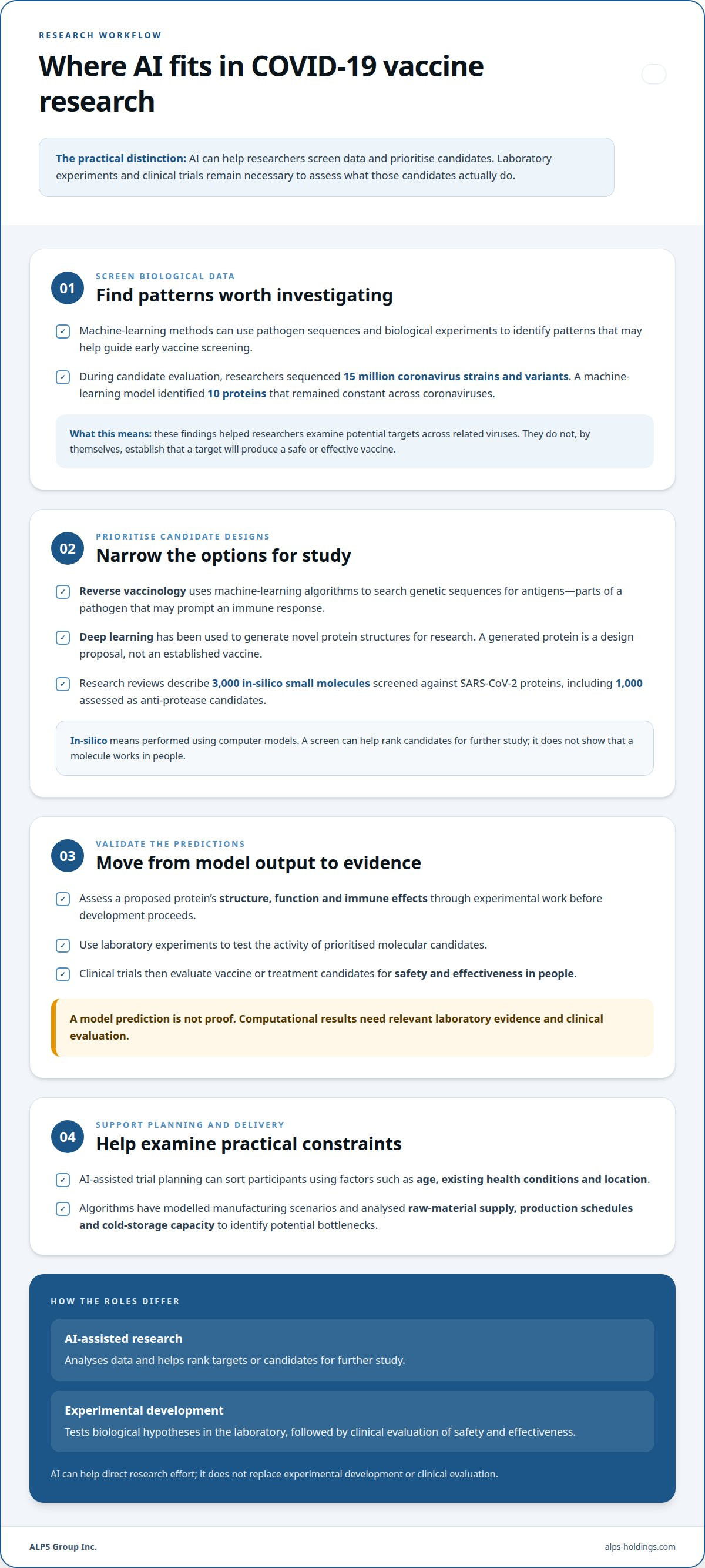
Machine learning uses examples from pathogen sequences and biological experiments to identify patterns that may guide early vaccine screening. In preclinical research, this can help prioritise antigens, the parts of a pathogen that may prompt an immune response. Researchers sequenced 15 million coronavirus strains and variants during candidate evaluation. A machine-learning model identified 10 proteins that remained constant across coronaviruses, helping researchers examine potential targets across related viruses.
AI Methods for Vaccine Design
AI methods analyse pathogen information to suggest which targets or molecular features merit experimental study. In reverse vaccinology, machine-learning algorithms search genetic sequences for antigens that could elicit an immune response. This can narrow a broad set of biological possibilities to candidates for further evaluation. The models support vaccine design, but their predictions need testing against laboratory evidence and the relevant biological context.
Deep Learning for Protein Generation
Deep learning uses layered computational models to identify patterns and generate new protein structures for research. Researchers have used these models to create novel proteins that may serve as potential vaccines. A generated protein is a design proposal, not an established vaccine; its structure, function and immune effects need experimental assessment before development can proceed.
AI has also supported therapy discovery by helping screen molecular candidates against viral targets. Research reviews describe 3,000 in-silico small molecules screened against SARS-CoV-2 proteins, including 1,000 assessed as anti-protease candidates. These computational screens help prioritise compounds, while laboratory experiments test their activity. Later, clinical trials evaluate safety and effectiveness in people. AI-assisted trial planning can also sort participants using factors such as age, existing health conditions and location. For vaccine delivery, algorithms have modelled manufacturing scenarios and analysed raw-material supply, production schedules and cold-storage capacity to identify potential bottlenecks.
AI compared with traditional vaccine development
Traditional vaccine development relies on experimental research, while artificial intelligence can help prioritise computational screening. Their roles are complementary: AI may help direct research effort, but it does not replace experimental development or clinical evaluation.
Without a source identifying the work, no Malaysian institution, company or agency can be named as a confirmed user of AI for drug or vaccine development. This avoids conflating general biotechnology research or laboratory testing with the specific use of AI in candidate development.
AI and Traditional Development Approaches
Traditional approaches test biological hypotheses through laboratory experiments; AI analyses data to rank targets or candidates for further study. This distinction matters because faster computation does not establish faster development overall. Specific claims of 100-fold faster screening require an authoritative source and are not presented here as verified findings.
Vaccine development timelines vary. The claims that development can take nearly a decade and that the GUIDE collaboration aims to reduce drug development to 120 days or less require authoritative sources and are not presented here as established timelines. Conventional research and clinical evaluation remain essential to establish whether a candidate is appropriate for further use.
Limitations and Development Costs
AI-based development depends on relevant data, computing resources, laboratory experiments and expert interpretation. Accuracy can be limited when training data poorly represent the disease, target or population of interest. Model rankings alone cannot establish safety or effectiveness, so research teams need to assess predictions against experimental findings before advancing candidates.
Bacterial vaccine development presents distinct biological challenges. The claim that a Staphylococcus aureus vaccine remained elusive after approximately 30 clinical trials requires an authoritative source and is not presented here as a verified finding. Candidate selection is only one part of vaccine development.
AI may change how resources are allocated, particularly during computational screening, but it does not remove the costs of experimental work, manufacturing preparation or clinical trials. Overall resource needs depend on the candidate, evidence requirements, manufacturing process and trial design. A useful comparison considers the complete development programme, not screening speed alone.
In-silico vaccine safety and immune simulation
Clinical evidence for an AI-designed vaccine comes from experimental studies and clinical trials assessing safety and effectiveness in people. A model’s prediction is not clinical evidence: researchers evaluate immune responses, adverse events and relevant health outcomes using the evidence required for that candidate.
In-silico simulation uses computational models to examine biological structures before laboratory testing. During COVID-19 research, AI-enabled models simulated molecular configurations of the spike protein to assess which might prompt an effective immune response. The output helps researchers compare hypotheses; it cannot show by itself whether a vaccine is safe, protects people, or performs consistently across populations.
A practical validation pathway moves from prediction to experiment. Researchers first select a modelled configuration, then test whether it behaves as expected in laboratory systems. Subsequent clinical trials examine safety and immune responses in participants, alongside outcomes relevant to the vaccine’s intended use. Each stage addresses different uncertainties, so a favourable computational result cannot substitute for later evidence.
Simulation also depends on its assumptions. A model may represent selected molecular features while omitting biological interactions that affect an immune response. During a pandemic, rapid analysis can help prioritise research, but decisions still require experimental and clinical evidence. Model authors should describe the data and assumptions behind predictions so other researchers can interpret results and assess reproducibility.
For research teams assessing computational vaccine work, the key distinction is between a predicted immune effect and demonstrated clinical benefit. Review the validation stage, the outcomes measured, and whether findings support the intended use. Discuss relevant research and testing needs with the team.
Evidence of safety and effectiveness comes from experimental studies and clinical trials assessing immune responses, adverse events and health outcomes relevant to the candidate’s intended use. Computational predictions alone do not demonstrate clinical safety or benefit.
ALPS Group: testing services
ALPS Group Inc. offers testing services for organisations seeking laboratory support. Available services include Whole Genome Sequencing, mRNA Testing, Biochemistry, Serology and Immunology Tests, Haematology Tests, and Microbial Tests. The suitability of a service depends on the specific question, sample, and testing requirements.
Related testing options include Whole Genome Sequencing, mRNA Testing, and Biochemistry, Serology & Immunology Tests. These are distinct services, and their suitability depends on the specific question, sample, and testing requirements. Discussing the research objective and required information can help clarify which service is relevant.
To enquire about service availability or suitability, contact ALPS Group Inc.
Turn computational insight into a research plan
The next step is to define the biological question before choosing analytical or laboratory support. For Malaysian research and healthcare teams, this means clarifying the intended use, the evidence needed and how results will inform subsequent decisions. AI can construct new drug and vaccine candidates computationally, but translating a design into a research programme requires a clear link between the model, the sample and the validation approach.
ALPS Group Inc. offers Whole Genome Sequencing, mRNA Testing, and Biochemistry, Serology & Immunology Tests. These services may be relevant when a project requires molecular or laboratory testing; suitability depends on its specific objectives and requirements. Interpret computational predictions and test results in light of the evidence available for their intended use, rather than treating them as guarantees of clinical outcomes.
To discuss how ALPS Group Inc.’s testing services may fit your research or healthcare requirements, contact ALPS Group Inc. A well-defined question is a strong foundation for the next stage of research.
Frequently Asked Questions
What are the main AI drug discovery technologies, such as machine learning and generative AI?
Machine learning identifies patterns in biological data, while generative AI proposes new molecular structures or protein sequences. Structure-prediction and docking tools can help researchers assess how molecules might interact with a target. Each method serves a different research task, such as ranking candidates or generating designs. AI can construct new drug and vaccine candidates computationally, but experimental evidence is needed to assess their relevance.
What are examples of AI-designed drugs or vaccines that have reached clinical trials or approval?
The examples described here do not establish that an AI-designed drug or vaccine has reached clinical trials or approval. Los Alamos scientists validated eight AI-chosen antibody candidates for potential use in new drugs. This is an experimental research result, not evidence of clinical approval. Treat a candidate as having reached a clinical milestone only when its trial or regulatory status is explicitly documented.
How long and how much does AI-assisted drug development cost compared with traditional development?
There is no single reliable duration or cost comparison for every AI-assisted programme. Overall time and expenditure depend on the target, candidate, laboratory studies, manufacturing development and clinical-trial design. Computational screening is only one part of development, so faster analysis does not by itself mean lower total costs or a shorter route to use. Project planning should distinguish these stages rather than treat them as a single estimate.
What are the steps from AI target identification to drug or vaccine clinical trials?
A typical pathway defines the disease and intended use, selects relevant biological data and identifies a target for investigation. Researchers then generate or rank candidates and test selected designs in laboratory studies. Results inform whether further preclinical evaluation is warranted. Before a candidate enters clinical trials, its development plan must specify the evidence sought, trial outcomes and participant safeguards appropriate to the research.
What are the risks and limitations of using AI to design drugs and vaccines?
AI predictions can reflect gaps or imbalances in training data, and a model may optimise a measurable feature that does not capture the desired biological effect. Results may also transfer poorly to a different population or pathogen variant. Researchers should document model assumptions, assess performance on relevant independent data and interpret predictions alongside experimental findings, rather than treating a ranking as proof.
What clinical evidence shows AI-designed drugs and vaccines are safe and effective?
Experimental studies and clinical trials in people assess safety and effectiveness, including immune responses, adverse events and relevant health outcomes. Model predictions alone are not clinical evidence.


