

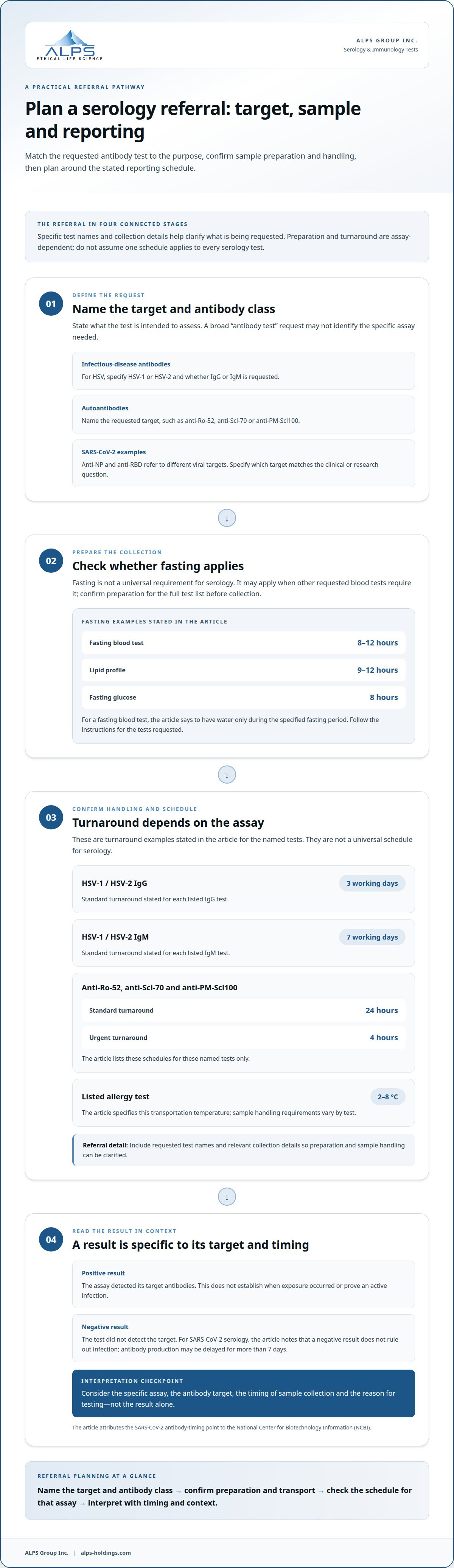
Serology results do not have one standard waiting time; the assay ordered determines the reporting schedule. In Malaysia, HSV-1 and HSV-2 IgG tests have a standard turnaround of 3 working days, while HSV-1 and HSV-2 IgM tests have a standard turnaround of 7 working days. These examples show why the test name matters when arranging serology testing in Malaysia.
Professional serology testing is arranged through medical laboratory services, with the assay chosen to match the testing purpose. Reporting time is one practical consideration for clinical follow-up, referral planning and research workflows, alongside what the antibody result is intended to assess.
This article explains what serum antibody testing identifies, when fasting may be required, and how to approach test pricing in Malaysia. It also outlines the information that helps a laboratory assess a request and the factors that can affect turnaround time, giving clinics, hospitals, healthcare professionals and research organisations a clearer basis for planning next steps.
Key Takeaways
- Preparation depends on the test requested; fasting is not a universal requirement for every serology test.
- Serum antibody results need to be interpreted in context, including the timing of sample collection and the antibody measured.
- Test type, sample requirements and reporting arrangements are practical details to clarify when planning a laboratory referral.
- ALPS Group’s mRNA Testing and Biochemistry, Serology & Immunology Tests support healthcare and research organisations with laboratory testing needs.
Fasting and preparation requirements for serology testing clients
Preparation depends on the requested test and sample collection plan. A serology test may be requested alongside other blood tests, which can affect preparation. Fasting instructions apply when another requested blood test requires fasting. Confirm the preparation plan before collection, especially when several tests are requested together.
For fasting blood tests in Malaysia, avoid food and drinks other than water for 8-12 hours beforehand. The required period depends on the test. A lipid profile is listed with a fasting period of 9-12 hrs, while fasting glucose is listed with a fasting period of 8 hrs. These requirements are distinct, so the test name matters.
- For a fasting blood test, follow the specified 8-12-hour period and drink only water.
- For a lipid profile, allow 9-12 hrs of fasting before collection.
- For fasting glucose, the stated fasting period is 8 hrs.
- Avoid alcohol for 24 hours before a blood test.
Other preparation can also affect collection. IJN Laboratory advises avoiding strenuous exercise for 12 hours before your blood test. It also advises avoiding vitamin C intake above 250 mg per day for at least 12 hours before blood collection. Tell the collection team about relevant supplements or medicines, so they can consider the instructions for the tests requested.
For clinics and referring teams, include the requested test names and relevant collection details with the referral. This helps clarify whether fasting instructions apply and what preparation to communicate to the person providing the sample. If a blood draw is combined with a lipid profile or fasting glucose test, follow the preparation instructions for those tests rather than assuming every serology request has the same requirements. Clear instructions support an orderly collection and help prevent delays caused by incomplete preparation.
Antibody identification in serum
Serum antibody tests detect immune proteins directed against particular targets. The target and antibody class determine what the result reports.
Available Serology Test Types
Assays can measure different antibody classes and target proteins. For SARS-CoV-2, examples include anti-NP and anti-RBD antibodies. NP and RBD refer to different viral targets, so the requested assay should match the clinical or research question. Results for one target do not establish findings for another.
According to CIDRAP, in 16 patients with serum samples available 14 days or longer after symptoms began, anti-NP IgG antibody rates were 94%, anti-NP IgM 88%, anti-RBD IgG 100%, and anti-RBD IgM 94%. These findings describe that patient group and sampling period.
Test Accuracy and Result Meaning
Accuracy depends on the assay, target and sample timing. A positive result means the assay detected its target antibodies; it does not establish when exposure occurred or prove an active infection. A negative result means the test did not detect the target. Interpretation should account for the specific assay and reason for testing.
For SARS-CoV-2, a negative serology result does not rule out infection. According to the National Center for Biotechnology Information, antibody production may be delayed for more than 7 days. Collection timing therefore matters when interpreting results. The finding should be considered alongside the clinical context rather than treated as a standalone diagnosis.
For clinic and research referrals, specify the antibody class, target and purpose. For example, an anti-RBD request is more precise than a general antibody request. Include relevant timing information to support interpretation. These details help distinguish a test intended to assess a particular immune response from a broader laboratory investigation.
To discuss serum antibody testing requirements, contact the laboratory team.
What types of serology tests are available in Malaysia?
Serology panels vary according to the antibody target and clinical question. Test menus in Malaysia can include infectious-disease antibodies, autoantibodies and allergy-related tests. The assay name matters because similar labels can refer to different targets. Clearly state the intended target and purpose in the referral.
For herpes simplex virus, examples include HSV-1 and HSV-2 IgG tests, as well as HSV-1 and HSV-2 IgM tests. Listed standard turnaround times are 3 working days for each IgG test and 7 working days for each IgM test. These are distinct assays, so the requested antibody class should be specified.
- Infectious-disease antibodies: HSV-1 and HSV-2 IgG or IgM tests assess antibodies directed at the named virus type.
- Autoantibodies: examples include anti-Ro-52, anti-Scl-70 and anti-PM-Scl100 tests.
- Allergy testing: the listed allergy test requires transportation at 2 to 8 °C.
For anti-Ro-52, anti-Scl-70 and anti-PM-Scl100, listed standard turnaround is 24 hours. Listed urgent turnaround is 4 hours. These schedules apply to those named tests; they should not be assumed for other antibody assays. Sample transport requirements also vary by test, as the allergy-testing temperature demonstrates.
To select a suitable test, match the assay name to the question being investigated. A request for a virus-specific antibody, for example, should state HSV-1 or HSV-2 and IgG or IgM. Autoantibody requests should name the specific target, such as anti-Scl-70. Then align the sample handling and reporting plan with that assay. Test names, targets, collection timing and transport conditions give the laboratory the information needed to process the request correctly. A panel label alone may not communicate which individual antibodies are required, so precise referral details support clear processing and interpretation.
Referral or appointment for serology test in Malaysia?
Referral and appointment arrangements depend on the testing facility and request pathway. For clinical testing, a referral connects the requested assay with the reason for testing. A research request may instead be organised through the study team. Since processes differ between Malaysian laboratories, clarify the intended pathway before sample collection.
A useful referral gives the laboratory enough information to identify and process the request. Include the requested antibody test, the reason for testing, relevant collection timing and the referring clinician or organisation. For example, specify HSV-1 IgG rather than writing only “herpes antibodies”. That distinction helps separate the requested target and antibody class in the laboratory workflow.
- Clinical request: provide the referral details and the exact test name.
- Research request: identify the study contact and the required assay.
- Appointment planning: arrange collection through the relevant facility’s booking process.
- Combined tests: include each requested test, since preparation may differ.
An appointment can help coordinate collection, especially when a referral includes several tests or specific sample-handling requirements. For example, allergy testing has a transport requirement of 2 to 8 °C, so collection and transport arrangements need to align. The laboratory request should identify the test clearly, while the collection team follows the relevant handling process.
Before collection, the referring team should ensure the request names the intended test and identifies the appropriate clinical or research contact for the report. For a patient referral, the clinical question and collection timing can support interpretation. For a study, using consistent assay names across requests helps organise results for analysis. These details make the handover between referrer, collection point and laboratory more precise.
To discuss a serology testing referral or laboratory request, contact ALPS Group Inc..
ALPS Group Inc.: mRNA Testing
ALPS Group Inc. provides mRNA Testing and Biochemistry, Serology & Immunology Tests for healthcare and research organisations. Serology examines antibodies in serum, while mRNA testing is a distinct molecular service. The appropriate choice depends on the question being investigated and the required laboratory analysis.
For an antibody-testing request, include the specific test name, purpose and relevant sample details. For mRNA testing, provide the project or referral requirements so the laboratory can assess the service needs. ALPS Group Inc. also offers Whole Genome Sequencing and Microbial Tests for other laboratory testing objectives.
For information about testing suitability or a quotation, contact ALPS Group Inc..
Plan the next step for your testing request
For Malaysian clinics, hospitals and research teams, start by defining the testing purpose and the information the laboratory needs to assess the request. A clearly framed enquiry can help identify the relevant assay, sample requirements and reporting considerations before collection is arranged. This is especially useful when serology testing in Malaysia is part of a broader laboratory project.
ALPS Group Inc. offers Whole Genome Sequencing, mRNA Testing, and Biochemistry, Serology & Immunology Tests. These services address different testing needs, so let the purpose of the request guide the discussion, not just the test name. Share the intended purpose and relevant sample details when seeking guidance or a quotation.
Contact ALPS Group Inc. about serology testing to discuss a suitable next step for your organisation’s request.
Frequently Asked Questions
When Will You Get Results?
Most routine blood test results in Malaysia are available within 24-48 hours, although this does not describe every antibody assay. Reporting schedules depend on the specific test and laboratory workflow. For example, a specialised assay may follow a different schedule from routine blood work. The report should identify the assay performed and its findings, so the result can be matched to the original request.
What is serology testing and what does it detect?
Serology testing examines serum, the liquid portion of blood, for antibodies directed at specified targets. The test request identifies which antibody or target the assay measures. A result reports whether that assay detected its target under its testing criteria. For SARS-CoV-2, the National Center for Biotechnology Information notes that a negative serology result does not rule out infection because antibody production may be delayed for more than 7 days.
Where can I get a serology test in Malaysia?
Serology tests are provided through medical laboratory services for clinical or research needs. ALPS Group Inc. offers Biochemistry, Serology & Immunology Tests for healthcare and research organisations. When enquiring, state the intended test and its purpose, such as a specific antibody target. This helps the laboratory assess the request and relevant service requirements.
How much does serology testing cost in Malaysia?
Pricing depends on the specific request and is provided through a quotation. Factors may include the assay, number of targets, sample-handling needs and reporting requirements. To request a useful quotation, specify the test name and whether the request is for clinical work or a research project. A general request for a “serology panel” may not define the required testing scope.
Do Malaysian public hospitals and private clinics offer serology tests?
Availability of a particular serology assay depends on the facility and its test arrangements. Public hospitals and private clinics may have different pathways for clinical requests, while research organisations can arrange testing through their project workflows. For a referral, name the required assay and intended purpose. ALPS Group Inc. provides Biochemistry, Serology & Immunology Tests for healthcare and research organisations.
What preparation and sample collection requirements should I confirm with a serology testing provider?
Confirm the sample type, collection tube, required volume, labelling details and transport conditions for the specific assay. Clarify whether other requested tests have separate preparation instructions and whether the sample needs particular handling during transport. For example, the listed allergy testing requires transportation at 2 to 8 °C. Include the assay name and relevant collection timing in the referral information.


