

A screening package’s immunology panel is shaped by the clinical question it is intended to address, rather than by one universal list. Immunology tests in Malaysia may include antibody tests, which measure immune proteins, and antigen tests, which detect specific components associated with an infection or other target. The result provides evidence for interpretation alongside the purpose of testing and relevant clinical information.
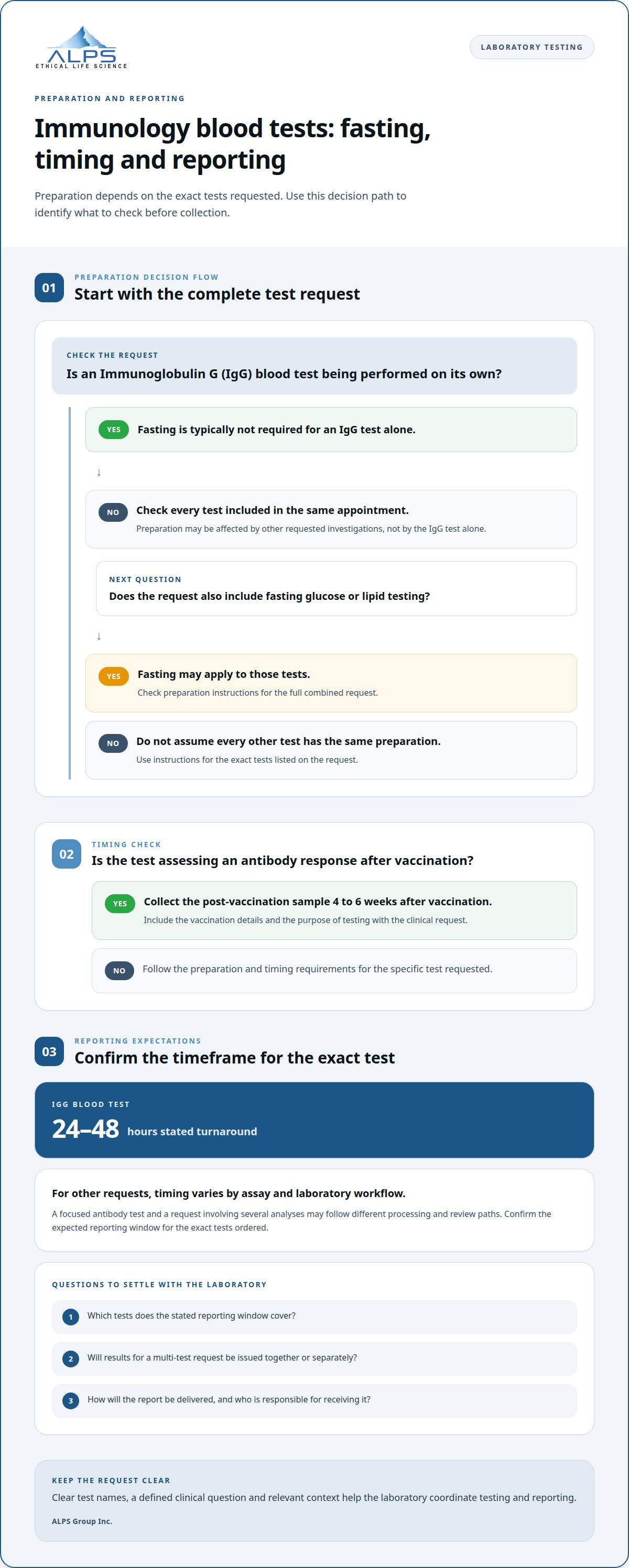
For an Immunoglobulin G blood test, the stated turnaround time is 24-48 hours, and fasting is typically not required unless the test is combined with a fasting glucose or lipid panel. This article explains which antibody and antigen tests may appear in screening packages, what their results can and cannot indicate, how turnaround time is affected, and when fasting may apply. It also outlines the practical considerations for selecting laboratory testing and preparing samples for professional analysis.
Key Takeaways
- Screening panels can include different antibody and antigen tests; the right combination depends on the clinical question being assessed.
- Interpret allergy-related results alongside symptoms and medical history, rather than treating a test result as a diagnosis on its own.
- Turnaround time depends on the test and laboratory workflow, so confirm the expected reporting timeframe when arranging testing.
- Fasting is generally unnecessary for an Immunoglobulin G blood test, unless it is combined with a fasting glucose or lipid panel.
Antibody and antigen tests included in health-screening packages
Immunology test panels may combine antibody and antigen tests, depending on the clinical purpose. Their results provide different evidence and need to be interpreted in context.
Package Test Inclusion
Antibody tests detect immune proteins produced in response to an allergen, infection or vaccination. Specific IgE testing can assess sensitisation to allergens such as dust mites, cat dander, egg white or cow’s milk. Antigen tests look for components of a target, including those associated with infection. Because a package may include only selected tests, check the test names and intended purpose.
Different questions call for different tests. Allergy assessment may use specific IgE, while immune-response testing can measure immunoglobulins such as IgG or antibodies following vaccination. Infection testing may use antibodies or antigens, depending on the suspected disease and purpose of testing. Autoimmune assessment requires tests selected for the suspected condition, rather than a single universal screening panel.
Accuracy varies by test and clinical context. In a study of allergy tests, the World Health Organization reports sensitivities ranging from 71.4% to 93.1%. A positive specific IgE result does not necessarily mean clinical allergy; symptoms and medical history also matter. False-positive dengue serology can be addressed with confirmatory neutralisation testing, according to the European Union.
A doctor’s referral may depend on the test and the hospital or laboratory pathway. A referral is useful when symptoms or a suspected disease need clinical assessment alongside test selection.
Coverage and Test Costs
Health insurance coverage depends on policy terms, while access to public healthcare depends on the care pathway. A screening appointment does not mean every test is covered. Review the relevant policy or public-service arrangements for the specific test and clinical reason.
There is no single cost for common immunology tests: charges depend on the test selected and package contents. Request an itemised quotation before proceeding to clarify laboratory, consultation and additional test charges.
Test turnaround times
Reporting schedules differ by assay and laboratory workflow, so a single estimate cannot represent every immunology request. A focused antibody test and a panel involving several analyses may require different processing and review. For clinics and hospitals, the useful planning point is the expected reporting window for the exact test ordered, not a general estimate for all immune testing.
The requested test list is one factor. Each assay has its own method, processing sequence and interpretation requirements. A request combining antibody testing with other investigations may therefore follow a different reporting pathway from an individual test. Clear test names and a defined clinical question help the laboratory coordinate the work and clarify which results belong to each request.
Reporting also depends on what the requesting team needs from the result. A report intended for clinical review may need information connecting the findings with the referral question. For example, a post-vaccination antibody assessment needs relevant vaccination context. Complete referral details help the report reach the right team with appropriate context for interpretation.
When coordinating with a laboratory, establish how the reporting window is defined, which tests it covers and how the report will be delivered. Ask whether results for a multi-test request are issued together or separately. These details help clinics plan follow-up appointments and set realistic expectations for patients, without assuming every assay follows the same schedule.
For institutional requests, identify the responsible contact for receiving reports and any required documentation. Incomplete request details can lead to clarification steps before testing proceeds. Clear communication between the requesting team and laboratory helps resolve these points and supports an orderly process from request submission through report delivery.
For test coordination and reporting requirements, discuss your needs with the testing team.
Sample preparation and fasting requirements
Preparation depends on the requested test and any other investigations planned for the same appointment. An Immunoglobulin G (IgG) test uses a blood sample, and fasting is typically unnecessary when it is performed alone. If the request also includes fasting glucose or lipid testing, fasting may apply to those tests. Reviewing the full test request helps clarify which preparation instructions are relevant.
Different tests answer different clinical questions, so preparation should match the exact request. A blood test measuring an antibody response after vaccination has a timing consideration: collect the post-vaccination sample 4 to 6 weeks after vaccination. The interval provides a defined point for assessing the immune response. The vaccination date and test purpose give the result useful context.
For a combined appointment, distinguish tests that require fasting from those that do not. This is especially relevant when an immunology blood test is ordered alongside glucose or lipid measurements. The combination, rather than the immunology test alone, determines whether fasting is needed. Clear test names on the request also help the collection team understand the intended investigations.
For post-vaccination antibody testing, include vaccination details with the clinical request. This allows the reported measurement to be considered in relation to the relevant vaccine and collection interval. If the request concerns a different immune response, state the test purpose clearly so the selected analysis addresses that question.
Before the appointment, review the requested tests and identify any combined fasting investigations. Share relevant vaccination information when antibody-response testing is planned. These details help align collection with the diagnostic question and reduce ambiguity when interpreting the result. A test result contributes evidence to clinical assessment; on its own, it does not determine a diagnosis or treatment decision.
Where can I get immunology tests in Malaysia, including public hospitals and private labs?
In Malaysia, immunology testing can be arranged through public hospitals or private laboratories. The appropriate route depends on the clinical question, requested assay and need for consultation. The Institute for Medical Research Allergy Unit is Malaysia’s national referral centre for allergy diagnostics and research under the Ministry of Health.
Public-sector assessment may be relevant when symptoms require clinical evaluation alongside testing. A hospital consultation can connect the test request with symptoms, history and suspected condition. Suspected allergy and post-vaccination antibody response call for different tests and clinical context. The test name alone does not establish the right pathway.
Private laboratories provide another route for laboratory testing in Malaysia. Before booking, identify the exact assay, specimen type and report format required. For example, a specific IgE test measures sensitisation to a named allergen, but does not independently establish clinical allergy. Clarify how results are reported and whether interpretation consultation is separate.
Clinics and hospitals arranging tests for patients can support referral coordination by sending the clinical question with the request. Include relevant symptoms, suspected disease, vaccination details where applicable, and the requested test. Confirm sample handling and report delivery with the laboratory. These details help align the analysis with the clinical decision that follows.
For immunology tests in Malaysia, assess the service pathway as well as location. Establish whether the laboratory performs the required assay, how specimens reach it, and who receives the report. Clarify whether follow-up consultation is available through the referring hospital or arranged separately. For a clinic referral, also confirm how the report returns to the requesting team and what information accompanies it. These practical details support continuity from testing to clinical review.
To discuss laboratory testing requirements, contact the testing team.
ALPS Group: Biochemistry, Serology & Immunology Tests
ALPS Group provides Biochemistry, Serology & Immunology Tests for clinics, hospitals, healthcare professionals and research organisations requiring laboratory testing. These services are relevant when a defined clinical or research question calls for serological or immunological analysis. Select tests according to their intended purpose and sample requirements.
For related laboratory needs, ALPS Group also offers Microbial Tests, Whole Genome Sequencing and mRNA Testing. These are distinct services, selected according to the testing objective rather than used as substitutes for antibody or antigen testing. Clear referral details help align the requested analysis with the question being investigated.
For Malaysian healthcare teams planning a testing request, provide the test requirement and relevant sample information when making an enquiry. This supports a focused discussion about suitability, reporting needs and coordination. Contact ALPS Group to discuss laboratory testing requirements.
Plan a clear next step for laboratory testing
Make the next step a clearly defined laboratory request. For immunology tests Malaysia, align the test purpose with the clinical or research question, and clarify how the result will be used. This gives the requesting team a clear basis for referral and reporting. If several investigations are being considered, distinguish the primary objective from additional analyses so each request remains purposeful.
A well-defined request also gives the laboratory context for coordinating the testing process. The referring organisation can provide relevant specimen details and reporting requirements, then consider how findings will inform subsequent clinical review. Interpret results within their intended use and relevant patient information, rather than treating them as standalone decisions. Clear communication between the requesting team and laboratory supports a coherent process from request to report.
For clinics, hospitals and research organisations planning a testing request, contact ALPS Group Inc. to discuss your requirements. A considered request is a practical foundation for informed next steps.
Frequently Asked Questions
How Can Healthcare Teams Use the Results?
Results can help organise the next stage of clinical review, such as deciding whether further assessment is relevant. Keep the complete report with the referral information so the healthcare professional can consider the original reason for testing. For ongoing monitoring, retain previous reports for comparison. The treating team can explain how the findings relate to the care plan.
What immunology tests are commonly available in Malaysia?
Laboratory menus can include antibody, antigen, immunoglobulin and allergen-specific assays. The exact tests available vary by laboratory and by the purpose of the request. For a referral, specify the clinical question and test name, if known. This helps the laboratory identify the relevant testing pathway and clarify whether the request concerns an immune response, an allergen or an infection.
What sample preparation requirements apply to immunology blood tests, and is fasting required?
There is no single preparation rule for every immunology blood test. Fasting is typically unnecessary for an IgG test performed alone, but combined tests can change preparation requirements. Provide the complete test request when arranging collection and follow the instructions for that combination. This avoids applying one test’s preparation guidance to the entire appointment.
How long do immunology test results take in Malaysia?
Reporting time depends on the specific assay and laboratory process. For practical planning, request the expected reporting window for the exact test and clarify whether it starts from collection or receipt of the sample. If several tests are requested, ask whether the report will be issued as one complete set or in separate parts, so follow-up can be arranged appropriately.
How should healthcare teams respond to abnormal immunology test results?
Arrange a review with the healthcare professional who requested the test, and have the complete report and relevant clinical records available. Consider what the result means for the original referral question, whether further assessment is appropriate, and whether follow-up should be planned. Do not change treatment based solely on a laboratory value; decisions should follow clinical review.


