

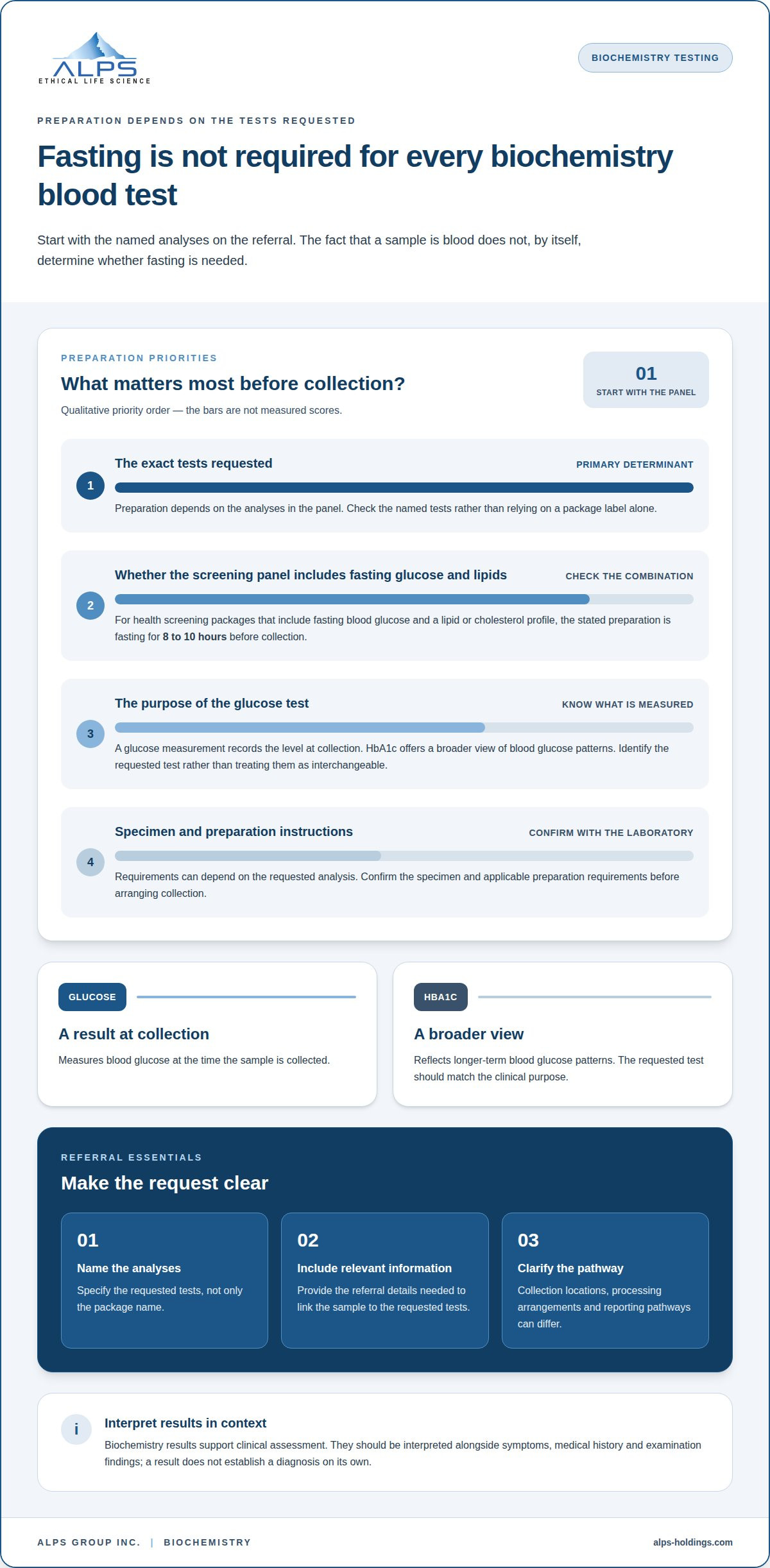
Fasting is not required for every biochemistry blood test. For biochemistry tests in Malaysia, preparation depends on the tests requested: health screening packages that include fasting blood glucose and lipid or cholesterol profiles advise fasting for 8 to 10 hours before collection.
When advising patients before a blood draw, referrers should distinguish fasting glucose from HbA1c: the former measures glucose at the time of collection, while the latter offers a broader view of blood glucose. Whether fasting is needed therefore depends on the test panel, not simply on the fact that blood will be taken.
This article explains how biochemistry tests support clinical assessment, what referrers should know about fasting before glucose testing, and why reporting schedules depend on the requested analyses and laboratory workflow. It also outlines what clinics and healthcare professionals can consider when arranging testing, helping clarify preparation and reporting expectations.
Key Takeaways
- Match the biochemistry panel to the clinical question, since different measurements support different aspects of diagnosis and ongoing management.
- Understand how fasting glucose and HbA1c differ before arranging diabetes testing and interpreting the requested tests.
- Plan reporting expectations around the analyses requested and the laboratory workflow, rather than assuming every blood test has the same turnaround.
- For professional testing needs, consider how biochemistry services can fit within a broader laboratory testing plan for clinics, hospitals and research organisations.
Laboratory tests supporting diagnosis and management
Biochemistry tests measure substances in blood or other specimens. Clinicians interpret results alongside symptoms, medical history and examination findings. For example, a glucose result can contribute to blood sugar assessment, while a lipid profile measures cholesterol-related markers. Results inform clinical decisions but do not establish a diagnosis on their own.
Biochemistry test panels vary according to the biomarkers selected and the purpose of testing. A screening panel may combine fasting blood glucose with lipid measurements, while a clinician-requested panel can focus on a specific question. When comparing biochemistry tests in Malaysia, look at the named tests and sample requirements rather than relying on package labels alone.
Malaysian laboratories commonly offer glucose and HbA1c testing, alongside lipid or cholesterol profiles. HbA1c reflects longer-term blood glucose patterns, whereas a glucose measurement records the level at collection. The requested tests depend on the clinical purpose and should be identified clearly on the referral.
When selecting a biochemistry service, confirm that the laboratory can perform the requested analyses and clarify the specimen and preparation requirements. These details help the referring professional determine whether the service is suitable for the clinical request and what information to provide with the referral.
To arrange testing through a Malaysian clinic or laboratory, the referring professional specifies the requested analyses and provides the relevant referral information. The laboratory then communicates applicable specimen and preparation requirements. For fasting glucose and lipid or cholesterol profiles in health screening packages, the stated preparation is fasting for 8 to 10 hours.
Clear collection and reporting instructions support laboratory processing. Professionals need results linked to the correct patient and requested tests, so a complete referral helps the laboratory process the specimen appropriately. Facilities can differ in which analyses they perform on site and which they route for further processing.
Laboratory services across Malaysia can involve separate collection locations and processing facilities. For clinic referrals, the specimen route, transport arrangements and reporting pathway all affect coordination. Clarifying these details during referral helps set practical expectations without assuming every location handles every analysis.
Accreditation should be considered in relation to the specific test and laboratory scope. The term alone does not show whether a requested analysis falls within that scope. Healthcare professionals can review the laboratory’s stated accreditation details and reporting arrangements when selecting a service for clinical use.
Chemical pathology and analysis of chemical processes
A biochemistry blood test measures chemicals and biological molecules in a blood sample. These can include glucose, enzymes, electrolytes, proteins, fats and waste products. Their concentrations can help clinicians assess organ function and metabolic processes. Interpretation depends on the specific test, clinical context and other findings.
Chemical pathology examines these substances and the processes that produce or change them. For example, testing can investigate suspected inborn errors of metabolism, conditions that affect the body’s ability to process particular substances. Specialist diagnostic services may support detection, while biomedical research examines diagnostic indicators and develops tests for these conditions.
Analysis starts with a defined question and a suitable specimen. A laboratory selects a method according to the target substance, required sensitivity and sample characteristics. Clinical chemistry analysers measure routine chemical components, while spectrophotometry measures how a sample absorbs light. High-performance liquid chromatography (HPLC) separates compounds, and gas chromatography-mass spectrometry (GC-MS) identifies substances after separation.
Some specialist analyses use liquid chromatography-tandem mass spectrometry (LC-MS/MS), which separates compounds and detects them through their mass and fragmentation patterns. Gas chromatography-mass spectrometry is another approach for analysing selected chemical compounds. The method used shapes what can be measured and how results are interpreted.
Metabolomics studies patterns of small molecules, called metabolites, in a biological sample. Rather than testing one marker alone, metabolomics analysis can examine multiple metabolic signals together. Researchers use computational metabolomics and bioinformatics to process these datasets, identify patterns and support biomarker discovery. These research applications help develop and evaluate analytical methods; they do not establish a clinical diagnosis on their own. For biomedical researchers sourcing reference materials and peptides for analytical studies, resources like eurolabpetides.com offer practical guidance on vetting suppliers and ensuring quality.
For health screening or clinical testing, the requested analysis should match its intended purpose. A referral can specify the clinical question, relevant history and requested tests. This helps the laboratory select an appropriate analytical pathway and return results in a useful context. For project or service enquiries, contact the laboratory team to discuss testing requirements.
Blood test result turnaround
Reporting schedules depend on the requested analyses and the specimen’s route through the laboratory. A routine chemistry panel and a specialist metabolic analysis can involve different workflows. The laboratory receives and checks the sample, performs testing, reviews findings and prepares a report. Each stage contributes to the schedule.
Test complexity is a key factor. Established clinical chemistry methods may follow a different pathway from specialist techniques such as LC-MS/MS. Analyses that require additional processing or interpretation can take longer. For screening referrals, the specific tests requested shape the workflow more than the general label “blood test”.
Specimen quality and referral information also affect progress. If a sample cannot be matched to the correct patient or requested analysis, clarification may be needed. Missing test details can delay routing to the appropriate workflow. Accurate identifiers, a clear test request and relevant clinical context help the laboratory process referrals efficiently.
Some findings require technical review or additional analysis before reporting. A doctor assesses results alongside symptoms, medical history and other investigations. A value outside a reference interval does not establish disease on its own, and a value within range may not resolve every clinical question. Interpretation depends on the test and the patient’s context.
Preparation and collection conditions are relevant factors. IJN advises avoiding strenuous exercise for 12 hours before a blood test. It also advises avoiding biotin, vitamin C above 250 mg per day and non-prescribed supplements for at least 12 hours before blood collection. For collection-site care, IJN advises pressing the puncture site for at least five minutes after collection, or ten minutes for patients taking blood-thinning medication.
For clinic referrals, clarify the requested analyses, specimen requirements, report recipient and delivery pathway. These details help determine whether the workflow suits the clinical purpose. Patients should follow the laboratory’s instructions for their specific tests and tell the collecting professional about relevant medicines or supplements.
Diabetes tests, including fasting glucose and HbA1c
Fasting glucose and HbA1c provide different information for diabetes assessment. A fasting glucose test measures glucose in a blood sample collected after fasting. The World Health Organization describes HbA1c as reflecting average blood glucose over the preceding two to three months. The tests are not interchangeable, so specify the requested test and its purpose in the referral.
Fasting is not automatically required for every biochemistry panel. Health screening packages that include fasting blood glucose and lipid or cholesterol profiles advise fasting for 8 to 10 hours before collection. When arranging testing, identify the requested analyses and confirm preparation requirements for the full panel.
For clinics and healthcare professionals, define the purpose of testing and name the required analyses clearly on the referral. This helps the laboratory process the request and gives the doctor context for reviewing the report.
Interpretation depends on clinical context. A doctor considers test results alongside the patient’s history and other findings, rather than treating one measurement as a complete picture. Select tests according to the referral purpose and follow the preparation instructions for the full panel.
For diabetes assessment enquiries, contact the laboratory team about suitable testing.
ALPS Group: Biochemistry, Serology & Immunology Tests
ALPS Group provides biochemistry, serology and immunology tests for clinics, hospitals, healthcare professionals and research organisations. This service is relevant when a project or referral requires laboratory testing within these areas. The medical laboratory services can be considered alongside the specific analyses required and the purpose of testing.
For a referral or project enquiry, provide the requested test details, intended use and relevant sample information. These details help establish whether the testing pathway suits the clinical or research question and clarify reporting requirements. ALPS Group also offers Whole Genome Sequencing, mRNA Testing and Microbial Tests for distinct testing needs; these services are not substitutes for biochemistry analysis.
Contact ALPS Group to discuss test suitability or a quotation.
Plan testing around the clinical question
For teams arranging biochemistry tests in Malaysia, start by defining the decision the testing should inform. A clear request can align the intended analysis, specimen planning and reporting with clinical or research objectives, while keeping interpretation in the appropriate professional context. This helps make the testing pathway purposeful from referral through result review.
ALPS Group Inc. offers Biochemistry, Serology & Immunology Tests, alongside Whole Genome Sequencing and mRNA Testing for distinct laboratory requirements. These services address different testing needs, so matching the proposed work to its purpose is central to a well-structured request. Clinics, hospitals, healthcare professionals and research organisations can contact ALPS Group Inc. to discuss the appropriate service and their requirements.
Contact ALPS Group Inc. about testing to identify a practical next step for your referral, programme or study. Clear objectives provide a strong foundation for the work ahead.
Frequently Asked Questions
What fasting instructions should a Malaysian laboratory provide for a referred biochemistry blood test?
For health screening packages that include fasting blood glucose and lipid or cholesterol profiles, the stated preparation is fasting for 8 to 10 hours before collection. Instructions should identify the tests covered and explain any preparation relevant to the specific request. If a referral combines different analyses, the laboratory’s instructions should address the complete panel rather than assume one preparation rule applies to every test.
What information should an organisation provide when requesting a blood-test quotation in Malaysia?
There is no single cost for every blood test in Malaysia, because the requested analyses determine what the laboratory needs to perform. To request a quotation, specify the tests required and whether the request is for screening, clinical assessment or research. The quotation depends on the case, with the selected biomarkers and scope of testing among the relevant cost factors.
What should healthcare teams ask about blood-test reporting times?
Ask about the reporting schedule for the exact test request rather than relying on a general estimate for blood tests. A useful enquiry states whether the report is needed for a scheduled review, ongoing monitoring or another planned decision. The laboratory can then discuss the workflow and reporting arrangements for those analyses without implying that every test follows the same timetable.
How can organisations compare quotations for biochemistry tests in Malaysia?
Charges at private laboratories and hospitals vary according to the requested panel and its biomarkers, so comparisons should use equivalent test lists. For an accurate quotation, provide the intended analyses and clarify whether additional testing is requested. The quotation depends on the case; a general estimate would not reliably represent a specific panel.
What should healthcare teams confirm about biochemistry test reporting?
Timing and delivery arrangements depend on the particular test request and reporting pathway. For a referral linked to a planned appointment, confirm the expected schedule and agree who should receive the report. This helps the healthcare team coordinate review and follow-up. Do not assume results for different analyses will be issued together or through the same channel.
How do biochemistry test panels differ across Malaysian providers?
Panels vary in their selected biomarkers and purpose. Compare the named tests and specimen requirements, since laboratories may perform some analyses on site and route others for further processing.


