

When choosing a laboratory for human pathology testing, clinics and hospitals may consider how it demonstrates competence. In Malaysia, ISO 15189 provides a reference for quality standards for medical laboratories, setting out requirements for quality and competence.
Understanding the applicable standard can help healthcare providers ask informed questions when assessing a laboratory. Evidence of quality management and technical capability can show how the laboratory controls testing and assures results.
This article explains how ISO 15189 defines quality and competence, what assessors look for when evaluating a laboratory, and how these principles relate to human pathology testing accreditation in Malaysia. It also outlines practical considerations for clinics and hospitals choosing a laboratory testing service, including questions about test suitability, sample requirements, reporting, and factors that influence turnaround time and cost.
Key Takeaways
- Understand how ISO 15189 frames laboratory quality and technical competence, and why the standard matters when pursuing accreditation.
- Learn what customers, regulators and accreditation bodies use to recognise a laboratory’s competence.
- See how assessment considers integrity, impartiality and evidence that quality processes are applied consistently.
- Explore how Malaysia’s regulatory context relates to laboratory accreditation and where ALPS Group’s testing services may fit your needs.
ISO 15189 requirements for medical laboratory quality and competence
ISO 15189 sets a framework for medical laboratory quality and competence. Its requirements connect reliable laboratory processes with technically sound testing.
Purpose and Scope of ISO 15189
ISO 15189 defines requirements for medical laboratory quality and competence. ISO 15189:2012 specifies these requirements in medical laboratories, according to International Organization for Standardization (ISO). The standard’s purpose is to support consistent laboratory operations and technically capable testing. Quality concerns the control of laboratory work; competence concerns the capability to perform it reliably. Together, these concepts link laboratory processes with results used in healthcare decisions.
ISO 15189 Accreditation
ISO 15189 accreditation is formal recognition that a medical laboratory meets requirements within an assessed scope. Assessments include checking that the laboratory operates a quality management system. This system organises processes for controlling and reviewing laboratory work. The scope identifies the activities covered by accreditation; recognition does not automatically extend to every test in a facility. For hospital and clinic customers, that distinction helps clarify which laboratory activities have been assessed. Accreditation offers a structured basis for recognising capability, rather than a general claim of quality.
Transition to ISO 15189:2022
The transition to ISO 15189:2022 is the move from the earlier edition to its published revision. ISO 15189:2012 was withdrawn on 2022-12-06. ISO 15189:2022 was accepted into use in December 2022. For a laboratory, transition involves aligning its quality management system and assessment evidence with the newer edition. Customers reviewing accreditation information can use the edition stated there to understand the reference applied. The edition matters because accreditation should be interpreted against the standard used for assessment.
ISO 15189 and ISO/IEC 17025
ISO/IEC 17025 applies to testing and calibration laboratories and provides a foundation for ISO 15189. The two standards are related, but ISO 15189 addresses medical laboratory quality and competence specifically. ISO/IEC 17025 provides the broader testing and calibration laboratory foundation. This distinction helps explain why medical laboratory accreditation references ISO 15189, rather than relying only on a general testing standard. For laboratories, the relevant standard depends on the nature of the work and its medical context.
Recognition of laboratory competence by customers, regulators and accreditation bodies
Accreditation connects documented laboratory capability with confidence in specific testing activities. In Malaysia, the SAMM documents and stated accreditation scope help clarify the applicable criteria.
Accreditation evidence commonly includes controlled procedures, technical records, staff competency records and quality management processes. Assessment considers how these support the laboratory’s work within its defined testing scope.
Accreditation Criteria and Guidance
Accreditation criteria are requirements and supporting documents used to assess laboratory competence. Malaysia’s SAMM policy on metrological traceability is SP 2, Issue 5, dated 10 February 2022. Its measurement uncertainty policy, SP 5, Issue 2, dated 28 February 2007, applies to testing laboratories only and has Amendment 2 dated 13 February 2019. Listed Malaysian document prices are RM120.00 for MS ISO 15189:2022 and RM90.00 for MS ISO 15189:2014.
Steps Toward Laboratory Accreditation
The accreditation pathway is the sequence of preparing evidence, defining scope, and undergoing assessment. A new laboratory first identifies the testing activities for assessment, then aligns its documented processes with applicable criteria. SAMM Circular 1/2023 addresses transition to ISO 15189:2022. Circular 2/2021 covers a quality management system under one legal entity’s purview. Assessment planning and evidence should correspond to the laboratory’s intended scope.
Pathology Testing Accreditation Coverage
Accreditation coverage is the set of pathology activities included within an assessed scope. Malaysia’s STR 2.1, Issue 6, dated 12 June 2025, addresses anatomical pathology cytopathology laboratory accreditation. Coverage matters because recognition applies to the activities assessed, not automatically to every test or laboratory location. Customers and regulators can use the stated scope to understand which pathology work falls within the accreditation.
Accreditation Documents, Staff, and Quality Processes
Accreditation documentation should demonstrate that staff and processes support competent testing. Laboratories organise procedures, test records, staff competency evidence and quality management records around their actual scope. Assessors evaluate how controls work in practice, not simply whether documents exist. For clinics and hospitals, matching a requested test to the documented scope helps clarify what the accreditation covers.
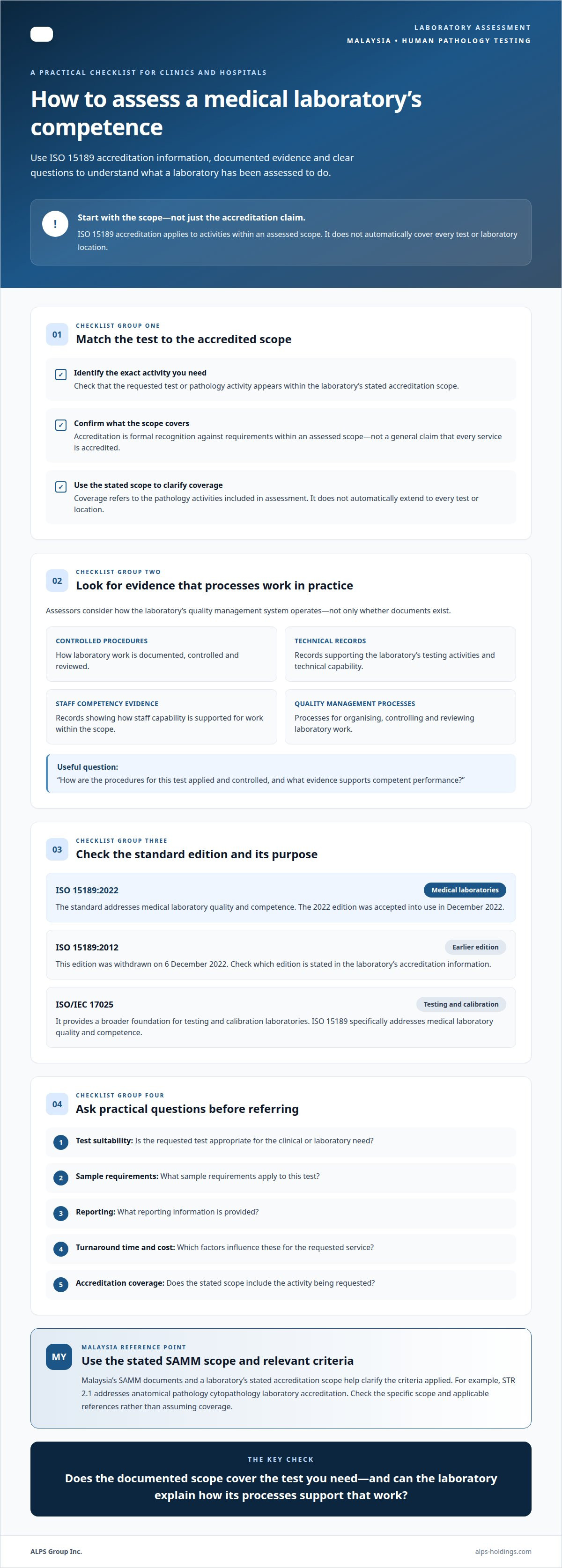
Assessing a laboratory’s integrity, impartiality and competence
An ISO 15189 assessment examines laboratory integrity, impartiality and competence. These areas can help customers understand how a laboratory supports sound testing in practice.
Questions about laboratory processes
When assessing a testing service, ask how the laboratory controls and performs its activities. Under ISO 15189, assessors evaluate whether the quality management system operates in practice, rather than existing only as documentation. Customers can ask how procedures are applied across laboratory work and what evidence supports competent performance. For example, you could ask how a testing process is documented and controlled. This helps clarify how stated procedures relate to the work performed.
Medical laboratory quality and competence standards provide a framework for this assessment. ISO 15189:2012 can be used by laboratories to develop quality management systems and assess their own competence. When choosing a testing service, ask how the laboratory’s quality system relates to the work it performs and what information it can provide about its processes. This can help you understand how the system supports testing.
Questions about integrity and impartiality
Integrity and impartiality concern whether laboratory work is conducted honestly and without inappropriate influence. ISO 15189 accreditation assessments verify laboratory integrity, impartiality and competence. Customers can ask how the laboratory demonstrates objective conduct and technical capability. These are distinct but connected considerations: impartiality supports unbiased work, while integrity concerns trustworthy conduct. Together, they inform how customers, regulators and accreditation bodies interpret evidence of competence.
When comparing testing services, ask how the laboratory’s quality management system supports the work relevant to your request. You could ask what information is available about procedures, records and responsibilities, and how documented arrangements relate to actual practice. Clear answers can help you understand the service and the evidence behind its approach.
Customers can also ask how the laboratory reviews competence over time. A focused discussion can link a requirement to the relevant procedure and evidence of its application. For example, ask whether the quality system reflects current laboratory activities and how records show that controls are followed. An internal review does not replace external assessment, but asking about it can help clarify how the laboratory monitors its operations and addresses areas that may need attention.
How can clinics choose and refer for laboratory tests?
When choosing a laboratory test, start by identifying the clinical or research question and the type of testing required. ALPS Group offers Whole Genome Sequencing, mRNA Testing, Biochemistry, Serology and Immunology Tests, Haematology Tests, and Microbial Tests. Confirm with the laboratory whether the requested test is available and suitable for your purpose, and what information is needed to assess the referral.
Before referring a sample, ask the laboratory about its sample requirements, including the sample type, collection and handling instructions, and any information that must accompany it. Requirements can depend on the test. For example, a Haematology Test and a Microbial Test are different testing services, so do not assume that the same sample or handling instructions apply to both.
Ask how results are reported and whether the report will address the question behind the referral. If you are reviewing laboratory accreditation, check the scope and relevant testing discipline. References such as STR 2.1, Issue 6, dated 12 June 2025, for anatomical pathology cytopathology and STR 2.4, Issue 6, dated 06 April 2026, for haematology and transfusion medicine relate to named fields. Circular 3/2019 on assessment man-days under SAMM MS ISO 15189 and Circular 1/2021 on remote assessments concern assessment processes.
For procurement and referral planning, discuss test availability, sample requirements, reporting and any factors that may affect cost or turnaround time directly with the laboratory. Do not assume that accreditation information for one discipline applies to another, or that it confirms a particular test is available. These questions can help clinics, hospitals and research organisations assess whether a service fits their needs before arranging a referral.
ALPS Group
ALPS Group Inc. gives Malaysian clinics, hospitals and research organisations access to laboratory testing across molecular and other testing disciplines. Its molecular laboratory meets MS ISO 15189:2022 standards, a relevant quality framework for medical laboratory work.
Available testing services include Whole Genome Sequencing, mRNA Testing, Biochemistry, Serology and Immunology Tests, Haematology Tests, and Microbial Tests. The appropriate option depends on the testing question, intended use and sample requirements. Clear information about the requested test and sample helps establish suitability and supports discussion of reporting and cost considerations.
Organisations assessing a referral or testing requirement can discuss how a service relates to their needs. Contact ALPS Group Inc. to discuss testing suitability or request a quotation.
Match the testing need to the appropriate service
For Malaysian healthcare and research organisations, define the intended use, sample information and reporting needs before selecting or referring for a test. This helps make discussions about service suitability and request requirements more specific, with results considered in the appropriate clinical or research context.
ALPS Group Inc. offers Whole Genome Sequencing, mRNA Testing, Biochemistry, Serology and Immunology Tests, Haematology Tests, and Microbial Tests. These services address different testing needs, so suitability depends on the purpose and request requirements. When choosing or referring, identify the relevant service and confirm sample and reporting requirements with ALPS.
To discuss a testing requirement or request a quotation, contact ALPS Group Inc. to ask about service availability and suitability for your organisation’s needs.
Frequently Asked Questions
What is ISO 15189?
ISO 15189 is an international standard for medical laboratory quality and competence. It gives laboratories a framework for managing quality and demonstrating the technical capability behind their testing work. In practice, a healthcare organisation can use a laboratory’s stated accreditation scope to see which activities have been assessed. That scope is more informative than treating accreditation as a blanket endorsement of every test.
What are the main international quality standards for medical laboratories, including ISO 15189?
ISO 15189 and ISO/IEC 17025 are two relevant standards, but they address different contexts. ISO 15189 is specific to medical laboratories, while ISO/IEC 17025 applies to testing and calibration laboratories and provides a foundation for ISO 15189. The appropriate reference depends on the laboratory’s work. For example, medical testing should be considered in its healthcare context, rather than viewed only as general testing activity.
What requirements does ISO 15189:2022 set for medical laboratory quality and competence?
ISO 15189:2022 sets requirements for medical laboratory quality and competence. A laboratory needs a quality management system that supports controlled operations and evidence of technical capability. In practical terms, its processes and records should relate to the tests within its scope. Customers reviewing laboratory information can consider whether the stated accreditation scope matches the testing service they intend to use.
How do ISO 15189, ISO 9001, and ISO 17025 differ for medical laboratories?
ISO 15189 is tailored to medical laboratory quality and competence. ISO/IEC 17025 applies to testing and calibration laboratories and provides a foundation for ISO 15189. ISO 9001 concerns quality management more broadly across organisations; it does not, by itself, describe medical laboratory competence in the same specific terms. For a medical testing decision, consider the standard and accredited scope relevant to the particular laboratory activity.
What are Malaysia's accreditation requirements for medical laboratories under SAMM and ISO 15189?
In Malaysia, SAMM accreditation assessment uses ISO 15189 alongside technical requirements relevant to the laboratory’s discipline and requested scope. Requirements therefore differ by testing field. For example, anatomical pathology cytopathology has a specific technical reference, as do haematology and transfusion medicine. A laboratory preparing an application should map its intended activities to the applicable criteria and organise evidence around that scope, rather than assume one document covers every discipline.
What are the steps and typical timeline for a medical laboratory to obtain ISO 15189 accreditation in Malaysia?
The main steps are to define the testing scope, align laboratory processes with ISO 15189 and applicable SAMM criteria, prepare supporting records, and undergo assessment. The timeline depends on the laboratory’s readiness, the breadth of its scope, assessment arrangements and any findings requiring corrective action. These factors make a single typical duration unreliable; planning should account for both preparation and follow-up work.


