

A laboratory’s reliability depends not only on the result, but also on the processes that support it. For a medical laboratory in Malaysia, ISO 15189:2022 sets requirements for quality and competence, according to the International Organization for Standardization. Its purpose is to provide a framework for consistent laboratory practice and for demonstrating that a laboratory can perform its work competently.
Understanding the standard matters to hospital laboratories, clinics and healthcare professionals assessing quality systems or laboratory recognition. This article explains what ISO 15189 covers, how it can guide the development and assessment of a quality management system, and how accreditation relates to recognition of a laboratory’s competence in Malaysia. It also clarifies the distinction between following a standard and receiving accreditation, so you can interpret what the standard means when considering laboratory testing and reporting.
Key Takeaways
- Understand how ISO 15189:2022 defines medical laboratory quality and competence, and what that means for dependable testing processes.
- See how laboratories can use the standard to structure a quality management system and assess their competence.
- Distinguish the requirements of a standard from accreditation, and understand how accreditation can support laboratory recognition.
- Identify how the standard’s purpose relates to hospital laboratories and decisions about testing services.
ISO 15189 medical laboratory quality and competence requirements
ISO 15189:2022 is the medical-laboratory standard for requirements on quality and competence, according to the International Organization for Standardization. It provides a framework for examining how laboratory processes support reliable medical testing.
Assessing Medical Laboratory Competence
Assessment is a structured examination of a laboratory’s ability to perform its work competently. Laboratories can use the standard to evaluate whether their processes, personnel and quality controls support the testing they conduct. For example, an assessment may examine how staff follow a documented procedure and record their work. This can reveal gaps between written processes and actual practice.
Common causes of nonconformities or delays in Malaysian accreditation include incomplete records, inconsistent use of procedures and insufficient evidence of staff competency. Resolving an issue can take time: the laboratory must identify its cause, implement a change and demonstrate that the change works. Clear records make this process easier to review.
Recognition of Laboratory Competence
Recognition is formal acknowledgement that a laboratory has demonstrated competence within an assessed scope. Laboratory customers, regulating authorities and accreditation bodies can use ISO 15189 to confirm or recognise medical laboratory competence. The scope matters: it describes the activities or services covered by that recognition, rather than making a general statement about every test a laboratory could perform.
For a hospital laboratory, this distinction helps decision-makers interpret the relevance of an assessment. They can consider whether the recognised scope covers the required testing service and how documented processes support that work. Recognition links evidence of competence to practical decisions about laboratory services, but does not guarantee every individual result.
Quality Management and Personnel Competency
A quality management system is the set of linked processes a laboratory uses to manage and improve the quality of its work. ISO 15189 can guide laboratories as they develop these systems and assess their own competence. Documented procedures, records and review of problems help make responsibilities and process changes traceable across laboratory activities.
Personnel competency is the demonstrated ability of staff to perform their assigned work. A laboratory can define tasks, document relevant training and assess whether staff follow the applicable procedures. For example, a competency record can connect an employee’s testing duties with evidence that they can carry them out. System and personnel assessments together support a consistent approach to quality.
Use of the standard in developing quality management systems
A quality management system (QMS) is the linked procedures and responsibilities used to manage laboratory quality. Medical laboratories can use ISO 15189 to develop that system and assess their own competence. The standard provides a structure for connecting documented processes with the work performed, from managing records to reviewing problems and improvement actions.
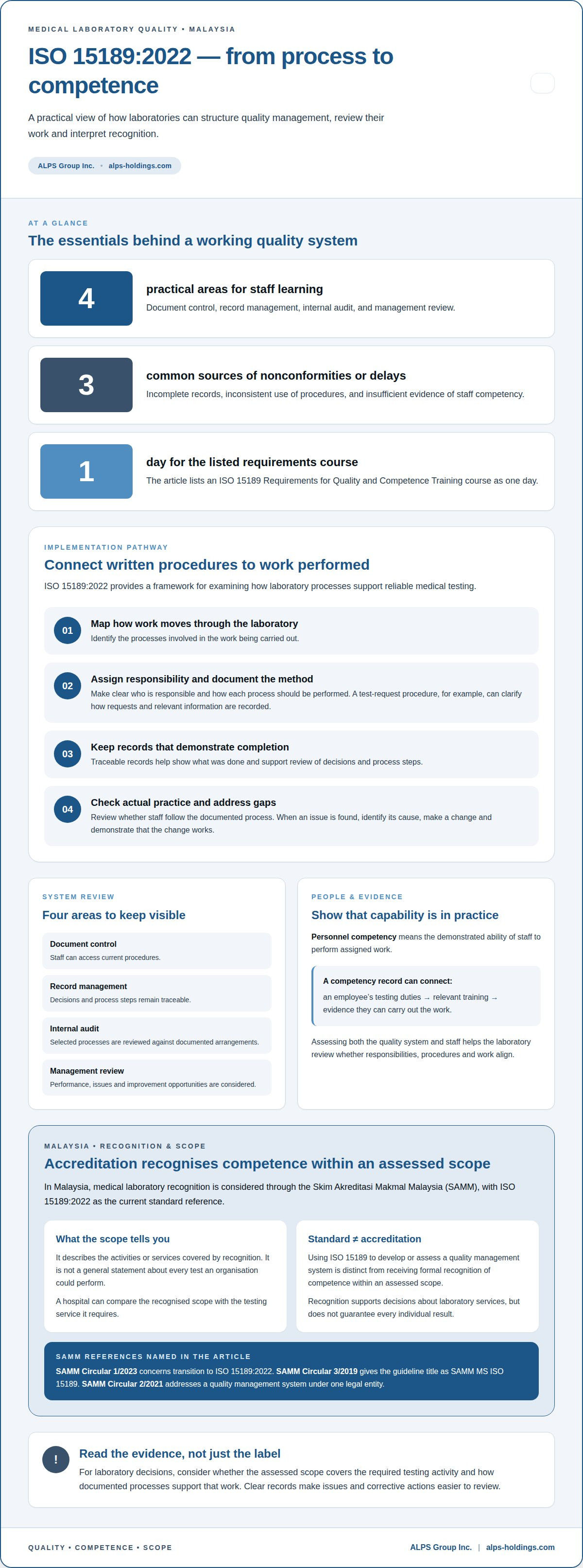
Implementation can start by mapping how work moves through the laboratory. The team identifies each process, assigns responsibility, documents the method and determines which records demonstrate completion. For example, a test-request procedure can clarify how staff record requests and manage relevant information. The laboratory can then review whether practice follows the documented process and address any gaps.
Quality management coordinates activities that help an organisation meet its quality objectives. In a medical laboratory, this involves more than writing procedures: managers need to consider how responsibilities, records, resources and process reviews work together. Internal audits are structured reviews of selected processes against the laboratory’s documented arrangements. Findings can guide corrective action, which addresses the cause of a problem rather than only its immediate effect.
Useful topics for staff learning and system development include:
- Document control, including how staff access current procedures.
- Record management, so decisions and process steps remain traceable.
- Internal audit planning, findings and follow-up actions.
- Management review of performance, issues and improvement opportunities.
These are practical areas for a laboratory’s learning plan, not a claim about a specific course syllabus. A listed ISO 15189 Requirements for Quality and Competence Training course is 1 day. Training can help staff understand how management-system processes relate to their roles, while internal audits help determine whether those processes operate as intended. Together, learning and review give laboratory leaders a practical route from written procedures to sustained implementation.
Hospital laboratory recognition and accreditation
Accreditation is formal recognition of a laboratory’s competence within an assessed scope. In Malaysia, medical laboratory recognition is considered through the Skim Akreditasi Makmal Malaysia (SAMM), with ISO 15189:2022 as the current standard reference.
Accreditation Requirements and Evidence
Accreditation requirements are the criteria used to assess a laboratory’s requested scope. SAMM Circular 1/2023 concerns the transition to ISO 15189:2022, while SAMM Circular 3/2019 gives the guideline title as SAMM MS ISO 15189. SAMM Circular 2/2021 addresses a quality management system under one legal entity.
Application evidence relates to the laboratory’s defined activities and how it manages them. Assessment is therefore tied to the submitted scope, not every service associated with an organisation. A hospital seeking recognition should compare the scope with the testing activity it requires.
Fees and Accreditation Timeline
Accreditation fees are charges associated with applying for and maintaining recognition. The standard itself does not set application, assessment or annual fees. Laboratories should base financial planning on the applicable SAMM arrangements rather than assume that one amount applies to every application.
The accreditation timeline is the period required to complete assessment and reach a decision. It depends on the application and assessment process, including how findings are addressed. ISO 15189:2022 does not give a universal completion duration.
Assessment, Surveillance, and Renewal
Assessment evaluates a laboratory’s scope and evidence against relevant requirements. Malaysian SAMM circulars address assessment and transition matters, so laboratories should refer to the applicable scheme documents for the specific process. Surveillance and renewal are later reviews of continued recognition, but no universal schedule is established here.
These distinctions matter: procedures used by another accreditation body should not be assumed to apply to SAMM.
Currently Accredited Medical Laboratories
The figure of 114 ISO 15189-accredited laboratory sites in 2025 is not included as it is not supported here by an authoritative source.
For primary healthcare laboratories under Malaysia’s Ministry of Health, the available schemes include ISO 15189 accreditation or the Primary Healthcare Laboratory Accreditation Scheme (PHLAS). The relevant scheme depends on the laboratory’s context.
Purpose of ISO 15189 certification for medical laboratories
ISO 15189 gives medical laboratories a framework for demonstrating competence across defined testing activities. Its purpose is to make processes assessable and support informed consideration of how laboratory work is conducted. The standard connects quality arrangements with technical activities, rather than treating documentation as the sole measure of capability.
For hospitals and referring clinics, recognition can inform decisions about laboratory services. Scope is central: recognition relates to assessed activities, so it should cover the test required. For example, a hospital planning a referral pathway can check whether the relevant testing activity falls within the laboratory’s recognised scope. Recognition does not guarantee an individual result or replace clinical interpretation.
In Malaysia, the Skim Akreditasi Makmal Malaysia (SAMM) is the accreditation framework discussed for medical laboratories. ISO 15189 is intended for medical laboratory quality and competence; therefore, a general quality-management certificate alone should not be treated as evidence that medical testing competence has been assessed against this standard.
A practical selection process starts by identifying the required test, then matching it to the laboratory’s recognised scope and considering how its processes support the work. This keeps recognition relevant to the intended use instead of relying on a certificate label alone.
Contact ALPS Group Inc. to discuss laboratory testing requirements and identify a considered next step.
ALPS Group Inc.
ALPS Group Inc. supports Malaysian healthcare and research organisations seeking laboratory testing aligned with their project or referral needs. Its molecular laboratory meets MS ISO 15189:2022 standards. This describes conformity with the standard and should not be interpreted as a claim of SAMM accreditation.
Available services include Whole Genome Sequencing, mRNA Testing, Biochemistry, Serology and Immunology Tests, and Microbial Tests. For a referral or research requirement, define the testing objective and discuss the appropriate service, sample requirements and reporting needs with the laboratory. These considerations help establish whether a test suits the intended work.
Contact ALPS Group Inc. to discuss laboratory testing requirements.
Translate quality priorities into your next step
For organisations assessing an ISO 15189 laboratory in Malaysia, the next decision is how the required testing will serve a clinical, operational or research purpose. Define the question the test must address, the sample involved, and the information needed in the report. These details help shape a clear referral or project request and keep laboratory selection connected to the work ahead.
ALPS Group Inc. supports organisations seeking laboratory testing, including molecular and other medical testing. Selecting a suitable service involves considering your requirements and practical details for the request. This gives clinics, hospitals and research teams a considered starting point for their next step.
Contact ALPS Group Inc. to discuss your laboratory testing requirements, and move forward with a defined purpose.
Frequently Asked Questions
Which Malaysian body accredits medical laboratories to ISO 15189?
The Department of Standards Malaysia administers the Skim Akreditasi Makmal Malaysia (SAMM), Malaysia’s laboratory accreditation scheme. For primary healthcare laboratories under the Ministry of Health, ISO 15189 accreditation is one available route; the Primary Healthcare Laboratory Accreditation Scheme (PHLAS) is another. This distinction is useful when interpreting recognition documents, since the scheme named on a record identifies the accreditation pathway involved.
How can I verify a Malaysian laboratory's ISO 15189 accreditation and scope?
Request the laboratory’s current accreditation certificate and accompanying scope document. Check that the laboratory’s legal name and site are identifiable, and review the certificate’s status and validity information. The scope document should specify the activities assessed. If the documents use different names or are difficult to interpret, ask for clarification about the relationship between the named organisation, site and laboratory activities before relying on the records.
What are the current ISO 15189:2022 accreditation requirements in Malaysia?
In Malaysia, medical laboratory accreditation is considered through SAMM, using ISO 15189:2022 as the current standard reference. Assessment covers the laboratory’s requested scope and supporting evidence; SAMM Circular 1/2023 concerns transition to the 2022 edition.
What are the application, assessment, and annual fees for Malaysian ISO 15189 accreditation?
Fees are set through the applicable SAMM arrangements; ISO 15189:2022 does not establish application, assessment, or annual fees.


