

For Malaysian clinics, hospitals and research organisations, choosing medical lab test services in Malaysia starts with defining the purpose of the request. The testing discipline, specimen requirements and intended report all shape how a laboratory referral is organised.
A clear request helps distinguish between testing pathways. Haematology, microbiology, serology and immunology address different laboratory questions, while specimen and reporting requirements depend on the analysis requested.
This article covers diagnostic haematology and coagulation studies, medical microbiology, serology and immunology testing in Malaysia. It also explains how to assess laboratory services and prepare a referral, including practical considerations related to cost and turnaround time.
Key Takeaways
- Match haematology and coagulation testing to the clinical or research question, and consider how the requested sample and report will support its intended use.
- Distinguish microbiology testing, which investigates microbes, from serology, which examines antibodies or other immune responses.
- When assessing a laboratory service in Malaysia, clarify sample requirements, reporting arrangements and the factors that influence cost and turnaround time.
- Consider ALPS Group’s mRNA Testing when molecular testing is relevant to your project, alongside its other laboratory testing offerings.
Diagnostic haematology and coagulation studies
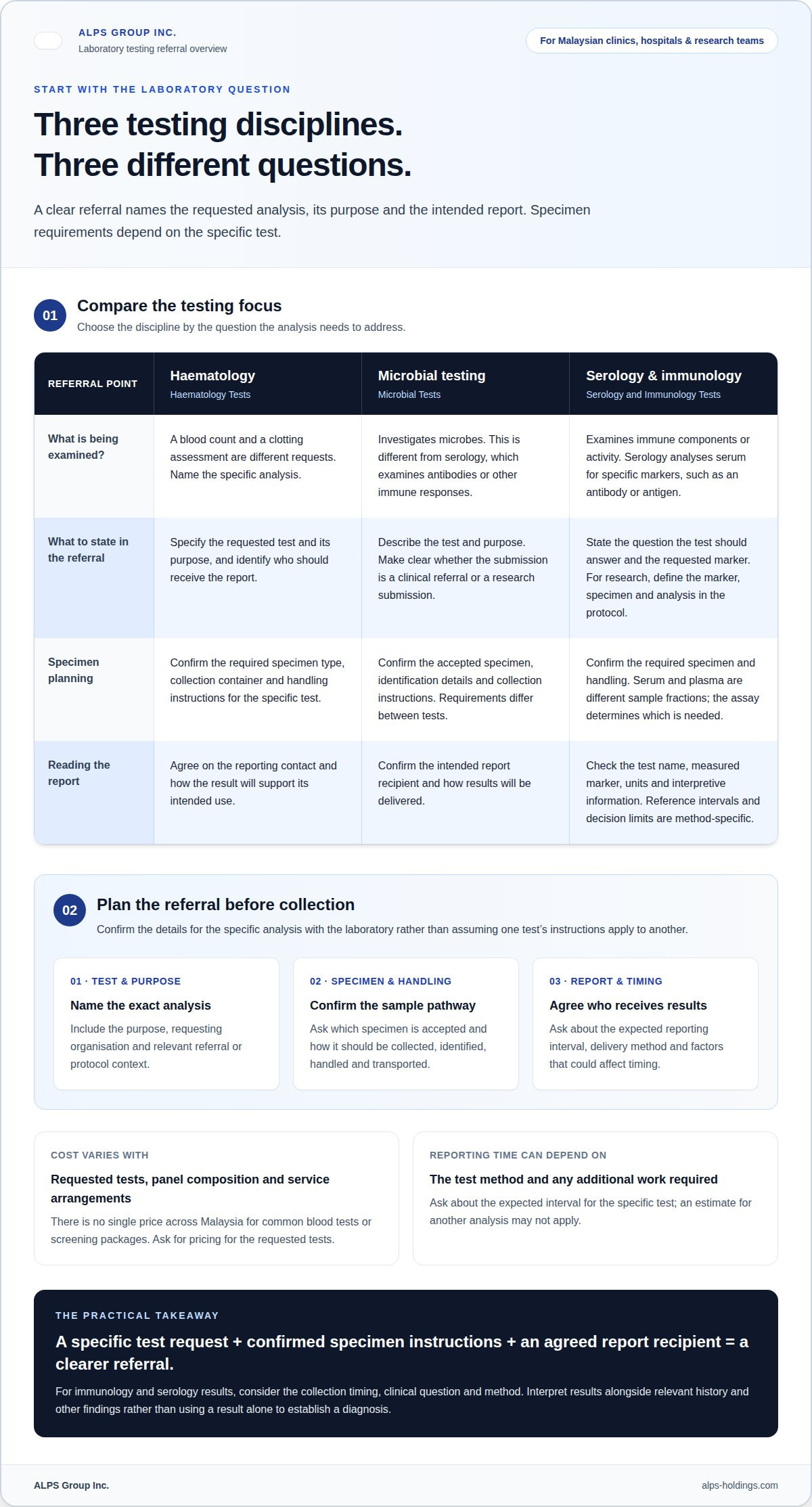
A referral for haematology or coagulation testing should identify the requested analysis and its purpose. Clear test details help the laboratory establish which specimen and handling instructions apply. For example, a blood count and a clotting assessment are different requests, so name the specific test.
Collection instructions are specific to the test. Follow the laboratory’s requirements for specimen type, collection container and handling rather than assuming that all blood tests use the same process. Confirm specimen handling requirements with the laboratory before collection.
Insurance coverage for private laboratory tests depends on the policy terms and how testing is arranged. A test category alone does not establish whether a particular expense is covered. Review the relevant policy provisions and referral requirements before relying on reimbursement.
There is no single price for common blood tests or screening packages across Malaysia. Costs depend on the requested tests, panel composition and service arrangements. Ask the laboratory how to obtain pricing for the requested tests.
Home collection and nationwide service depend on the provider’s arrangements for the requested test. Specimen type, collection location and transport needs affect whether a collection pathway is suitable. Establish these details during referral planning instead of assuming them from a general service description.
For clinics and research teams, record the requested tests, purpose and reporting contact in the referral information. The medical laboratory service is relevant when arranging laboratory testing; the specimen requirements and reporting process should align with the specific request.
Medical microbiology and serology
For a referral involving microbial testing or serology, start with the specific test and its purpose. These categories are not interchangeable. Clinics, hospitals and research teams should describe the question the analysis needs to address, then align the request with the laboratory’s test description and reporting requirements. A clear request also distinguishes a clinical referral from a research submission.
Before submitting a specimen, establish the requirements for the specific analysis. Confirm which specimen is accepted, how it should be identified and whether the laboratory provides collection instructions. Specimen and handling requirements depend on the test. Do not assume instructions for one microbial or serology test apply to another; record the laboratory’s guidance with the referral.
Booking information can include the test name, requesting organisation, relevant referral details and intended report recipient. For research work, include the protocol context needed to describe the specimen and requested analysis. Agree on how the laboratory will receive the request and specimen, and what information should accompany them. This preparation gives the laboratory a clear basis for processing the submission.
Discuss result timing for the specific test. Ask about the expected reporting interval, how results will be delivered and what factors could affect timing. The method and any additional work required can influence the reporting plan, so an estimate for another analysis may not apply. For recurring referrals, agree on a consistent communication route and identify who will receive the report.
Before submitting identifiable information, clarify how referral details and report access are handled. Confirm the named recipient and result-delivery method, particularly when several clinical or research contacts are involved. These questions help teams plan communication without making assumptions about privacy procedures. A defined test request, agreed specimen pathway and clear reporting contact provide a practical foundation for a microbiology or serology referral.
Immunology and serology
Immunology testing examines components or activity of the immune system. Serology is a related laboratory discipline that analyses serum, the liquid portion of blood, for specific markers. For example, an assay can measure an antibody, a protein produced by the immune system, or an antigen, a substance recognised by immune defences. The requested marker determines the test’s purpose.
These methods answer different questions. An antibody result concerns an immune response, while an antigen result concerns a target substance in the specimen. Depending on the requested analysis, immunology testing can also examine immune proteins or other components. A report should identify what the assay measures, rather than treating every result as a general measure of immune health.
Interpretation requires context. The timing of specimen collection, the clinical question and the method used can all affect what a result means. Consider a result alongside relevant history and other findings, rather than using it alone to establish a diagnosis. For research projects, define the marker, specimen and intended analysis in the protocol before submitting samples.
For a referral, specify the question the test needs to answer and the requested marker. The laboratory can then advise on the required specimen, collection tube, handling conditions and transport process. Serum and plasma are different sample fractions, so the correct type depends on the assay. Preparation instructions also vary by test; there is no universal fasting or collection rule for all immunology work.
Review the report for the test name, measured marker, result units and any interpretive information supplied. Reference intervals and decision limits are method-specific, so results from different assays are not automatically interchangeable. If a finding does not align with the clinical picture, the requesting professional can consider the method, specimen quality and need for further assessment. Clear referral details help the laboratory return results in a form suited to clinical or research interpretation.
Which medical labs and diagnostic providers operate in Malaysia?
Malaysia’s testing landscape includes hospital laboratories, private diagnostic laboratories, specialist facilities and research laboratories, each with different roles. A hospital laboratory may support care within its hospital, while a private diagnostic laboratory may accept external referrals. Specialist facilities focus on defined testing disciplines. Research laboratories analyse specimens for research questions, which differ from routine clinical testing.
Match the provider’s scope to the requested analysis. A full blood count, microbial test and whole genome analysis require different methods and workflows. Confirm that the laboratory accepts the referral type and specimen, then clarify collection requirements, transport conditions and report format. When comparing medical lab test services in Malaysia, remember that a general service description does not establish that every test is available through every service route.
Accreditation and licensing describe different aspects of laboratory oversight. For a specific test, establish which status applies, who issued it and whether its scope covers the relevant method. A certificate’s title alone may not show that a particular analysis falls within its scope. Ask how the laboratory identifies the test method and communicates limitations in its report.
For clinics, hospitals and research teams, a useful referral discussion covers:
- Purpose: State the clinical or research question and the result needed.
- Specimen: Confirm the sample type, collection container and handling instructions.
- Reporting: Agree who receives the report and what interpretation information is provided.
- Workflow: Clarify transport arrangements and the factors affecting result timing.
These points help distinguish routine diagnostic services from specialist or research workflows. For example, a research protocol may specify analysis requirements that differ from an individual clinical referral. The laboratory’s method, specimen acceptance criteria and reporting process should align with the intended use.
Laboratories in Malaysia serve different referral needs, so their services are not interchangeable. When assessing medical lab test services in Malaysia, match the provider’s scope to the requested test, specimen pathway and reporting requirements. For whole genome sequencing, the service description should explain the analysis offered and the report’s intended context. Clear alignment supports an informed laboratory referral.
ALPS Group: mRNA Testing
ALPS Group Inc. provides mRNA Testing for organisations requiring molecular analysis. Messenger RNA, or mRNA, carries gene-expression information that can be measured through suitable laboratory methods. The intended question and study context guide whether this testing is appropriate; results should be interpreted in context and do not independently establish a diagnosis.
Clinics, hospitals and research organisations can consider this service when their project calls for mRNA analysis. ALPS Group Inc. also provides gene expression profiling with mRNA testing, alongside Whole Genome Sequencing and Biochemistry, Serology & Immunology Tests. These are distinct testing approaches, so the requested analysis should match the sample and purpose.
For service suitability, sample requirements or a quotation, contact ALPS Group Inc..
Plan the next testing decision with confidence
Start by defining what the result needs to support, whether a clinical referral, research protocol or broader testing plan. This purpose helps shape the requested analysis and gives the laboratory a clear basis for discussing specimen requirements, reporting and suitability. For teams assessing medical lab test services in Malaysia, a well-defined request can make the referral process more focused.
ALPS Group offers Whole Genome Sequencing, mRNA Testing, and Biochemistry, Serology & Immunology Tests. These distinct services address different testing needs, so let the intended question guide the discussion about a suitable option. Aligning the request with the testing approach is a practical starting point for informed planning.
Contact ALPS Group about testing to discuss your requirements. A considered referral can help your team take the next step with clarity.
Frequently Asked Questions
What medical laboratory tests are commonly available in Malaysia?
Common laboratory testing categories include haematology, biochemistry, serology, immunology and microbial testing. Molecular services can include mRNA Testing and Whole Genome Sequencing. The specific menu varies between laboratories, and a broad category name does not establish that every analysis is available. For example, a clinic planning a referral should identify the particular test and intended use rather than rely on a general service label.
Can Malaysians get lab tests without a doctor's referral?
Whether testing can be arranged without a doctor’s referral depends on the laboratory’s intake process and the specific test. A referral may also provide clinical context to frame testing and interpretation. Establish what information the laboratory requires for the requested analysis before making arrangements. For research submissions, provide the study purpose and relevant protocol details so the service can be assessed against the project’s needs.


