
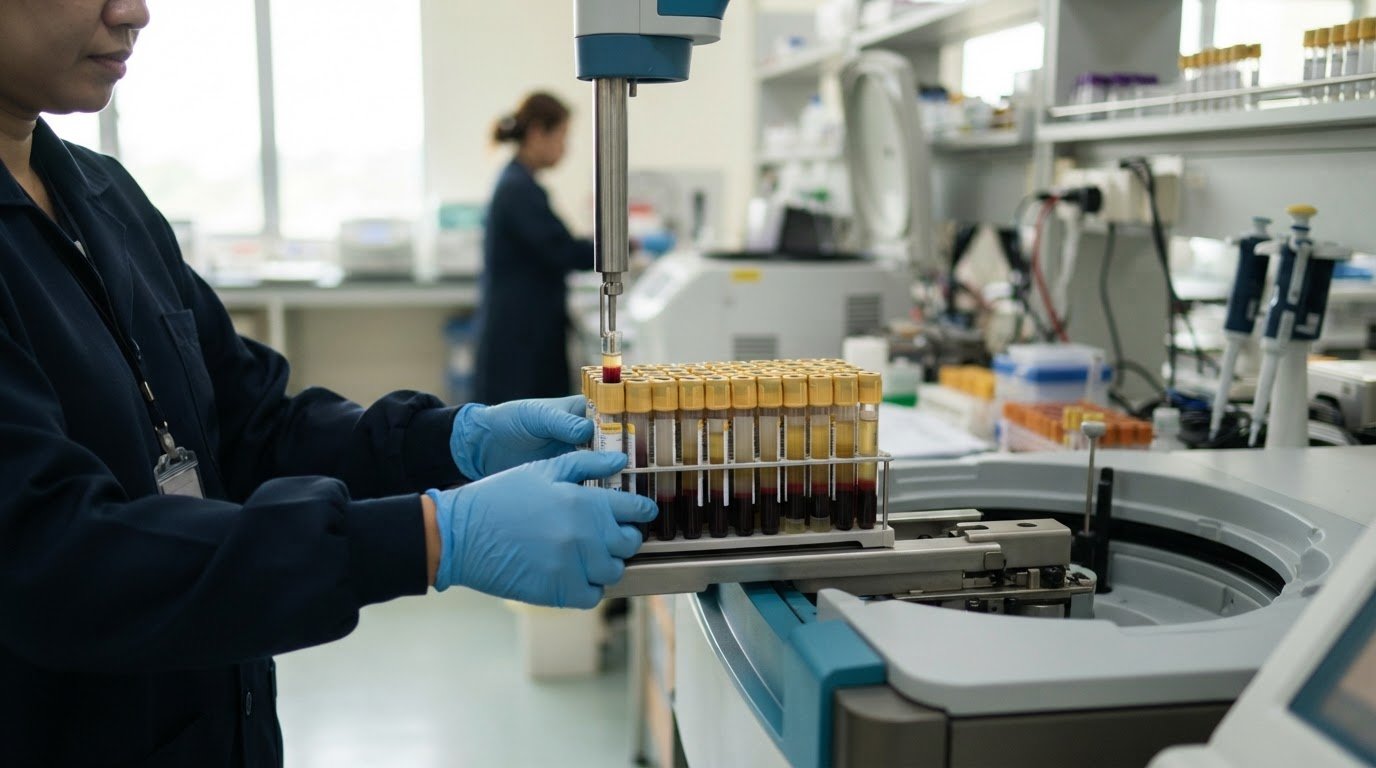
A nearby collection centre is not, by itself, a measure of laboratory quality. For clinics, hospitals and research organisations choosing a blood test laboratory in Malaysia, the relevant considerations include whether the laboratory performs the required test, how samples are handled and what quality standards support its processes.
When choosing a blood test laboratory in Malaysia, consider test suitability, laboratory quality standards and reporting arrangements, alongside distance and convenience. This guide explains common testing categories and practical points for clinics, hospitals and research organisations evaluating laboratory services. A quality standard supports confidence in processes, but it does not guarantee a particular result.
You’ll also learn how to assess laboratory and collection-centre locations in Malaysia, what information can help the laboratory process a referral, and which factors may affect cost and turnaround time. The aim is a practical basis for matching a testing need with an appropriate service and understanding the role that laboratory quality systems play.
Key Takeaways
- Match the requested laboratory test to the clinical, screening or research purpose, and provide clear referral information to support appropriate processing.
- Assess how sample handling, reporting and quality processes contribute to confidence in results; accreditation supports quality systems but does not guarantee a particular outcome.
- Consider collection-centre access alongside the practical factors that influence turnaround time and cost, such as the test and sample requirements.
- For molecular testing needs, explore whether ALPS Group’s mRNA Testing or other relevant laboratory services suit the intended work.
Laboratory services and diagnostic testing
Laboratories process routine panels and specialised investigations according to the test requested and its specimen requirements. The clinical or research purpose helps determine which laboratory service is appropriate.
Routine and Specialised Testing
Routine testing covers commonly requested blood investigations, while specialised testing addresses narrower questions using specific methods. Referral details should identify the requested test and relevant context. The World Health Organization identifies tuberculosis as an infection caused by bacteria in the Mycobacterium tuberculosis complex. Mycobacteriology testing examines mycobacteria, so the investigation and specimen must suit the clinical question. For molecular work, mRNA testing concerns gene-expression analysis rather than a routine blood panel.
Biochemistry, Haematology, Allergy and Autoimmune Tests
MedlinePlus describes blood tests as analyses of blood components that can help assess health. Biochemistry tests measure substances in blood, while haematology tests examine blood cells and related components. Allergy assessment can include tests for responses to particular allergens; the US National Institute of Allergy and Infectious Diseases emphasises that diagnosis also considers clinical history. Autoimmune investigations assess immune-related markers, but a result needs interpretation alongside the clinical picture. The requested test should match the question being investigated.
Private Laboratory Test Costs
Laboratory charges vary according to the test or panel, specimen requirements and processing needs. There is no single price for every investigation. Request a quotation for the specific work planned.
Public healthcare services can arrange blood testing through government clinics and hospitals. The amount payable depends on the service pathway and investigation, so costs differ. In any setting, clarify the requested test, collection arrangements and preparation instructions through the relevant clinic or laboratory.
Screening provider history and scale
A provider’s history is useful when it demonstrates continuity in screening and documented processes. For Malaysian clinics, hospitals and research organisations, consider the laboratory’s test scope, sample pathway and reporting arrangements. These operational details indicate whether its work fits a referral programme. A trusted partner should explain the scope and limits of each screening service, including how requests are handled and results communicated.
Consider a provider’s workflow in relation to the work planned. A laboratory handling varied requests may operate differently from one focused on a narrower screening programme; size alone does not establish suitability. Assess the test purpose and reporting needs, and distinguish screening requests from investigations intended to assess a specific clinical concern.
Allergy Screening
Allergy screening should relate to the suspected allergen and clinical history. Allergy tests, including skin or blood tests, are interpreted alongside a person’s history; a positive result alone does not establish clinical allergy. For example, a referral concerning a suspected food trigger should state the concern so findings can be considered in context.
Genetic Screening
Genetic screening examines genetic material for a defined purpose. Genetic tests analyse changes in genes, chromosomes or proteins. Screening and diagnostic testing serve different purposes: screening may identify a reason for further assessment, while diagnostic testing addresses a specific clinical question. Results should not be treated as predicting every condition or guaranteeing a diagnosis.
For programme planning, define the intended population, referral pathway and reporting needs before selecting a test. Then align each request with its purpose and interpretation process. These steps make comparisons more useful than provider history or scale alone. Discuss screening requirements for clinical or research work.
Centre locations and contact details
A centre’s address matters because blood collection and laboratory processing may happen at different sites. Before travelling, identify the location for collection, not only the laboratory’s administrative address. For example, a hospital may collect a specimen and arrange its onward processing. Confirm the building, department, appointment arrangements and contact channel with the relevant provider.
When arranging a blood test in Malaysia, use the provider’s published booking channel or contact the referring clinic or hospital. Provide the requested test name and referral details, then confirm the collection location, appointment requirements and specimen instructions with the provider before attending.
For a clinic or hospital referral, include the patient identifiers required by the laboratory, the requested investigation and a follow-up contact. Confirm whether the sample will be collected at the referring site or a designated centre. This affects transport planning, particularly for specimens with specific handling requirements. Research organisations arranging multiple samples should clarify collection, labelling and delivery responsibilities with the relevant provider before scheduling.
Use the laboratory’s published contact or booking channel to clarify the collection site, appointment arrangements and referral process. Keep the laboratory’s written instructions with the request, especially when a specimen must travel from a clinic to a central facility. Clear procedures make coordination easier for referring teams.
When comparing centre locations, consider the patient’s route, accessibility and collection needs. A centre near a hospital may suit a referral linked to hospital care, while a separate collection site may better fit another appointment. Do not assume every site handles every test. Confirm the location and specimen requirements with the provider for the named investigation, and retain any booking details for coordination with the referring team.
Laboratory accreditation and test accuracy
Accreditation provides a framework for assessing laboratory quality and competence, but its scope matters. The International Organization for Standardization states that ISO 15189 specifies requirements for quality and competence in medical laboratories. According to ALPS Group Inc., its molecular laboratory meets MS ISO 15189:2022 standards. That statement should not be extended to other services or interpreted as a guarantee for an individual result.
Accuracy also depends on the complete testing pathway. The World Health Organization’s laboratory quality management guidance addresses pre-examination, examination and post-examination processes. These include activities before analysis, the test itself and reporting. A referring professional should align the requested method and specimen with the investigation, while the laboratory’s procedures govern its handling and analysis.
A doctor’s referral is not a universal requirement for every blood test. Whether one is needed depends on the test and booking pathway. A clinical referral should identify the investigation and relevant context.
Common blood test packages do not have one universal price. Costs depend on the tests included, specimen requirements and processing. Compare the package contents with the intended investigation, and request a quotation for the specific work.
Preparation instructions vary by test. The laboratory or referring professional should state whether fasting is required and provide any other preparation instructions. Do not assume every blood test requires fasting; follow the directions for the requested investigation.
Blood collection may cause brief discomfort or bruising. The UK National Health Service also lists bleeding and fainting among possible effects of a blood test. Tell the collecting professional about relevant concerns before collection. For clinics and research organisations, reviewing the relevant standard, test scope and reporting arrangements supports a more informed assessment. Discuss laboratory testing requirements and suitable arrangements.
ALPS Group: mRNA Testing
Organisations assessing gene-expression profiling needs can enquire about the availability and suitability of mRNA testing from ALPS Group. mRNA, or messenger RNA, carries instructions used by cells to produce proteins; testing it supports analysis of gene expression. Clinics, hospitals and research teams can align the requested work with the study or referral objective and clarify sample requirements and reporting needs. Gene-expression profiling through mRNA testing is distinct from routine blood screening, and results should be interpreted according to the work’s purpose.
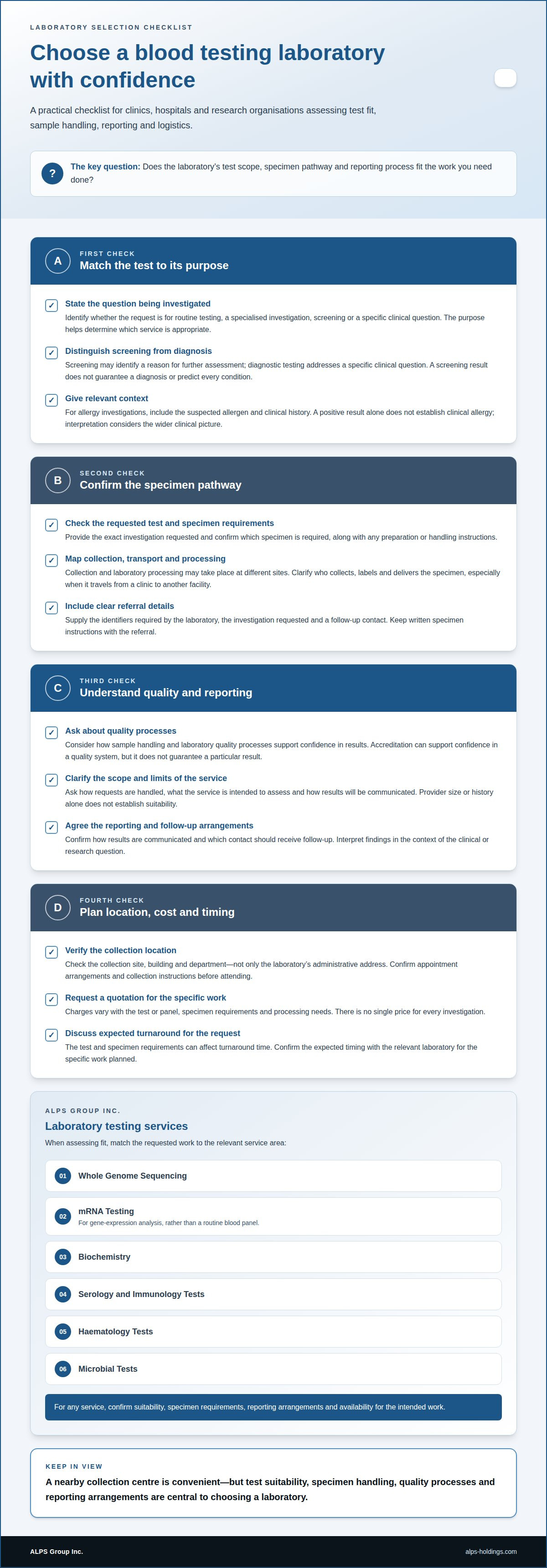
Other relevant laboratory services include Whole Genome Sequencing, Biochemistry, Serology & Immunology Tests, and Microbial Tests. The appropriate option depends on the investigation required, specimen and intended use. For service suitability or a quotation, contact ALPS Group.
Build a clearer path from referral to testing
For Malaysian clinics, hospitals and research teams, define the testing objective and referral workflow before arranging laboratory work. A clear request helps align the investigation, specimen requirements and reporting needs, while supporting communication between the referring team and laboratory. Choosing a blood test laboratory in Malaysia is part of establishing a coherent testing pathway, not simply selecting a collection point.
ALPS Group offers mRNA Testing. Whole Genome Sequencing, Biochemistry, and Serology & Immunology Tests may be available; enquire with ALPS Group to confirm availability. Suitability depends on the work planned. Share the intended purpose and relevant referral details through ALPS Group’s contact page to discuss the appropriate service and next steps.
Contact ALPS Group to discuss your needs and shape a considered approach to laboratory testing.
Frequently Asked Questions
Where can I get a blood test in Malaysia?
Blood testing can be arranged through a private laboratory, hospital or government clinic, depending on the care pathway and requested investigation. When choosing a blood test laboratory in Malaysia, establish where collection takes place and clarify the booking process, referral requirements and specimen instructions before attending.
What blood tests are commonly available at labs in Malaysia?
Laboratory menus vary, but testing categories include biochemistry, haematology, serology and immunology. Some services also cover microbial testing, mRNA testing and Whole Genome Sequencing, which analyses genetic material across the genome. These categories do not mean every laboratory offers every test. For a specific request, use the test name on the referral and establish whether it matches the intended clinical or research purpose.
How long do blood test results take at Malaysian laboratories?
Result timing depends on the test method, specimen requirements and laboratory workflow. A routine investigation and a specialised molecular test can involve different processing steps, so one timeframe cannot represent every request. Ask the laboratory about the expected reporting timeframe for the named test and whether referral details or additional processing could affect when the report is issued.
How can I check whether a medical laboratory in Malaysia is accredited or licensed?
Ask the laboratory for current documentation showing the relevant status, the named entity it covers and the scope of tests or activities included. Match those details to the specific service being considered, rather than relying on a general claim about a group or facility. Accreditation and licensing are distinct; request the appropriate evidence for each and confirm that it applies to the laboratory involved.
How do Malaysian laboratories deliver blood test results, and what reporting information can referring professionals expect?
Reporting arrangements vary between laboratories, so establish the reporting channel and authorised recipients when arranging testing. Clarify what the report includes, such as the test name, results, units, reference information and interpretive comments relevant to the investigation. Also ask how amended reports or results requiring follow-up are communicated, and how the referring team can direct questions.


