

The physical risks of serology and immunology testing come mainly from blood collection and can include soreness, bruising, dizziness, fainting or, less commonly, infection. For Malaysian clinics, hospitals, healthcare professionals and research organisations arranging testing, understanding what an antibody result can and cannot show is as important as knowing what to expect during the blood draw.
When arranging testing, it is useful to understand the procedure and its purpose before a sample is taken. A serology test looks for specific antibodies in blood. These may reflect a response to infection or vaccination, but a result alone cannot always distinguish between the two or show how much protection exists.
This article explains what antibody tests measure, how blood samples are collected and what risks may arise. It also describes how serological and immunological tests can support investigations of infection and immune conditions, and why results need to be interpreted in light of a person’s health and the reason for testing.
Key Takeaways
- Understand what antibody results can indicate, and why they need to be interpreted alongside symptoms and clinical findings.
- Learn about potential blood-draw effects, from temporary soreness or bruising to dizziness or fainting.
- See how different laboratory methods support investigations of infections and immune conditions.
- Identify the information that helps match a testing request to a laboratory service, including ALPS Group’s Serology & Immunology Tests.
What are antibody serology tests?
Serology and immunology testing examines immune markers in blood to help clinicians assess infection, vaccination or autoimmune activity.
What Antibody Tests Detect
Antibody serology tests detect specific antibodies, proteins made by white blood cells after recognising antigens. Antigens are structures on bacteria, viruses and other agents that can trigger an immune response. Results may be positive, negative or an antibody titre, which indicates antibody level. This helps clinicians assess a defined finding rather than treat one result as a complete diagnosis.
Antibodies can take a few weeks to develop after exposure or vaccination. A positive result alone cannot establish whether they followed a current infection, a past infection or vaccination. Detection also does not prove full protection or show how long it may last.
Antibodies Linked to Conditions
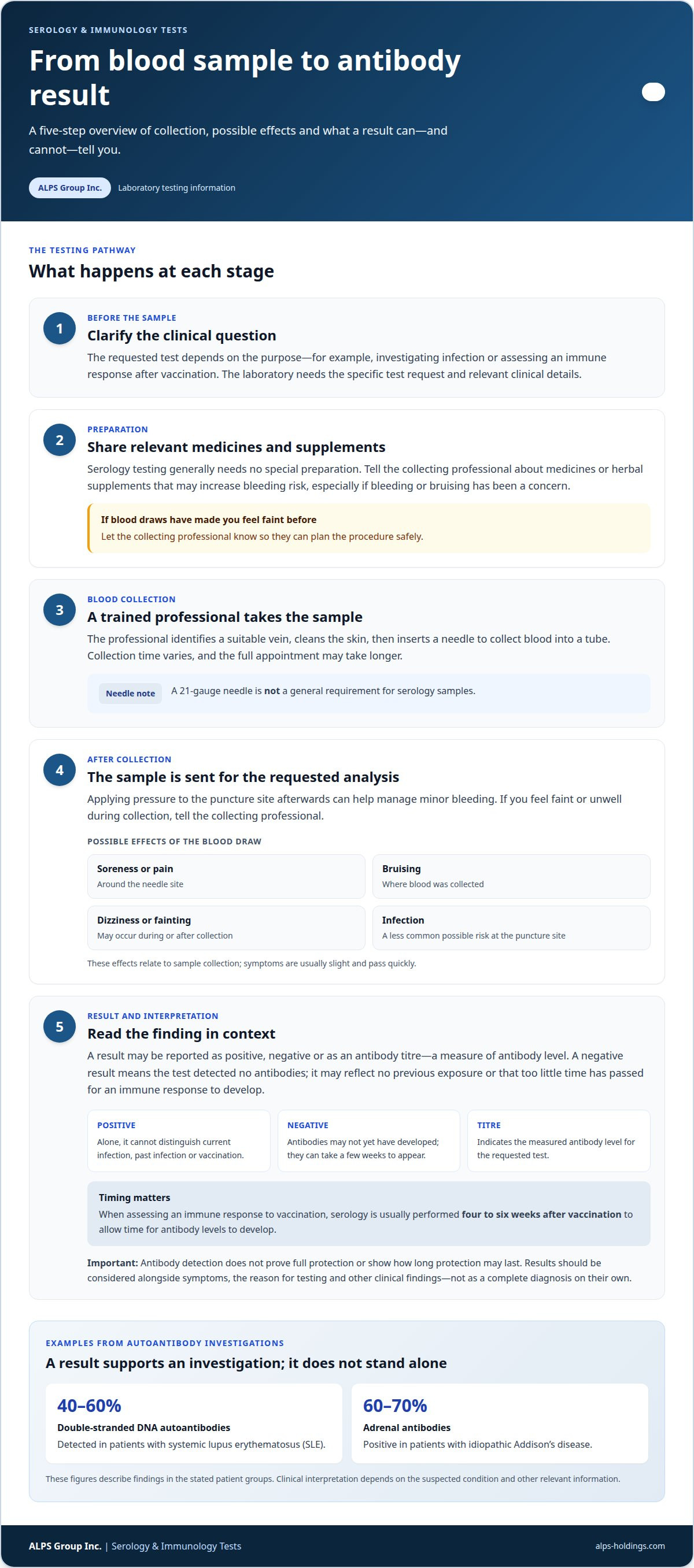
Autoantibodies are antibodies that mistakenly target healthy cells. In suspected connective tissue disorders, antinuclear antibodies (ANA) are relevant to systemic lupus erythematosus (SLE); their absence almost excludes SLE in that context. Double-stranded DNA autoantibodies are detected in 40-60% of patients with SLE. Antibodies to extractable nuclear antigens can help classify connective tissue disorder subsets and provide prognostic information.
Adrenal antibodies are positive in 60-70% of patients with idiopathic Addison’s disease. These findings help frame an investigation, but results require interpretation alongside clinical information.
Antibodies After Infection or Vaccination
Endogenous antibody testing assesses antibodies produced by a person’s own immune system, including responses following infection or vaccination. In clinical practice, serology and immunology testing may detect IgM or IgG antibodies to viruses, bacteria or fungi. Clinicians may use results to investigate exposure or assess vaccine-related immune responses; these tests do not establish complete protection.
When assessing an immune response to vaccination, serology is usually performed four to six weeks after vaccination. This allows time for antibody levels to develop before measurement. The specific test determines which antibodies the laboratory evaluates.
Are there any risks to this test?
Serology involves two distinct considerations: blood collection and interpretation of the findings. A needle draw can cause soreness or pain, bruising, dizziness, light-headedness or fainting. Infection at the puncture site is also a potential risk. Symptoms after a blood test are usually slight and pass quickly. These effects relate to collecting the sample, not to antibodies circulating in the blood.
When arranging collection, professionals should check whether medicines or herbal supplements may increase bleeding risk. During the draw, a needle enters a vein to collect blood; applying pressure to the site afterwards can help manage minor bleeding. If a person has felt faint during blood collection before, the collecting professional should be informed so they can manage the procedure safely.
Autoantibody tests look for proteins that mistakenly target healthy cells. Their findings may support clinical assessment, but the relevance depends on the clinical question and the tests requested. Results need to be considered alongside symptoms and other clinical findings: a laboratory result alone does not establish a complete diagnosis.
Interpretation matters because an antibody signal is not always specific to one disease. Positive results may occur in different clinical contexts, reducing the specificity of a finding. Clinicians consider the suspected condition, symptoms and other test findings before deciding what a result means. This helps avoid treating a single positive result as proof of one cause.
For a clinical request, the purpose of testing should be clear before sample collection. Discuss test requirements and suitability with the laboratory team when planning a referral or investigation.
How laboratories collect blood samples for serology tests
A serology blood test uses a blood sample to detect or measure antibodies. The appropriate test depends on the clinical purpose, such as investigating infection or assessing an immune response after vaccination. The laboratory needs the requested test and relevant clinical details to process the sample and interpret the result appropriately.
During collection, a trained professional identifies a suitable vein, cleans the skin and inserts a needle to draw blood into a collection tube. A 21-gauge needle is not a general requirement for serology samples. Collection time varies, and the full appointment may take longer.
Serology testing generally requires no special preparation. However, some medicines and herbal supplements can increase bleeding risk. Before the blood draw, ask about any relevant use, particularly if bleeding or bruising has been a concern. This helps the collecting professional plan the collection safely.
Possible effects include soreness, pain or bruising where the needle entered. Dizziness, light-headedness or fainting can also occur, and infection is another potential risk. Symptoms are usually temporary. If a person feels faint or unwell during collection, the collecting professional should be informed so they can respond while obtaining the sample.
After collection, the sample is sent for the requested laboratory analysis. Results may be reported as positive, negative or as an antibody titre, which expresses antibody level. A negative result means the test detected no antibodies; this may reflect no previous exposure or too little time for an immune response to develop. Antibodies, for example, may take a few weeks to appear after infection or vaccination. Clinicians consider this timing alongside symptoms and other findings when interpreting the result.
For referrals involving infection, vaccination or immune disorders, clear test requests and clinical context help the laboratory process the appropriate sample. Discuss sample requirements and testing suitability before arranging a referral.
Serological tests and their diagnostic uses
Serological methods support investigations of infection and immune-system activity. Their diagnostic value depends on the method, target and clinical context.
Common Tests and What They Measure
Serological tests measure specific antibodies or antigens in blood using methods such as ELISA, agglutination, neutralisation and Western blot. ELISA can measure antibody levels, while agglutination produces visible clusters when antibodies bind to particulate antigens. These methods investigate specific targets and immune responses, but each test examines a defined target rather than providing a general assessment of health.
Immunology testing also examines components of the immune system. The tests available depend on the laboratory’s confirmed services and the requested test.
Test Accuracy and Result Errors
Accuracy depends on the test target, timing and the person’s immune response. A positive result shows that the target was detected, but does not always establish its cause. Results need to be interpreted in the relevant clinical context. Testing early can also produce a negative result before antibodies develop; antibody production can take a few weeks after exposure.
Results therefore need to be interpreted alongside symptoms and other findings. The appropriate test and interpretation depend on the clinical question rather than a single result.
Some tests assess a cellular immune response rather than detecting antibodies. Ask the laboratory whether a test for a particular purpose is available and suitable.
In Malaysia, referral and appointment arrangements depend on the facility and requested test. The facility handling the request can explain its process before the appointment.
Blood sampling can cause temporary pain, bruising, dizziness or fainting; infection at the needle site is also a potential risk. Some medicines and herbal supplements can increase bleeding risk, so share relevant information before collection.
For test selection or referral planning, discuss testing requirements with the laboratory team.
ALPS Group: mRNA Testing
ALPS Group offers Biochemistry, Serology & Immunology Tests, alongside mRNA Testing, Whole Genome Sequencing and Microbial Tests for distinct laboratory testing requirements. For research or testing projects involving messenger RNA, mRNA Testing may be relevant; antibody analysis calls for a different testing approach. The project question should guide test selection.
For clinics, hospitals and research organisations, the appropriate service depends on the question being investigated and the type of result required. A discussion of the project aims and testing requirements can help establish whether mRNA testing is relevant to the work.
Contact ALPS Group to discuss testing requirements or request a quotation.
Make the next testing decision with clarity
A well-framed laboratory request starts with the decision the result needs to support. For Malaysian clinical and research teams, defining the question, intended use of the result and reporting needs can help align test selection with the work ahead. The appropriate approach may involve serology and immunology testing or another molecular or laboratory test.
ALPS Group offers Whole Genome Sequencing, mRNA Testing, and Biochemistry, Serology & Immunology Tests. These services address distinct testing requirements, so the project’s purpose should guide the discussion. Clear information about the requested analysis and sample helps establish relevant next steps.
Bring your testing requirements or referral question to the conversation, and the laboratory team can discuss the appropriate service and quotation. Contact ALPS Group to discuss your needs and move your testing plans forward with greater clarity.
Frequently Asked Questions
Will I need to do anything to prepare for this test?
Most antibody tests require no special preparation, but tell the healthcare professional about medicines and herbal supplements before the blood draw, as some can increase bleeding risk. If you take a medicine that affects clotting, sharing this information helps the collection professional plan appropriately. Follow any test-specific instructions provided for your appointment, since preparation can differ between laboratory investigations.
If the serological results are abnormal, what are the next steps?
An abnormal result may lead to repeat serology, additional tests or treatment, depending on the finding and clinical context. For example, a reactive screening result may need further laboratory assessment before a diagnosis is made. The healthcare professional considers the reason for testing, symptoms and other results when deciding what to do next. For patients seeking private medical guidance, services like GP Plus offer general practitioner consultations to evaluate abnormal findings and coordinate next steps. Keep the report available for that discussion, including any reference information it provides.
What are they used for?
Serology tests investigate immune responses to infections and can support assessment of some autoimmune diseases. Examples include tests for antibodies related to hepatitis, HIV, measles or rubella, and autoantibody assessment when lupus or rheumatoid arthritis is suspected. A clinician selects a test according to the question, such as whether there is evidence of previous exposure or an immune response associated with vaccination.
What do the results mean?
Results may be qualitative, quantitative or semi-quantitative, depending on the method. A qualitative report may state positive or negative, while a quantitative result gives a measured level. A semi-quantitative result indicates an estimated range or category. The report format and test target matter: a positive result means the measured target was detected, not necessarily that a particular disease is active.
What is a serological test?
A serological test analyses serum, the liquid portion of blood, for a specified antibody or antigen. The laboratory uses a method suited to that target, such as ELISA or agglutination. For instance, an antibody assay can examine an immune response to a named pathogen. The requested target defines the test’s purpose, so different serology tests answer different clinical questions.
When should I know the results?
Serological results are generally available within a few days, although timing depends on the specific test and laboratory workflow. Additional analysis or interpretation may affect when a report is issued. The laboratory or requesting healthcare professional can provide the expected timeframe for the test ordered. If several tests are requested, their results may not all be reported together.


