

A blood count is a starting point, not a diagnosis. Haematology blood analysis in Malaysia commonly begins with a full blood count, which measures red and white blood cells, platelets, haemoglobin, haematocrit and the white cell differential. These results can identify patterns that may warrant further assessment. The reference interval on the laboratory report helps healthcare professionals interpret individual results in context.
This article explains how blood tests can support the assessment of haematological conditions, what haemoglobin and haematocrit indicate, and how inherited disorders and blood cancers are investigated. It also covers reference intervals, why results need to be interpreted in context, and what clinics and healthcare professionals should consider when arranging laboratory testing.
Key Takeaways
- Understand which blood cell measures a full blood count examines and how additional tests can help investigate abnormal findings.
- Learn what haemoglobin and haematocrit reveal about red blood cells, while recognising that results need clinical context.
- Use Malaysian reference ranges as an interpretive guide, taking account of factors such as age and sex rather than treating a range as a diagnosis.
- Assess testing arrangements by considering sample requirements, reporting and turnaround factors, and explore ALPS Group’s Haematology Tests for laboratory testing needs.
How are haematology conditions screened & diagnosed?
Haematology screening combines blood counts with targeted tests selected according to symptoms, history and initial findings. Laboratory results support diagnostic assessment, but do not establish every condition on their own.
Diagnostic Laboratory Testing
A full blood count, blood smear and iron studies examine different aspects of blood. A smear shows the size, shape, number and appearance of cells, while iron studies assess circulating and stored iron. Prothrombin time and activated partial thromboplastin time assess clotting. Clinical chemistry tests examine substances in blood and add information about general biochemical status. A bone marrow biopsy analyses extracted marrow cells when further investigation is needed.
Full Blood Count Testing
A full blood count measures red cells, white cells, platelets, haemoglobin and haematocrit, alongside a white cell differential. White cells help fight infection; platelets support clot formation. The differential separates white cell types, helping clinicians interpret an unusual total count. A low white cell count is called leukopenia; a low platelet count is thrombocytopenia. Review of the pattern, symptoms and medical history informs whether further tests are appropriate. Full blood count testing provides this central set of measurements.
Referral and Testing Locations
In Malaysia, testing may be arranged through public hospitals, private laboratories or a treating clinic. Referral requirements depend on the facility and how testing is organised. The ordering clinician or laboratory can explain its intake process. Result timing also varies by test and laboratory workflow, as routine counts and specialised investigations follow different processes. Healthcare teams can confirm with the collection service whether blood collection may cause brief discomfort, bruising or light-headedness, and what support is available if complications arise.
Fasting and Test Preparation
Most blood tests do not require fasting unless specific instructions are given. A full blood count alone generally does not require fasting, while combined testing may involve different preparation instructions. Healthcare teams should confirm requirements for the complete test order with the laboratory rather than assuming every sample has the same requirements. They can also confirm whether medicines or supplements need to be reported and whether previous difficulty with blood collection affects arrangements. Collection staff can advise on pressure at the puncture site after sampling and any considerations for people taking blood-thinning medication.
Haemoglobin and haematocrit
Haemoglobin is the protein in red blood cells that carries oxygen. The World Health Organization uses haemoglobin concentration as a key measure when assessing anaemia, while noting that interpretation depends on relevant population characteristics. A result is an important measurement, not a complete explanation of why it is low or high. Clinicians interpret it alongside the rest of the blood count and the patient’s clinical context.
Haematocrit describes the proportion of blood volume made up of red blood cells. MedlinePlus explains that it should be interpreted alongside other blood count measurements, not in isolation. Reviewing haemoglobin and haematocrit together can show whether red cell measurements follow a consistent pattern. Differences between the results may prompt a review of the full report and the circumstances of collection.
Reference intervals are specific to the laboratory and can vary with the population and method used. The Malaysian adult ranges covered in this article provide context, but each result should be compared with the interval printed on its own report. A clinician also considers factors such as age, sex, medical history and symptoms. A value outside the stated interval may guide further assessment, but does not confirm a condition on its own.
Anaemia involves low red blood cells or haemoglobin. The World Health Organization recognises anaemia as a health condition requiring assessment of its underlying cause. Possible causes include iron, vitamin B12 or folate deficiency, while thalassaemia is an inherited disorder affecting haemoglobin production. These conditions require different investigations. A haemoglobin result alone cannot distinguish them, so clinical assessment may consider other blood count findings and targeted investigations.
For healthcare teams, the practical approach is to review the report as a whole and relate each measurement to the clinical question. Haemoglobin and haematocrit provide complementary information, but neither identifies a cause independently. If findings raise concern, the next investigation depends on the pattern, history and purpose of testing. This measured interpretation supports appropriate follow-up without treating a reference interval as a diagnosis.
Healthy Malaysian haematology reference ranges
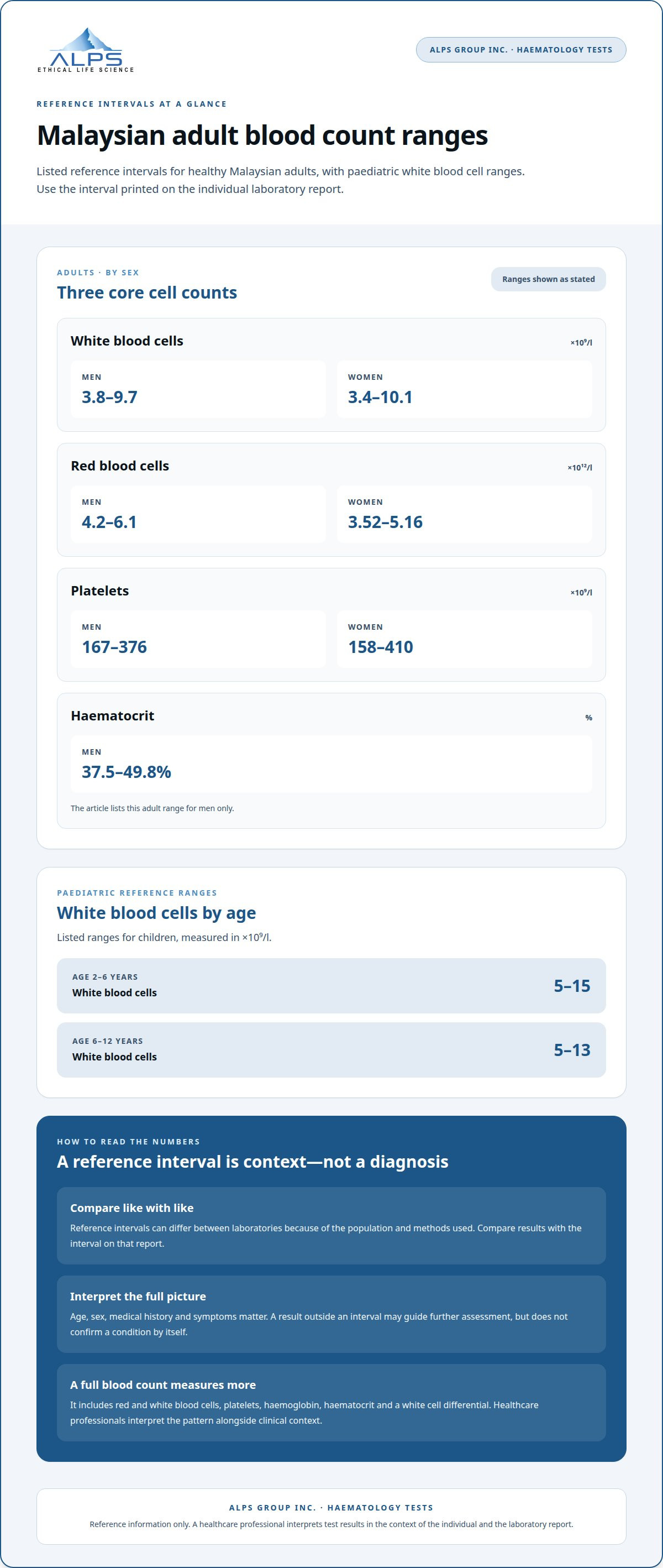
Reference intervals provide context for interpreting laboratory results; they are not diagnoses. The Clinical and Laboratory Standards Institute (CLSI) describes reference intervals as dependent on the population and laboratory methods used. Compare a result with the interval on its own report, rather than assuming a range from another laboratory is interchangeable.
Listed ranges for healthy Malaysian adults include:
- White blood cells: 3.8-9.7 ×10⁹/l for men and 3.4-10.1 ×10⁹/l for women.
- Red blood cells: 4.2-6.1 ×10¹²/l for men and 3.52-5.16 ×10¹²/l for women.
- Platelets: 167-376 ×10⁹/l for men and 158-410 ×10⁹/l for women.
- Haematocrit: 37.5-49.8% for men.
Age matters when interpreting paediatric results. Listed white blood cell ranges are 5-15 ×10⁹/l for children aged 2-6 years, and 5-13 ×10⁹/l for children aged 6-12 years. The World Health Organization’s guidance on haemoglobin assessment also emphasises relevant population characteristics. A clinician considers the person’s age and clinical context, alongside the interval supplied by the testing laboratory.
Coagulation results use separate measures and units. The listed activated partial thromboplastin time range is 30.0-45.8 seconds, with a correction value of less than 5 seconds. Coagulation reference intervals can vary, so interpret each result using the interval supplied by the testing laboratory. Clauss-method fibrinogen is listed as 2.32-4.44 g/l. Interpret each against its test-specific interval and method.
For clinics and other organisations arranging testing, confirm the requested investigation, referral pathway and associated charges with the relevant laboratory. For clinicians, the practical takeaway is to use the report’s own intervals and consider the patient’s context before deciding on follow-up.
Where can I get haematology blood tests in Malaysia, including public hospitals and private labs?
Haematology testing can be arranged through a public-hospital pathway or a private laboratory. The appropriate route depends on the requested investigation, how the sample is collected and where results need to go. Start by identifying the test name and the organisation responsible for reviewing the report. This gives the enquiry a clear purpose and helps establish the relevant intake process.
For a public-hospital pathway, direct the enquiry to the hospital service coordinating the patient’s care. Ask where collection takes place, how the request is recorded and how the report reaches the treating team. Procedures differ between facilities, so do not assume one hospital’s referral or collection process applies elsewhere. A clinician’s request, when available, can help the service identify the intended investigation.
For a private laboratory pathway, clarify how it receives requests and arranges sample collection. Confirm the requested test name, the report recipient and whether the intended investigation is included in the request. These details help distinguish a routine full blood count from a request that requires additional analysis. For organisational enquiries, also establish how results are delivered and which contact handles follow-up questions.
Before collection, establish the laboratory’s current specimen instructions, including the required container, identification details, transport arrangements and sample acceptance criteria. These requirements are specific to the facility handling the test. Confirming them in advance supports coordination between the requesting service, collection point and testing laboratory, without relying on another facility’s procedures.
Turnaround and charges depend on the requested work and service arrangement; confirm both with the relevant laboratory. A concise enquiry can state the investigation, collection context and reporting needs. For Malaysian healthcare and research organisations planning haematology testing, discuss testing arrangements as a practical next step.
ALPS Group: Haematology Tests
ALPS Group Inc. provides Haematology Tests for Malaysian clinics, hospitals, healthcare professionals and research organisations requiring laboratory testing. The service is relevant when a care or research workflow calls for haematology analysis. The requested investigation and reporting needs guide the discussion.
For a referral or testing enquiry, provide the requested test details and relevant sample information. This helps clarify the intended analysis and the arrangements needed for the work. Where broader investigation is relevant, ALPS Group Inc. also offers Whole Genome Sequencing, mRNA Testing, and Biochemistry, Serology & Immunology Tests. These are distinct testing services, selected according to the question being addressed.
To discuss haematology testing arrangements, contact ALPS Group Inc..
Plan the next step for your testing needs
Build the next step around the decision your team needs testing to inform. For Malaysian clinics, hospitals and research organisations, a clear request identifies the investigation, the intended use of results and reporting requirements. This gives laboratory discussions a practical focus, from sample planning to the information needed for interpretation.
ALPS Group Inc. offers Haematology Tests alongside Whole Genome Sequencing, mRNA Testing, and Biochemistry, Serology & Immunology Tests. These services address distinct testing needs. Choose a pathway based on the clinical or research question, rather than assuming one analysis will answer every question.
Planning haematology blood analysis in Malaysia means aligning the requested test with its purpose and the decisions it will inform. A structured enquiry can help establish relevant testing arrangements for your organisation. Discuss your testing requirements with ALPS Group Inc., and take a considered next step towards purposeful laboratory work.
Frequently Asked Questions
Need Help With Your Laboratory Test?
ALPS Group Inc. offers Haematology Tests for healthcare and research organisations. To make an enquiry useful, include the requested investigation, its intended purpose and any reporting requirements. If a clinician has supplied a test request, include the test name as written. Contact ALPS Group Inc. about laboratory testing to discuss your enquiry and the appropriate next step.
Which haematology investigations are relevant to our clinical or research requirements?
The appropriate investigation depends on the clinical or research question. Haematology tests can support the assessment of blood cell measurements and other specified areas of investigation. Share the intended purpose and requested test with the laboratory so it can discuss suitability and service availability. A test result should be considered in its clinical or research context and does not independently establish a diagnosis.
What information should we provide when enquiring about haematology tests in Malaysia?
Include the test requested, its intended purpose and any reporting requirements. If the request relates to a specific investigation, name it clearly. This information helps the laboratory understand the enquiry and discuss whether the requested service is available. Confirm sample requirements and any other submission details with the laboratory before sending samples.
How can our organisation request a quotation for haematology testing?
Request a quotation by providing the requested investigations and relevant service requirements. The cost may depend on the test scope and service arrangement, so confirm which investigations are included and whether additional analysis is requested. ALPS Group Inc. can discuss service availability and provide information relevant to your enquiry.
How should healthcare and research organisations approach haematology test results?
Results should be considered in the context of the intended clinical or research question, rather than as isolated numbers. Confirm the reporting arrangements when enquiring, including any requirements relevant to your organisation. A flagged result may prompt further assessment, but does not independently establish a diagnosis.
How do full blood counts, blood films and specialised haematology tests differ?
A full blood count provides measured cell results; a blood film allows cells to be examined under a microscope. Specialised tests investigate specific questions, such as iron status or clotting function. These tests are complementary, and the appropriate combination depends on the investigation required. Confirm the availability and suitability of specific tests with the laboratory.


