

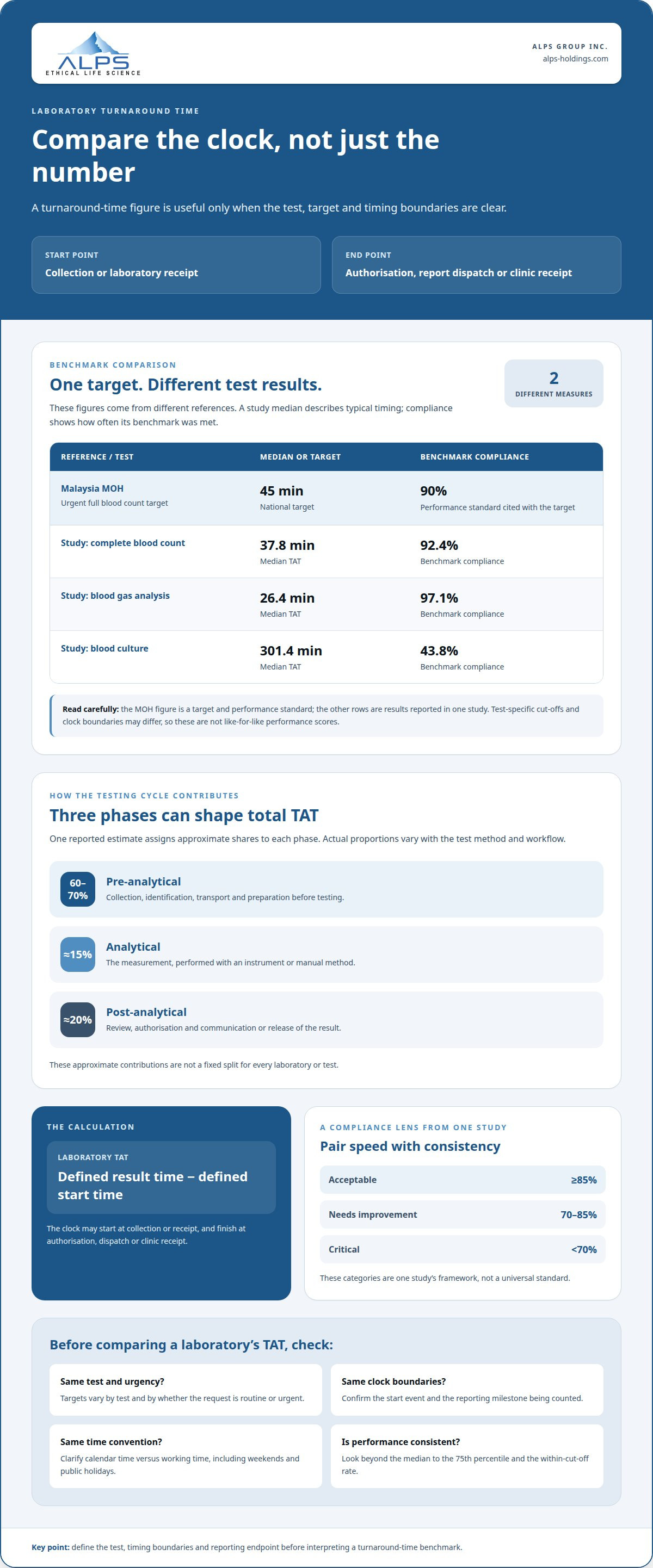
A fast result is meaningful only when the clock starts and stops at clearly defined points. For reference laboratory turnaround time benchmarks in Malaysia, the national target cited for urgent full blood count testing is 45 minutes, with a performance standard of 90%, according to the Ministry of Health Malaysia. Turnaround time is commonly measured from specimen receipt to result reporting, although a local target may define a different start point.
That distinction matters to clinics, hospitals and research teams deciding whether a result will arrive in time to inform care or research. One headline figure cannot describe every test: specimen handling, analysis and result review all shape the total interval.
This article explains how laboratory turnaround time is calculated, which pre-analytical, analytical and post-analytical phases it covers, and how local targets relate to Malaysian benchmarks. It also explains why performance should be interpreted in the context of the test, urgency and measurement boundaries, rather than as an isolated number.
Key Takeaways
- Use the median to understand typical performance, then examine the 75th percentile and within-cut-off rate to see how consistently results meet the target.
- Routine inpatient clinical biochemistry averaged 5.5 hours in one study, illustrating why test type and care setting matter when interpreting turnaround time.
- Map pre-analytical, analytical and post-analytical steps separately to identify where delays accumulate across the testing cycle.
- Compare local targets with Malaysian benchmarks only when the test, urgency and clock start and stop points are aligned.
TAT Benchmarks: What Does Good Performance Look Like?
A benchmark is most informative when paired with the percentage of results meeting it. One study classified compliance of at least 85% as acceptable, from 70% to 85% as needing improvement, and below 70% as critical. These categories help teams interpret performance alongside the test-specific cut-off, rather than treating a fast median as proof that every sample moves efficiently.
Test-level results show why that distinction matters. In one study, complete blood count results had a median TAT of 37.8 minutes and 92.4% benchmark compliance. Blood gas analysis recorded a median of 26.4 minutes with 97.1% compliance. Blood culture results had a median of 301.4 minutes, yet compliance was 43.8%. The median describes typical performance; compliance exposes how often the target was missed.
There is no single turnaround time that applies to blood, urine, microbiology and pathology tests. Blood-test performance depends on the assay and the laboratory’s target; culture reporting depends on which result stage is being measured. Pathology reporting includes specimen preparation and review, so a blood-test target is not directly comparable. Reference laboratories should define the test and reporting milestone covered by their service information.
For send-out, molecular, genetic and specialised tests, turnaround depends on transport, assay workflow, batching and interpretation. A published schedule should make clear whether the clock starts when the reference laboratory receives the specimen or earlier in the referral pathway.
Prices and faster-service arrangements depend on the test and requested service level. A quotation should specify the urgency arrangement, specimen pathway and reporting endpoint, so the proposed service matches the actual requirement.
Clinics can assess referral processes alongside medical laboratory services, considering how each test request is identified, tracked and reported.
How is laboratory TAT calculated?
Calculate laboratory turnaround time by subtracting the defined start time from the result time. The clock may start at sample collection or laboratory receipt; the endpoint may be authorisation, report dispatch or receipt by the clinic. The chosen boundaries must match the target being assessed.
Routine inpatient clinical biochemistry averaged 5.5 hours in one studied laboratory. That figure describes the setting and workflow studied, not a universal Malaysian target. Routine intra-laboratory testing is often benchmarked at 1-2 hours, while clinical laboratories may set a 24-hour target for most routine tests. Transport adds time when a sample travels between sites.
Targets also differ by urgency and assay. Common routine targets include no more than 2 hours for CBC, chemistry panels and urinalysis, measured from receipt to result. STAT targets can be shorter: blood gas and electrolyte testing has a target of no more than 30 minutes from receipt, while troponin has a target of no more than 60 minutes from collection.
A meaningful comparison requires the same test, setting and clock boundaries. Clarify whether the published interval uses calendar or working time and how weekends and public holidays affect it. Written service information should also explain receipt cut-offs, reporting steps and how to escalate a delayed result.
To assess performance, clinics can request a test-specific target, its start and end events, and the method used to report compliance. They can also ask how urgent samples are identified, who communicates delays, and how amended results are handled. These details show whether the measures reflect the clinic’s workflow and its ability to act on results.
For a service discussion, outline your laboratory testing requirements, including test type, sample transport and reporting needs.
Laboratory turnaround time definitions and phases
Laboratory turnaround time (TAT) is the interval between defined events in a testing pathway. A laboratory may measure from specimen receipt to report release, while clinicians may measure from placing an order to receiving the result. This broader interval is also known as total testing cycle time.
The testing cycle has three phases. Pre-analytical work covers steps before testing, including collection, identification, transport and preparation. The analytical phase is the measurement itself, using an instrument or manual method. Post-analytical work includes review, authorisation and communicating the result. Each phase needs clearly defined start and finish times.
- Pre-analytical: record collection, laboratory receipt and readiness for analysis.
- Analytical: capture the instrument start and completion times.
- Post-analytical: record review, authorisation and report release.
Pre-analytical processes account for 60-70% of total laboratory turnaround time in one reported estimate. The analytical phase accounts for approximately 15%, and the post-analytical phase approximately 20%. These approximate figures describe different contributions; actual proportions vary with test method and workflow.
Monitoring timestamps helps locate delays instead of treating TAT as one undifferentiated interval. For example, a long gap between receipt and analysis points to a different workflow issue than a delay after instrument completion. Tracking sample identification also helps distinguish process delays from errors such as incomplete labelling or missing information.
A critical result may require a defined communication step after analysis is complete. Recording when staff review and communicate the result makes the endpoint visible, rather than assuming instrument completion means the clinical team has been notified. Manual steps can add hand-offs; automated tracking can record events consistently when integrated into the workflow.
For specialised testing, including Whole Genome Sequencing, the same phase-based approach clarifies which intervals cover sample preparation, analysis and reporting. A useful TAT definition names the test, start event, endpoint and included phases. Consistent definitions support meaningful monitoring across samples and help teams target process improvements.
Local laboratory turnaround time targets versus national benchmarks
A national benchmark provides a reference point, while a local target reflects a laboratory’s defined workflow. Neither should be compared in isolation. For Malaysian reference, hospital and private diagnostic laboratories, comparisons are meaningful only when the test, urgency, timing boundaries and reporting endpoint match.
Reference laboratories may receive specimens after collection and transport, while hospital laboratories may begin processing within the hospital. An interval that starts at laboratory receipt therefore excludes earlier transport time. Private diagnostic services may also set targets around a different endpoint, such as report release rather than receipt by the clinical team. These distinctions mean that similar-looking figures can describe different parts of the testing pathway.
Local targets can reflect the test method, specimen route, service setting and operational workflow. A laboratory should define the test request category and the events that start and stop its clock. Consistent timestamps show whether performance changes during receipt, processing or reporting, and help teams assess whether a local target remains useful for service planning.
National cut-offs may be set by an organisation and may not reflect an individual laboratory’s locally determined turnaround time. Clinics comparing services should align the test and measurement boundaries before interpreting differences. This is more informative than assuming a national figure applies equally to every reference laboratory, hospital or private diagnostic setting.
For Malaysian accreditation or regulatory requirements, the available facts do not establish a universal turnaround-time reporting rule. ISO 15189 is identified as a quality standard relevant to laboratory turnaround-time management; a benchmark alone should not be treated as proof of a regulatory obligation or accreditation scope.
When reviewing a laboratory pathway, document the requested test, specimen route, timing definition and result communication endpoint. Discuss your laboratory testing requirements to consider how a testing pathway can align with your organisation’s reporting needs.
ALPS Group
ALPS Group Inc. supports Malaysian clinics, hospitals and research organisations seeking laboratory testing, with discussion focused on the requested test and reporting requirements. Its laboratory services include Whole Genome Sequencing, mRNA Testing, Biochemistry, Serology & Immunology Tests, Microbial Tests and Haematology Tests.
For a referral or testing enquiry, provide the test type, specimen details, intended use and any timing requirements. These details help frame a practical discussion about suitability, sample handling, reporting and how turnaround time is defined for the requested pathway. A benchmark is most useful when its start point and reporting endpoint match the workflow the organisation needs to plan.
Contact ALPS Group Inc. to discuss testing requirements, service suitability or a quotation.
Make turnaround expectations operational
For Malaysian clinics, a benchmark is useful when it informs a clear testing pathway. Define the operational endpoint, document how specimens move through collection and transport, and establish how delays are communicated. These steps connect laboratory performance with clinic workflows and reporting needs.
Use reference laboratory turnaround time benchmarks in Malaysia as a framework for setting expectations, not as a substitute for test-specific planning. Align the requested test, specimen requirements and reporting arrangements with the decisions the result needs to support. Reviewing these elements together can help clinics identify practical improvements and apply a consistent approach as testing needs evolve.
ALPS Group can discuss laboratory testing requirements and the factors relevant to a proposed pathway. Contact ALPS Group to discuss your laboratory needs and plan a considered next step for your organisation.
Frequently Asked Questions
What Is Laboratory Turnaround Time?
Laboratory turnaround time is a service measure whose meaning depends on the events included in its calculation. For operational reporting, a clinic can distinguish a result authorised by the laboratory from one received and accessible to its care team. A documented endpoint prevents a report-release figure from being mistaken for the time when staff can act on the result.
What causes poor TAT in laboratories?
Poor TAT can reflect uneven workload as well as process design. One study found night-shift turnaround was 1.45 times day-shift turnaround, illustrating why results should be reviewed by operating period rather than as one overall average. A clinic can discuss workload peaks, escalation routes and how delayed cases are identified, then use these details to understand recurring service gaps.
What is a good TAT for a clinical laboratory?
A good TAT supports the purpose of the requested test and is measured consistently. A result used to inform an immediate care decision, for example, calls for a different service expectation from a routine result used for follow-up. Clinics should assess whether the laboratory’s target, reporting endpoint and delay communication process fit the intended use.
What percentage of TAT is pre-analytical?
There is no fixed proportion that applies to every laboratory or test. One reported estimate assigns most of the testing cycle to pre-analytical work, but local proportions depend on collection arrangements, transport and how each phase is timed. For useful interpretation, distinguish avoidable collection or request problems from time required by the laboratory’s preparation workflow.
What are the typical turnaround times for urgent and STAT tests at Malaysian reference laboratories?
Urgent and STAT schedules vary by assay and referral pathway, so one timetable cannot describe every reference laboratory test. For a specific request, establish how urgent status is recorded, which event starts the clock and how the laboratory communicates delays. This clarifies the expected service level for the clinic’s workflow without treating one test’s target as universal.
What factors cause delays in reference laboratory testing and result reporting in Malaysia?
Delays can arise before a specimen reaches the laboratory, from incomplete test requests, or during review and release. Clinics can reduce preventable clarification by providing legible patient and specimen identification, the requested investigation, collection details and a reliable contact route. For recurring delays, group cases by cause and review them with the laboratory to distinguish referral issues from processing constraints.


