

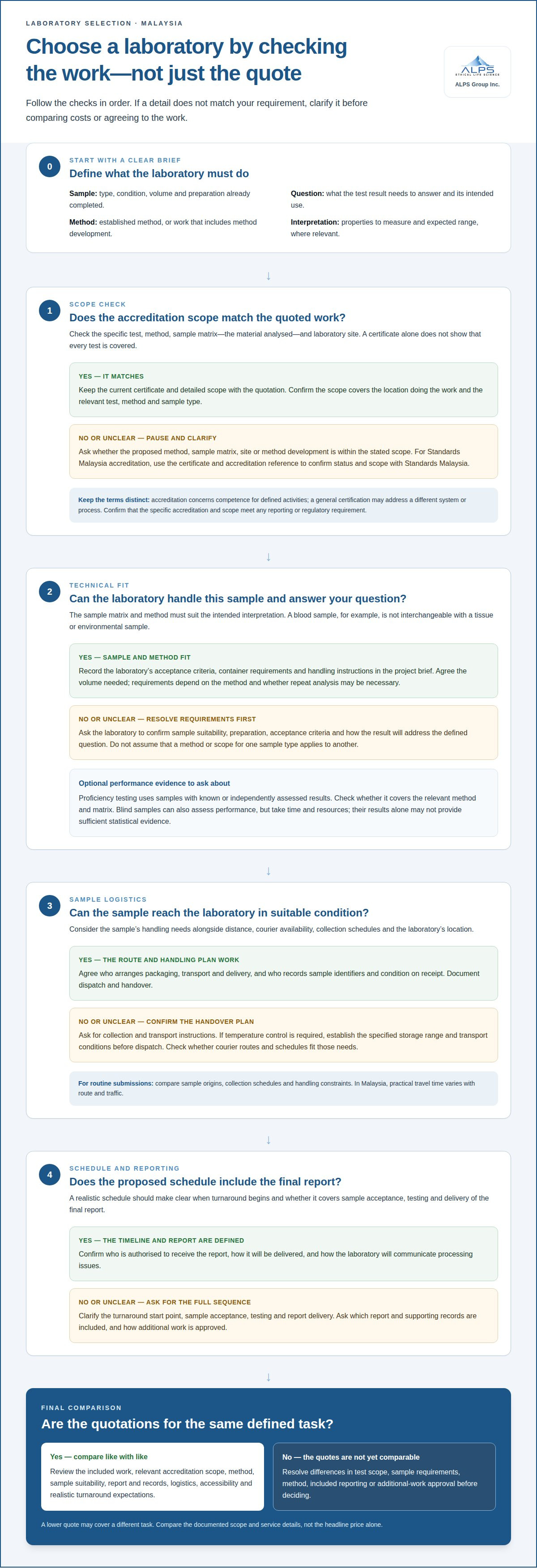
An attractive laboratory quote is not necessarily the right choice. To decide how to choose a testing laboratory, compare the work included, relevant accreditation scope, method, sample suitability, reporting, accessibility and realistic turnaround expectations.
Quotes are comparable only when they cover the same defined task. Clarify the sample type, the question the test must answer, any preparation required, and whether the work uses an established method or includes method development. Confirm which report and supporting records are included, and how additional work is approved. These details reveal differences in scope and service before you decide.
Practical logistics matter too. Consider how samples will reach the laboratory and whether the proposed schedule covers sample acceptance, testing and delivery of the final report. This article offers a structured comparison for Malaysian clinics, hospitals, healthcare professionals and research organisations, focusing on accreditation, sample suitability, accessibility and realistic turnaround expectations.
Key Takeaways
- Compare accreditation against the specific test, method and sample type, not just a laboratory’s general credentials.
- Define the sample and the decision the result must support so the quoted testing scope matches the real requirement.
- Weigh sample transport and access alongside technical suitability when assessing a laboratory’s practicality for routine work.
- Clarify when turnaround begins and whether the schedule includes delivery of the final report.
1. Verifying accreditation scope for a specific test, method, and matrix
Accreditation matters when its scope matches the work being quoted. The International Organization for Standardization identifies ISO 17025 as a standard for the competence of testing and calibration laboratories. A certificate alone does not show that every test is covered. Compare the named test, method and sample matrix, meaning the material analysed, with the laboratory’s accredited scope.
Request the current accreditation certificate and detailed scope. Match that scope to the proposed method and sample type, such as an assay performed on serum rather than another material. Check that the scope covers the laboratory site performing the work. If the quotation includes method development or a company-supplied method, clarify whether that work is within the stated scope.
To verify accreditation by Standards Malaysia, obtain the laboratory’s certificate and accreditation reference, then ask Standards Malaysia to confirm the status and scope. Check that the evidence covers the relevant laboratory location, test and method, rather than relying on a general accreditation statement.
Accreditation or expertise that does not fit the work can make a result unsuitable for its intended purpose. A scope covering one sample matrix, for example, may not apply to another, and a different method may not answer the same question. This can lead to decisions based on evidence that does not meet the testing or regulatory requirement.
Distinguish accreditation from certification when reviewing evidence. Accreditation concerns a laboratory’s competence for defined activities, while a general certificate may address a different system or process. For regulatory recognition, confirm that the specific accreditation and scope meet the reporting requirement. Keep the certificate, scope and quotation together, and resolve any mismatch before agreeing to the work.
2. Matching laboratory capabilities to the sample and business question
A suitable laboratory must be able to answer the specific question your sample raises. Define the material, properties to measure, expected range and intended use of the result. A blood sample, for example, is not interchangeable with a tissue or environmental sample. The method and expertise must suit both the sample matrix and the intended interpretation.
Before requesting a quote, describe the sample type, condition, volume and any preparation already completed. Ask the laboratory to state its acceptance criteria, container requirements and handling instructions. The volume needed depends on the method and whether repeat analysis may be necessary. Record the requirements in the project brief so collection and submission follow the same plan.
Agree who arranges packaging, transport and delivery, and who records sample identifiers and condition on receipt. If temperature control is required, establish the specified storage range and transport conditions with the laboratory before dispatch. Consider the laboratory’s location alongside courier availability and collection schedules. A distant facility may complicate routine submissions if transport cannot meet the sample’s handling needs.
For example, microbial testing requires a sample that remains suitable for the proposed analysis. The laboratory should explain relevant collection and transport instructions, while the sending team should document dispatch and handover. Clear responsibilities help identify where a sample’s condition may have changed before testing.
Assess technical performance through available proficiency testing, in which a laboratory analyses samples with known or independently assessed results. Check whether the programme covers the relevant method and sample matrix. Blind samples, submitted without identifying them as checks, can also assess performance. However, setting them up may take time and resources, and their results alone may not provide sufficient statistical evidence. Use these approaches alongside a clear review of the laboratory’s capabilities and sample-handling plan.
3. Laboratory proximity and accessibility
Distance affects more than convenience: it can shape appointment planning, sample delivery and access to reports. Map the journey from the patient’s home, clinic or collaborating institution to the laboratory. In Malaysia, travel time varies with route and traffic, so assess the practical journey at the time samples or patients need to arrive.
For patient testing, consider whether the location is accessible by the transport patients use and whether appointment times fit clinical routines. A nearby collection point may reduce travel demands for people with mobility limitations or ongoing care needs. If home sample collection is available, evaluate whether it suits the test and the patient’s circumstances.
For clinics and research teams, proximity can support coordinated collection and handover. Compare the laboratory’s location with sample origins, then consider courier routes, collection schedules and handling constraints. A clinic sending samples from several sites, for example, may need a dependable collection plan, even if one laboratory is centrally located.
Accessibility also includes communication and report delivery. Establish how the authorised recipient receives the report, who can access it, and how the laboratory communicates issues that affect processing. For a chemical test in a research workflow, a convenient site has limited value if report access or delivery does not fit the team’s review process.
Include these factors in the comparison rather than treating distance as the only measure. Record travel time, collection-point availability, transport arrangements, appointment access and report delivery for each option. Weigh them against sample needs and testing frequency. A location that works for occasional referrals may not suit routine submissions, while a more distant laboratory may be practical if transport and reporting are well coordinated.
4. Turnaround time expectations
A useful turnaround estimate covers the full reporting process, not just instrument time. Ask for separate estimates for sample acceptance, testing and report delivery. Clarify when the timing starts, such as when a suitable sample is received, and whether the stated endpoint means testing is complete or the report has been approved.
Published typical ranges can provide context, but they are not interchangeable across methods. Microbiological testing typically takes 3-7 working days, while chemical analysis typically takes 3-10 working days, depending on complexity. These examples illustrate why the test type and analytical procedures matter when selecting a laboratory. They should not be treated as a schedule for every test.
Discuss what shapes the proposed schedule. Sample preparation, method complexity, equipment availability, testing sequence and result review can affect the time required. A method needing additional preparation or specialist analysis may take longer than a routine procedure. Ask the laboratory to identify dependencies and explain how it communicates changes to the agreed schedule.
For a clear comparison, use the same milestones for each quotation. Record the expected sample receipt date, testing window, report review and delivery date. Confirm whether weekends or public holidays affect the stated working-day estimate. Establish how the laboratory handles an unsuitable sample, repeat analysis or unexpected finding, since each may change report timing.
Speed alone is not a reliable measure of quality. If an estimate appears unusually short for the stated method, ask how the schedule is achieved and whether it includes review and report approval. Compare the laboratory’s proposed timeline against your clinical or research workflow, then agree on a realistic target and communication process. Discuss testing schedules and service suitability for your requirements.
ALPS Group: mRNA Testing
ALPS Group Inc. offers mRNA Testing for clinics, hospitals, healthcare professionals and research organisations considering laboratory services for work involving mRNA. The service may be relevant when the testing question, sample requirements and expected report align with its scope. Let the project’s purpose guide test selection, and interpret results in the appropriate clinical or research context.
Before proceeding, align the requested work with the sample type, handling instructions, reporting needs and expected schedule. These details help establish whether the service fits the project and provide a clear basis for discussing a quotation. ALPS Group Inc. also offers Whole Genome Sequencing and other laboratory testing services for different testing requirements.
For guidance on mRNA Testing suitability or a quotation, contact ALPS Group Inc.
Turn a laboratory comparison into a clear testing brief
Turn your selection criteria into a brief that supports a confident, internally agreed decision. State the question the test must address, the intended use of the result and the operational requirements that matter to your team. This gives colleagues a shared basis for evaluating options and keeps the chosen service aligned with the work. A considered approach to how to choose a testing laboratory also makes future referrals and repeat testing easier to coordinate.
For Malaysian clinics, hospitals, healthcare professionals and research organisations, ALPS Group Inc. offers mRNA Testing, Whole Genome Sequencing, and Biochemistry, Serology & Immunology Tests. The appropriate service depends on the testing question and project requirements.
When you are ready to discuss your testing needs, contact ALPS Group Inc. A clear brief is a practical foundation for the next stage of your testing work.
Frequently Asked Questions
What belongs in a comparable laboratory quote?
A comparable quote should define the test deliverable and every activity included in the fee. It should identify the method, sample preparation, any method development, report format and expected schedule. Clarify how repeat work, unsuitable samples, amendments or project changes are charged, and who must approve extra work. This makes the commercial comparison more useful than comparing headline totals alone.
What factors should I consider when choosing a testing laboratory in Malaysia?
Consider whether the laboratory’s scope fits the intended use of the result, the method suits the sample, and the report meets your team’s needs. For a Malaysian clinic, hospital or research organisation, assess the practical route for patient access or sample delivery, as well as the timeline required by your workflow. The right balance depends on the project’s purpose and constraints.
What is ISO/IEC 17025 accreditation and why does it matter when selecting a lab?
ISO 17025 is a standard for the competence of testing and calibration laboratories, according to the International Organization for Standardization. Accreditation against a standard can support confidence in defined laboratory activities, but the relevant scope still matters. It does not automatically show that every test, sample type or intended use is covered, so assess it alongside the specific work being quoted.
How do I check whether a lab's accreditation covers my specific test or product?
Use the laboratory’s certificate and detailed scope to match the proposed work to the named activity. Compare the test, method, sample matrix and laboratory location with the scope, then note any differences during quote review. For a product test, identify the product matrix precisely rather than relying on a broad category name. This helps distinguish a relevant scope from a general credential.
What questions should I ask a testing laboratory before requesting a quote?
Provide a concise project brief and ask which method and work stages the quote covers. Clarify sample acceptance criteria, preparation, report contents, schedule milestones and how the laboratory handles unexpected results or repeat work. Ask how additional work is approved and charged before it begins. Naming the person who will review and accept the report can also prevent uncertainty at project close.
How do I compare testing methods, equipment, and reporting quality between laboratories?
Compare method identifiers and the work each method is intended to perform, rather than treating equipment lists as proof of equivalence. Ask each laboratory to describe relevant equipment and how results are reviewed. Examine a sample report for clear sample identification, method details, units, findings and supporting attachments. These features help your team assess whether reports can be interpreted and reviewed consistently.


