

For Malaysian clinics and healthcare teams, molecular testing can help investigate a defined clinical question involving genetic material, such as a suspected inherited condition or infection. PCR, or polymerase chain reaction, amplifies selected genetic material so a laboratory can detect a specific target. The appropriate test depends on the clinical question and specimen required. This general information does not imply that ALPS Group provides PCR-based diagnostic testing.
Choosing a service involves more than identifying a test name. Sample type and handling, referral and consent requirements, laboratory quality standards, and report detail all affect how testing fits into a diagnostic pathway. This article explains who may be considered for testing, how PCR-based analysis works, and what to clarify about sample submission, reporting, cost factors and turnaround time. It also outlines how specialised genetic diagnostic services relate to clinical investigations, and how laboratory accreditation should be understood when selecting a testing service.
Key Takeaways
- Match a molecular test to the clinical question, sample type and information needed from the report.
- Assess laboratory accreditation in context: a laboratory’s quality standards and the accreditation status of a particular test are distinct considerations.
- Understand how PCR amplifies genetic material and why sample handling and laboratory processes affect reporting time.
- Consider how testing scope and sample requirements shape costs, and where ALPS Group’s mRNA Testing and other laboratory services may fit.
Laboratory accreditations and certifications
In Malaysia, regulatory oversight and laboratory standards are separate considerations. A laboratory’s stated standards do not establish that every test is suitable for every clinical question. Test results also depend on the method, specimen quality, controls, and interpretation. For a referral, clarify the test’s scope and reporting pathway with the laboratory.
Laboratory quality standards provide a framework for consistent processes and competence. They do not, by themselves, establish that a test is suitable for every clinical question. Clarify whether the laboratory’s stated scope covers the method and specimen involved, and how the report presents findings, limitations, and any need for further testing.
Biosafety matters when staff handle potentially infectious material. Laboratory design, protective equipment, staff training, and specimen workflows help manage biological risks. Before sending a sample, the referring team should clarify packaging, transport conditions, and acceptance criteria with the laboratory. These arrangements support safe handling from collection through processing.
Test method also affects how results are interpreted. The World Health Organization says antigen tests are faster and less expensive than NAATs, the reference method for SARS-CoV-2. A clinician selects the method according to the diagnostic purpose and context.
For clinics serving rural communities, Sabah, or Sarawak, access depends on referral routes, collection arrangements, and transport to the testing laboratory. Before dispatch, clarify the required specimen, packaging, and reporting pathway with the laboratory. These details help clinics coordinate testing when analysis takes place away from the collection site.
Reference laboratory services can support hospitals when a requested molecular test requires specialised methods or expertise. A referral should state the clinical question, include relevant history, and specify the requested test. The laboratory report contributes to clinical interpretation; it does not independently determine treatment. Clear communication between the referring team and laboratory supports appropriate use of results.
Malaysia’s specialised molecular genetic diagnostic services
Specialised genetic services can support selected investigations, but screening does not universally predict future disease. Test selection should reflect the clinical question, family history, and available evidence.
Test Type Comparisons
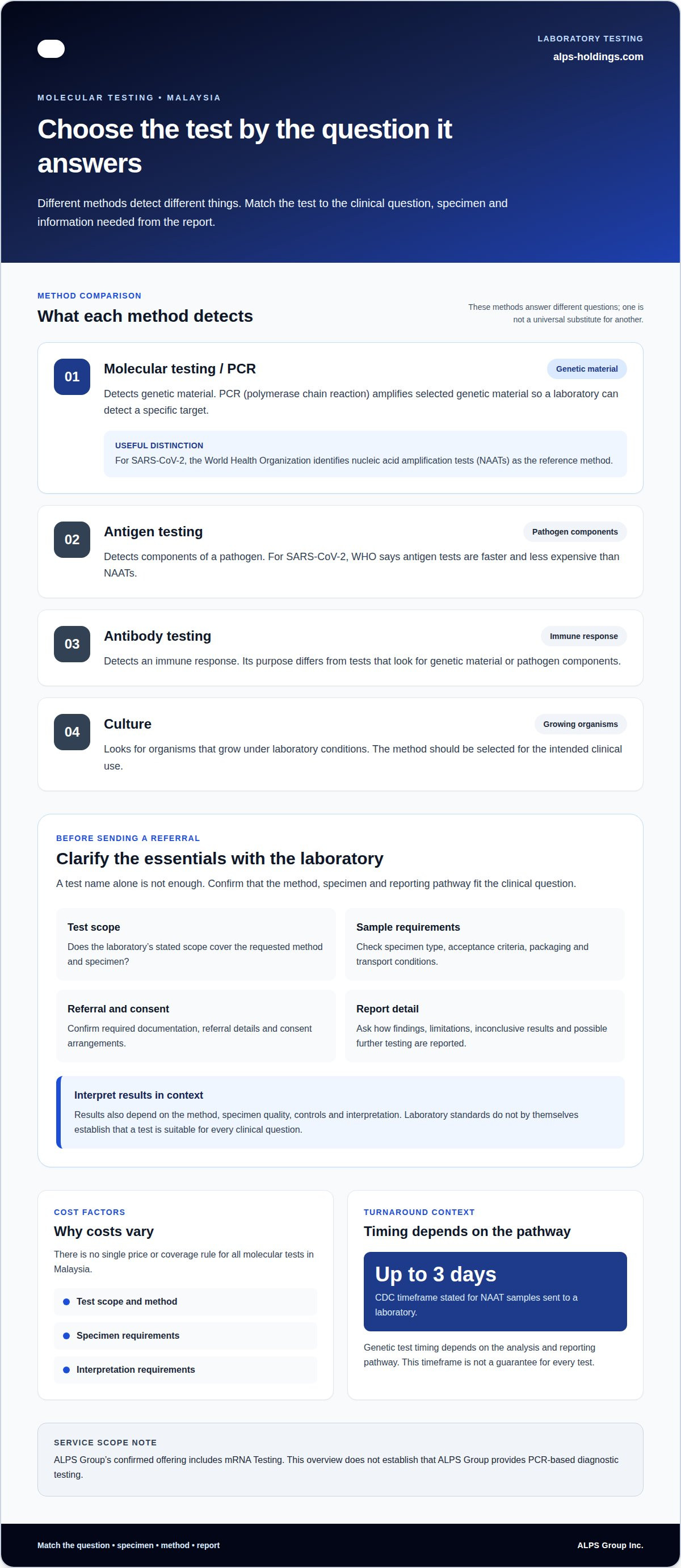
Molecular tests detect genetic material, while antigen tests detect components of a pathogen and antibody tests detect an immune response. Culture looks for organisms that grow under laboratory conditions. Each method answers a different question, so compare the target, specimen and intended clinical use. For SARS-CoV-2, the World Health Organization identifies nucleic acid amplification tests as the reference method.
Test Costs and Healthcare Coverage
Costs vary with the test’s scope, method, specimen, and interpretation requirements. There is no single price or coverage rule for all molecular tests in Malaysia. For insurance claims, review the policy’s diagnostic benefits, referral conditions, and approval process. In public healthcare, discuss the clinical pathway and referral requirements with the treating service before arranging testing.
The Institute for Medical Research Molecular Diagnostics Unit researches inherited metabolic disorders, mitochondrial diseases, genetic syndromes, and neurogenetic disorders. Its work also covers other genetic conditions, as well as molecular genetics training and consultancy for local and international institutions. Research activity does not establish that a routine clinical screening service is available.
Genetic screening for cancer, heart, or metabolic risks should address a defined clinical question. A genetic result may inform an assessment, but it cannot predict every disease or determine an individual outcome. Wellness and fitness screening also requires careful interpretation: distinguish evidence-based clinical testing from broader risk or lifestyle claims.
At the Institute for Medical Research, genetic testing is accepted following consultation with a Clinical Geneticist or Neurologist, or when relevant biochemical testing or screening suggests the condition. Requests require appropriate referral and informed consent, except for DNA extraction. Clarify how findings, limitations, and possible inconclusive results will be reported.
Sample requirements depend on the test. The Institute for Medical Research specifies 2.5 ml of blood in an EDTA tube for molecular diagnostic testing, and advises against heparin tubes. Its consent information notes that additional samples may be needed if results are absent or inconclusive. Prepare according to the test-specific instructions.
For NAAT samples sent to a laboratory, results may take up to 3 days, according to the Centers for Disease Control and Prevention; genetic test timing depends on the analysis and reporting pathway. Identifying information for testing at the Institute for Medical Research is kept confidential, with sample and information exchanges coded. Its consent form also addresses possible paternity information and DNA storage.
For a discussion of laboratory testing requirements, contact the testing team.
Molecular diagnostic services and PCR
Molecular diagnostic testing in Malaysia depends on matching an assay to a defined clinical question. Before a PCR request proceeds, the requested target and test name should correspond clearly. PCR means polymerase chain reaction, a laboratory method for amplifying selected genetic material. The laboratory can then process the request against the method’s stated purpose and required documentation.
For Malaysian molecular diagnostic requests, the electronic request must include clinical history and diagnosis, alongside a completed request form. This information connects the laboratory request with the patient’s clinical context. A precise diagnosis and relevant history help distinguish the intended investigation from other tests that may examine similar material. Complete documentation also supports clear communication between the referring team and laboratory.
If a request is made verbally, the requesting or treating doctor must make it on the same day the sample is sent to the laboratory. This makes the timing and responsible clinician part of the request process. For a hospital or clinical centre, arranging verbal communication alongside the paperwork helps ensure the laboratory receives the request through the appropriate channel.
PCR requests should identify the question the result needs to address, rather than relying on the method name alone. A laboratory’s standards and assay scope shape which targets it can assess. Clinical teams should therefore specify the suspected target, relevant history, and requested analysis in the submission. This helps the laboratory assess whether the assay fits the referral.
For teams arranging molecular diagnostic testing in Malaysia, document control is a practical part of coordination. Ensure that patient identifiers, the electronic request, and the accompanying form all refer to the same investigation. If the sample and paperwork describe different tests, clarification may be needed before processing. Clear, aligned requests support traceability from referral through result reporting.
What are the prices of common molecular diagnostic tests in Malaysia?
There is no single price for every molecular diagnostic test in Malaysia. Different laboratory workflows apply to Whole Genome Sequencing and mRNA Testing, ALPS Group’s confirmed molecular testing offerings. The price depends on the request and is provided after a quotation request. The requested scope, specimen, method, and reporting needs help determine the quotation.
Availability of a specific molecular test should be confirmed with the laboratory. Do not assume that generic PCR assays or infectious-disease NAATs are available. For confirmed offerings, the laboratory considers the requested scope, specimen preparation, extraction, and quality controls. As a result, testing requirements may affect the quotation.
Genetic tests also differ in scope. A focused test examines a particular variant or condition, while broader analysis examines more genetic material and may require more extensive interpretation. Whole Genome Sequencing is a broad approach, not a substitute for every targeted clinical test. Let the referral question and intended use guide the choice.
Before requesting a quotation, clinics and research teams can organise the details that affect test planning:
- Test purpose: specify the clinical or research question and requested target.
- Specimen: identify the sample type and any collection or transport requirements.
- Scope: clarify whether the request concerns a single target or broader analysis.
- Reporting: describe the information needed and the intended recipient.
These details help distinguish the test itself from associated requirements, such as specimen handling or additional interpretation. They also support a clear discussion of the appropriate method and reporting pathway. A quotation should reflect a confirmed offering and its defined scope, not a generic category such as “PCR”.
For a quotation based on your testing requirements, contact the laboratory team to confirm service availability and share the test purpose, specimen details and requested scope.
ALPS Group: mRNA Testing
ALPS Group offers mRNA Testing for organisations whose research or testing question involves messenger RNA, a molecule involved in carrying genetic instructions within cells. Selecting a suitable test begins with defining the purpose, the information required and how results will be used. The laboratory’s mRNA testing service is one option within a broader molecular testing pathway.
If the question concerns broader genetic analysis, Whole Genome Sequencing may be relevant. Biochemistry, Serology & Immunology Tests and Microbial Tests address different needs, so the appropriate service depends on the requested analysis and specimen. These services are not interchangeable and do not guarantee a diagnosis or clinical outcome.
For Malaysian clinics, hospitals, healthcare professionals and research organisations considering mRNA Testing, contact ALPS Group to discuss suitability or request a quotation.
Plan the Next Step in Testing
For teams planning molecular diagnostic testing in Malaysia, start by defining the question the analysis must address and the decision the result will support. A clear request helps align test scope, specimen, reporting needs, and the clinical or research context. It also gives the laboratory a practical basis for discussing suitability and preparing a quotation.
ALPS Group offers Whole Genome Sequencing, mRNA Testing, and Biochemistry, Serology & Immunology Tests. These services address different testing requirements, so selection should begin with the purpose of the analysis, not the technology name alone. Clinics, hospitals, and research organisations can share their testing objectives with ALPS Group for a focused discussion.
Contact ALPS Group to discuss your testing requirements. A well-defined question is a strong foundation for the next step.
Frequently Asked Questions
Who Should Consider This Test?
People whose care or research involves a defined genetic or infectious target may be considered for molecular testing. For example, a clinician may consider testing when routine findings leave a specific molecular question unresolved. The decision should reflect the intended use of the result: a laboratory result contributes evidence but does not independently determine diagnosis or treatment.
What molecular diagnostic tests are available in Malaysia?
Molecular testing in Malaysia can examine DNA or RNA, including through PCR-based assays and broader genomic analysis. Test menus differ between laboratories according to their methods and scope. For a useful enquiry, state the target or condition under investigation and whether the request is clinical or research-based. This helps identify the relevant test category without assuming similarly named assays are interchangeable.
Which Malaysian hospitals and laboratories offer molecular diagnostic testing?
Examples discussed in this article include the Institute for Medical Research’s Molecular Diagnostics Unit. ALPS Group Inc. offers Whole Genome Sequencing and mRNA Testing. A hospital may coordinate testing through its own laboratory or a referral pathway, depending on the requested analysis. For a specific case, start with the treating service: it can clarify where the test is processed, how results are returned, and who will interpret them in context.


