

An inconclusive mRNA result does not establish that a target was detected or absent. Understanding mRNA test results begins with identifying what the assay measures: messenger RNA (mRNA), which carries instructions from genes, or a specific RNA target such as HPV E6/E7. A detected result means the assay found its target in the sample; it does not, by itself, establish a diagnosis.
It is understandable to want a clear answer from a laboratory report, especially when its wording leaves room for interpretation. What a result means depends on the test’s purpose, the target it measures and whether the assay could interpret the sample.
This article explains what RNA testing measures, what a detected result can indicate and why a result may be inconclusive. It also covers how sample quality, reporting criteria and clinical context shape follow-up, helping healthcare professionals and research teams in Malaysia assess findings in context.
Key Takeaways
- Identify what the assay measures before interpreting a detected or inconclusive result; different RNA tests examine different targets.
- A detected target is a laboratory finding, not a diagnosis on its own; its significance depends on the test’s purpose and clinical context.
- For an unclear result, review the report’s interpretation and discuss appropriate follow-up with a genetic counsellor or clinical geneticist.
- When planning laboratory testing, clarify the intended question, sample requirements and reporting needs so the chosen service fits the work.
Evidence limitations and follow-up safety
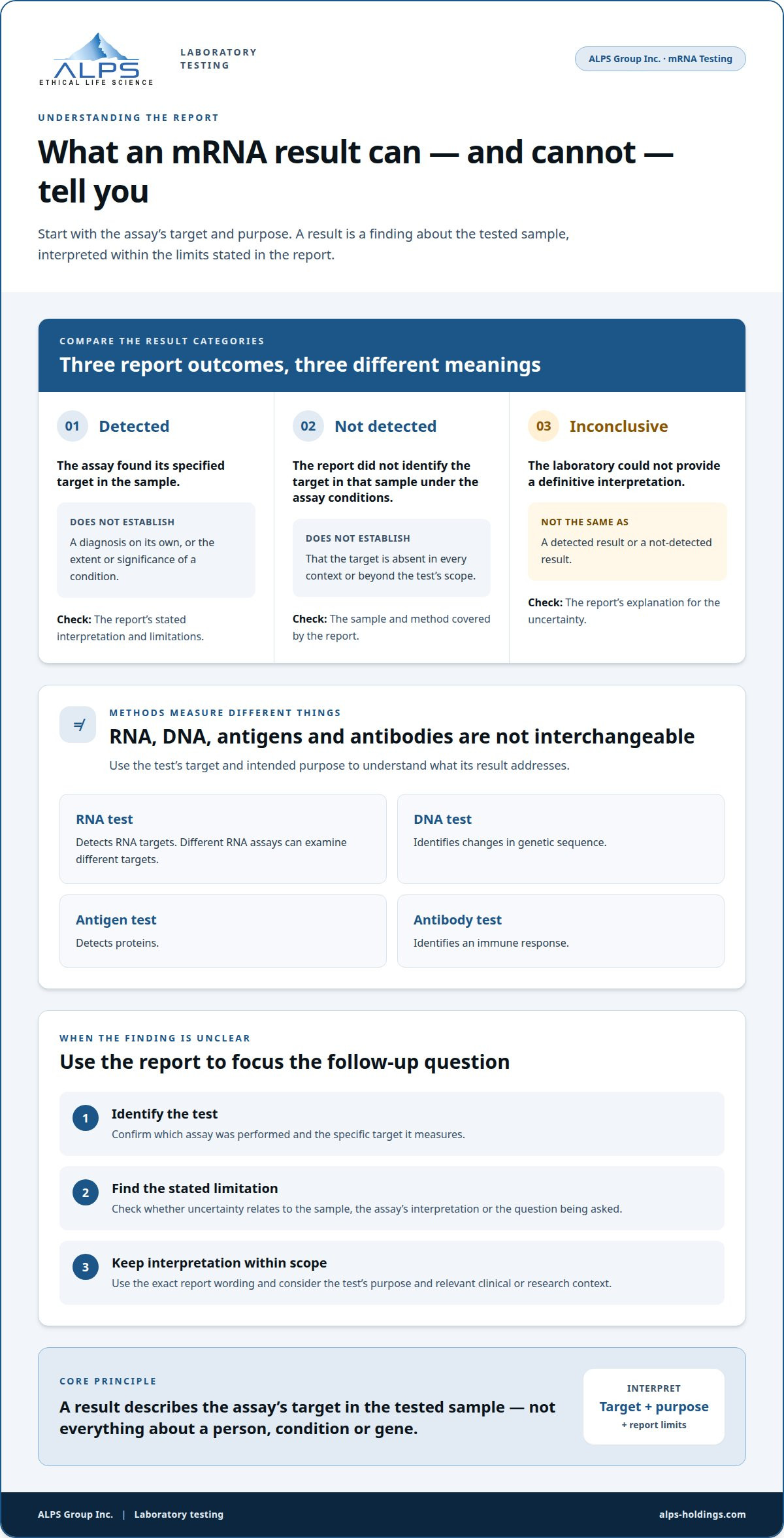
An RNA result addresses the target and purpose defined by the assay. For example, an HPV mRNA report concerns the test’s specified HPV target, not a complete assessment of cervical health. The report’s interpretation and limitations define what the result can establish.
A detected finding does not, by itself, describe the extent or significance of a condition. Likewise, a result that does not detect the target applies to the sample and method used. These distinctions matter when interpreting a report alongside other clinical information or considering further assessment.
For an inconclusive result, start with the report’s explanation of why the laboratory could not provide a definitive interpretation. Clarify whether the limitation relates to the sample, the assay’s interpretation or the question being asked. Each possibility calls for a different follow-up discussion.
For example, an HPV mRNA report and a genetic RNA analysis address different targets. A follow-up discussion should establish which test was performed, what its result category means and what evidence could answer the remaining question. Do not interpret a result beyond the test’s stated purpose.
For Malaysian clinical and research teams, retain the exact report wording when communicating about follow-up. The mRNA testing service is relevant to laboratory analysis, while decisions about an individual’s care require the appropriate clinical context. A precise referral question helps keep interpretation aligned with the test performed.
A person with a detected HPV mRNA E6/E7 result may be advised to return for another HPV test in 1 to 3 years.
Possible next steps after an inconclusive RNA test
After an inconclusive result, identify the test’s target and the report’s stated reason for uncertainty. Inconclusive is not the same as detected or not detected. Understanding what the assay could not resolve helps focus follow-up on the relevant laboratory or clinical question.
RNA tests detect RNA targets; antigen tests detect proteins, while antibody tests identify an immune response. Because these methods measure different things, their results are not interchangeable. This distinction matters when choosing a test for a specific purpose or interpreting results from different methods.
No single interval after exposure or symptom onset applies to every mRNA test. Appropriate timing depends on the target and the assay’s intended use. For a specific clinical question, follow the test instructions and relevant care pathway to determine when testing is appropriate.
Turnaround time depends on the assay and laboratory process. Reports present findings according to the method used, so read result categories and interpretive details in the context of the specific report.
For genetic results that remain unclear, a genetic counsellor or clinical geneticist can discuss what the finding means and possible next steps. To discuss laboratory testing requirements, contact ALPS Group.
RNA and messenger RNA basics
DNA stores genetic information, while RNA helps use that information. DNA has two strands; RNA usually has one. The US National Human Genome Research Institute describes RNA as a nucleic acid involved in gene expression, the process by which genetic instructions are used. RNA also differs chemically from DNA: it contains uracil instead of thymine.
Messenger RNA, or mRNA, carries a copy of gene information that can guide protein production. Before mature mRNA forms, cells produce precursor messenger RNA, called pre-mRNA. The cell processes this precursor through steps including splicing, which joins selected RNA segments and removes others. This processing shapes the message available for later cellular use.
The National Center for Biotechnology Information’s Molecular Biology of the Cell discussion of RNA splicing describes how RNA transcripts can be processed before they become mature mRNA. This matters because a change affecting splicing may alter the transcript produced from a gene, even when the laboratory question began with a DNA finding.
RNA analysis can complement DNA analysis, but the methods examine different material. DNA testing identifies changes in genetic sequence; RNA analysis can examine transcripts produced from genes. If a DNA result raises a question about a gene’s RNA processing, RNA evidence may help assess that specific question. Interpretation still depends on the assay and the broader clinical or research context.
RNA tests can examine different targets. One assay may focus on a particular RNA molecule, while another analysis may assess transcripts relevant to a genetic investigation. The report’s target and method define the result’s scope. A finding about one transcript does not describe every RNA molecule or gene in the sample, so the biological question should guide test selection.
What a detected result does and does not mean
A detected result identifies the assay’s target in the tested sample. Its meaning depends on the target and the test’s stated purpose.
Interpreting a Detected Result
A detected result means the laboratory reported the specified RNA target according to the assay’s interpretation criteria. Refer to the report for the result’s stated meaning and limitations; the result alone does not establish a disease diagnosis.
For example, if an HPV mRNA assay reports its target as detected, refer to the report for what that finding means. It does not, on its own, establish cervical cancer. For genetic testing, refer to the report for the interpretation of any RNA finding and the evidence considered.
After a positive result, review the report’s interpretation and discuss its relevance with the healthcare professional responsible for the test. A negative result means the report did not identify the target in that sample under the assay conditions. Refer to the report for the test’s scope and limitations.
Understanding Ct Values
If an assay report includes a Ct value, use the assay-specific interpretation provided in the report. Ct values should be read in the context of the test that produced them.
A Ct value is not, by itself, a diagnosis or a measure of disease severity. Refer to the report’s interpretation and any assay-specific notes; values from different tests may not be directly comparable.
Some mRNA reports do not include a Ct value. For a positive or negative finding, refer to the report for the result and the question the test was designed to answer. Discuss the report’s interpretation and limitations with the healthcare professional responsible for the test.
For laboratory-specific questions about mRNA testing and reporting, discuss testing requirements.
ALPS Group: mRNA Testing
ALPS Group Inc. offers mRNA testing for Malaysian healthcare and research organisations seeking laboratory services. It may be relevant when a project or referral requires analysis of an RNA target. The intended question should guide test selection.
Before arranging testing, define its purpose and clarify the expected sample, reporting format and interpretation requirements. These details help align the laboratory request with the clinical or research question. If the question concerns genetic sequence rather than RNA, Whole Genome Sequencing may be relevant; the appropriate method depends on the information sought.
ALPS Group also provides Biochemistry, Serology & Immunology Tests and Microbial Tests for other laboratory questions. To discuss the suitability of mRNA Testing for your requirements, contact ALPS Group.
Bring the Next Testing Decision into Focus
A clear testing question is the best starting point for a laboratory referral. Define the decision the result needs to inform, the intended use of the analysis and the information required in the report. This gives clinical and research teams a practical basis for assessing whether the selected test fits their objectives.
For Malaysian healthcare professionals and research organisations, understanding mRNA test results also means placing laboratory findings within the limits of the specific assay and the wider evidence available. A focused discussion about the testing question can help establish whether an mRNA analysis or another laboratory approach is more suitable for the work.
ALPS Group can discuss testing requirements and the suitability of its laboratory services for your project or referral. Contact ALPS Group to discuss your testing needs, and take the next step with a defined purpose and a clearer basis for planning.
Frequently Asked Questions
What is RNA testing?
RNA testing examines ribonucleic acid in a sample to address a defined biological or clinical question. The test may focus on a particular RNA molecule or a gene transcript, the RNA copy of a gene. Before requesting a test, confirm its target and intended use with the laboratory. These details help determine whether the service is suitable for your research or testing requirement and what conclusions its report can support.
What is RNA?
RNA is a type of molecule involved in how cells use genetic information. Messenger RNA (mRNA) carries instructions used in protein production. RNA contains uracil, while DNA contains thymine. As RNA and DNA are different materials, ask the laboratory which sample type and collection requirements apply to the requested test. Confirming these details before sending a sample can help ensure that the laboratory receives material suitable for the service.
What does an mRNA test measure?
An mRNA test examines a specified messenger RNA target or transcripts produced from genes. The exact measurement depends on the test. Ask the laboratory which target the assay examines, what sample it requires and whether the test is intended for your research or clinical question. A report’s description of the target can help you assess whether the service addresses your requirement; do not assume it examines other transcripts or gene activity across the sample.
How do I interpret positive, negative, and invalid mRNA test results?
Result categories and their interpretation depend on the specific test and the laboratory’s reporting criteria. If a report is unclear or marked invalid, ask the laboratory what that means for the assay and whether the sample can be retested. For positive or negative results, check the report’s stated target, intended use and notes. Discuss clinical decisions with an appropriate healthcare professional, and use research results in the context of the study design.
How accurate are mRNA tests, and what can cause false results?
Performance depends on the specific assay, target, sample type and intended use, so ask the laboratory for information relevant to the test you are considering. Before submitting a sample, confirm collection, handling and storage requirements, and ask how the laboratory reports results that cannot be interpreted. These questions can help you understand the test’s limitations and what its findings can support. Do not treat a single result as a guarantee of diagnosis or an answer to a broader biological question.


