

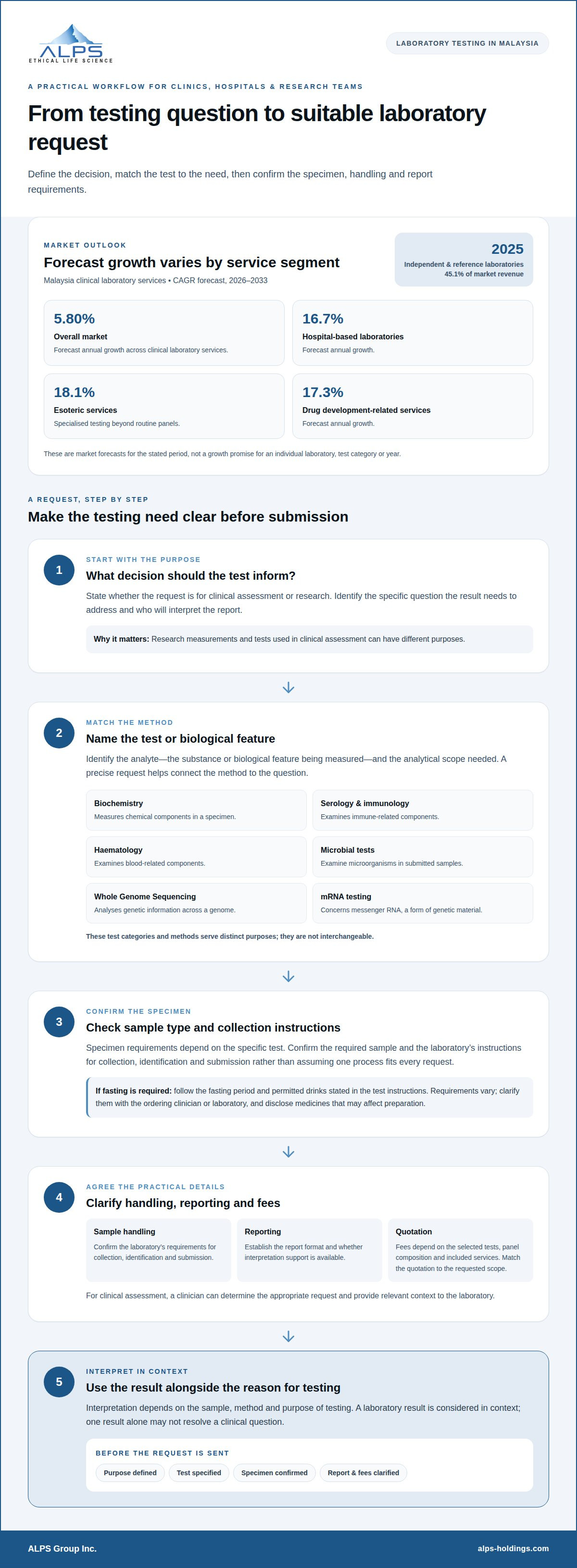
Esoteric services in Malaysia’s clinical laboratory market are forecast to grow at 18.1% from 2026 to 2033, compared with overall market growth of 5.80% over the same period. That gap signals the rising importance of specialised testing within a market forecast to expand. For clinics, hospitals, healthcare professionals and research organisations, medical laboratory testing in Malaysia is not only about test volume; it is also about identifying the right laboratory capability for each clinical or research need.
A growing market can still be difficult to navigate: demand, service mix and provider distribution all affect practical choices. This article explains the outlook for medical laboratory testing in Malaysia, the factors driving demand for specialised testing and where these services are used. It also outlines how clinics, hospitals and research organisations can assess a laboratory’s testing scope, sample requirements, reporting process and fees.
Key Takeaways
- Understand why demand for specialised laboratory testing is growing and what this may mean for healthcare and research organisations.
- See how Malaysia’s clinical laboratory market is forecast to develop, including which service areas are projected to expand.
- Explore where laboratory testing is used and how to match the testing requirement with the appropriate service category.
- Review the provider landscape across key Malaysian locations and learn how ALPS Group’s testing services may fit a laboratory need.
Demand for specialized, high-accuracy testing
Specialized testing examines a defined biological feature beyond routine laboratory panels. Examples include molecular analysis, immune markers and microbial identification. High-accuracy testing aims to produce precise, reproducible measurements under controlled procedures. In Malaysia, these capabilities support clinical assessment, research and drug development, where a result must answer a specific question rather than simply provide a broad screening picture.
Independent and reference laboratories accounted for 45.1% of Malaysia’s clinical laboratory services market revenue in 2025. These laboratories provide testing beyond the routine work handled by many general laboratories. Their role becomes relevant when a care team or research group needs a specialised method, a wider analytical scope, or a result that supports further investigation.
Forecasts also point to faster growth in specialised segments. Esoteric services are projected to grow at a CAGR of 18.1% in Malaysia’s clinical laboratory services market from 2026 to 2033. Drug development related services are forecast to have a CAGR of 17.3% from 2026 to 2033. These figures indicate distinct areas of expansion, rather than a uniform rate across every test type.
For a clinic, hospital or research organisation, start by defining the decision the test must inform. Identify the relevant analyte, meaning the substance or biological feature being measured, and the required sample type. Then confirm the laboratory’s collection instructions, handling requirements, report format and interpretation support. A specialised test is useful when its method and output fit the clinical or research question.
For a fasting blood test, follow the fasting period and permitted drinks stated in the test instructions. Requirements vary, so clarify them with the ordering clinician or laboratory before collection, and disclose medicines that may affect preparation.
Interpretation depends on context. A laboratory result is considered alongside the sample, method and reason for testing; one result alone may not resolve a clinical question. A research measurement and a test used in clinical assessment, for example, can have different purposes. Documenting the intended use helps the laboratory select appropriate procedures and report findings meaningfully.
Malaysia clinical laboratory services market size and forecast
Market size measures revenue generated by clinical laboratory services, while CAGR describes average annual growth across a defined period. Malaysia’s clinical laboratory services market is forecast to grow at a CAGR of 5.80% from 2026 to 2033. This is an overall projection, not a growth promise for each laboratory, test category or year.
Forecasts differ across service segments. Hospital-based laboratories are forecast to have a CAGR of 16.7% from 2026 to 2033. Esoteric services, meaning specialised tests beyond routine panels, are forecast to have a CAGR of 18.1% over the same period. For planning, organisations can compare these trends with their expected referral volumes, test complexity and reporting needs.
Whether a doctor’s referral is needed depends on the test and how it is arranged. For testing linked to clinical assessment, the ordering clinician can determine the appropriate request and provide relevant context to the laboratory.
Medical laboratory services operate within applicable quality and information-governance frameworks. When evaluating a laboratory, establish how it documents procedures, controls access to patient information and communicates results. The necessary arrangements depend on the organisation’s role and testing pathway.
There is no single price for common blood tests or health-screening packages. Fees depend on the selected tests, panel composition and included services. A quotation should match the requested scope.
Public healthcare access, insurance reimbursement and employer benefits follow different arrangements. Eligibility depends on the care pathway and benefit terms, so establish coverage with the responsible healthcare or benefits administrator before testing.
For clinics and research organisations, market projections are most useful when they inform service planning. Define the testing purpose, likely specimen and reporting requirements, then assess how these needs may change as demand for specialised laboratory services develops.
Clinical laboratory applications
Clinical laboratory testing analyses specimens for healthcare or research purposes. The appropriate category depends on the question and information required. Before arranging a test, define its intended use, identify who will interpret the report and establish what decision the result is expected to inform. A clearly framed request helps match the method to the work.
Biochemistry tests measure chemical components in a specimen. Serology and immunology tests examine immune-related components. Because these categories involve different approaches, specify the required test rather than relying on a broad label. For a referral, include the testing purpose and relevant background.
Haematology tests examine blood-related components, while microbial tests examine microorganisms in submitted samples. Specimen requirements depend on the specific test. Follow the laboratory’s instructions for collection, identification and submission instead of assuming one type of specimen or handling process applies to every request. Accurate request details help match the sample to the intended analysis.
Whole Genome Sequencing analyses genetic information across a genome. mRNA testing concerns messenger RNA, a form of genetic material. These methods serve distinct purposes and are not interchangeable. For research, state the study question and intended analysis; for clinical work, define the requested test and its role in the care pathway.
Before submission, confirm the test name, specimen requirements, labelling information, report format and intended recipient. These details help prevent avoidable delays caused by incomplete requests or mismatched samples. Interpret the report according to the stated test and purpose: research findings and clinical results serve different contexts.
For clinics, hospitals and research organisations, a practical selection process is to define the question, identify the relevant test category, then align specimen and reporting requirements. This makes a referral more specific without assuming a test can answer questions beyond its stated scope.
Directory of medical laboratory testing companies in Malaysia
A directory can help organisations map laboratory providers and compare their stated testing scopes. Its entries are a starting point, not proof of suitability or accreditation.
Comparing Private and Hospital Labs
Private and hospital laboratories operate in different service settings; compare them against the specific referral requirement. Identify the test scope, specimen instructions, report format and intended recipient. RevenueBase listed 30 Malaysian medical laboratory testing companies in the 11-50 employee band and 12 in the 1-10 employee band as of September 2026. These directory categories describe company size, not laboratory capability or quality.
Turnaround time is the interval between a laboratory receiving a sample and reporting a result. It varies by test and laboratory workflow, so agree on expected timing and result-delivery arrangements before referral. A clinic coordinating care, for example, may need the report sent to a specified clinician.
Laboratory Accreditation
Accreditation recognises a laboratory’s competence within a defined scope of testing. Malaysian medical laboratories may hold SAMM accreditation to MS ISO 15189, but accreditation should not be assumed for every provider or test. Malaysia’s SAMM specific criteria for medical testing laboratories are Issue 6, dated 25 July 2024, with Amendment 1 dated 09 April 2025. The relevant scope matters.
Blood collection can cause discomfort or bruising, and sample errors can affect results. Correct identification and following the laboratory’s collection instructions help reduce avoidable problems. Results also need interpretation in context; a laboratory finding alone does not necessarily establish a diagnosis.
When evaluating laboratories from a directory, record each provider’s stated test scope, accreditation details, sample requirements and reporting process. Comparing these details gives clinics, hospitals and research organisations a practical basis for assessing referral fit, rather than relying on a directory entry alone.
ALPS Group: mRNA Testing
ALPS Group Inc. offers mRNA Testing for organisations with a defined molecular testing requirement. Messenger RNA, or mRNA, carries cellular instructions involved in protein production. mRNA testing involves examining this type of RNA. The purpose and interpretation depend on the specific question and method, so select a test that fits the intended work.
ALPS Group Inc. also offers Whole Genome Sequencing, Biochemistry, Serology & Immunology Tests, and Microbial Tests. These are distinct testing categories; the right choice depends on the specimen and information required. Clear referral details help establish the testing objective, sample requirements and reporting needs before submission.
To discuss whether mRNA Testing suits your requirements, contact ALPS Group Inc..
Turn testing requirements into a clear next step
For clinics, hospitals and research organisations, start by defining the decision a test should inform. Specify the intended use, specimen and reporting needs, then match them to the laboratory method. This provides a clearer basis for referrals and project planning for medical laboratory testing in Malaysia, without treating market growth as a substitute for technical suitability.
ALPS Group offers Whole Genome Sequencing, mRNA Testing, and Biochemistry, Serology & Immunology Tests. These services address different testing requirements, and the appropriate option depends on the question and intended use. Contact ALPS Group to discuss the proposed request, including sample requirements, reporting expectations and testing scope.
Bring your testing objectives into the conversation and identify the practical details that will shape the next step. Contact ALPS Group to discuss your needs. With a well-defined question and suitable laboratory pathway, teams can move forward with greater clarity.
Frequently Asked Questions
What is the Malaysia Clinical Laboratory Services Market Size and Growth Rate?
Malaysia’s clinical laboratory services market is forecast to grow at a CAGR of 5.80% from 2026 to 2033. CAGR is the average annual growth rate across a defined period, rather than a promise that every year or laboratory will grow at the same pace. For planning, clinics and research organisations can consider how their testing needs may change alongside this broader market outlook.
What types of medical laboratory tests are available in Malaysia?
Medical laboratory testing categories include biochemistry, serology, immunology, haematology, microbial and molecular tests. The appropriate category depends on the question and specimen required. Molecular testing can include Whole Genome Sequencing or mRNA Testing, while microbial testing examines microorganisms in a sample. Clinics and research teams should match the method to its intended clinical or research use.
Where can I find accredited medical laboratories in Malaysia?
Start with laboratories’ published accreditation information, then confirm that the stated scope covers the specific test you need. Accreditation is not a blanket assurance for every method a facility performs. Request the current certificate details and scope, and compare the laboratory’s legal entity and test location with those records. ALPS Group states that its molecular laboratory meets MS ISO 15189:2022 standards; this wording should not be taken as an accreditation claim.
What rules govern medical laboratory services and patient data in Malaysia?
Medical laboratories operate under applicable quality and information-governance frameworks. SAMM Circular 1/2023 concerns the transition to ISO 15189:2022 for medical testing, and Circular 2/2021 sets out a quality management system policy for medical testing laboratories under one legal entity; organisations should also check how procedures, patient-data access and result communication are managed.
How long do medical laboratory tests take and how are results delivered in Malaysia?
Turnaround time varies by test and laboratory workflow. Agree on expected timing and result-delivery arrangements before referral, including the intended recipient, such as a specified clinician.


