

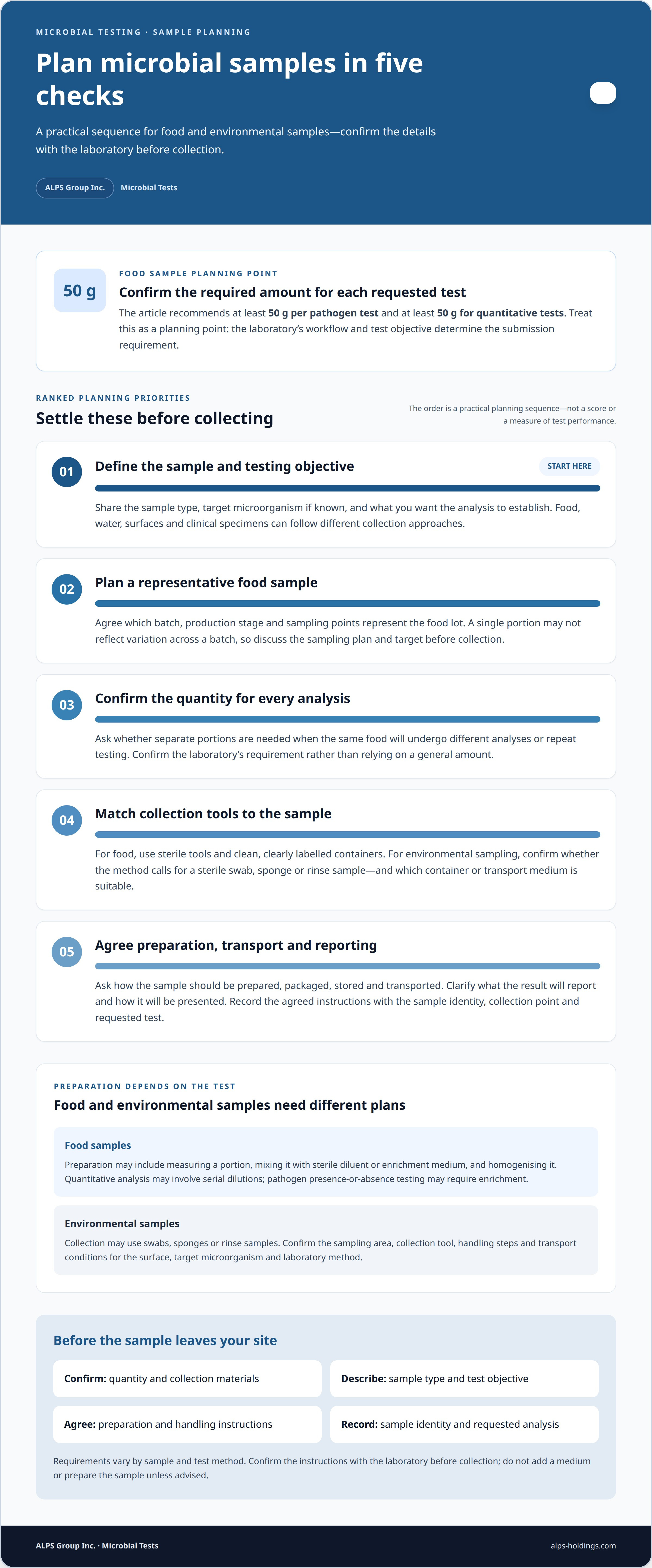
A representative sample matters as much as the test method. Knowing how to prepare samples for microbial testing means collecting food with sterile tools in clean, clearly labelled containers, then using a preparation method suited to the sample and test objective. For food pathogen tests and quantitative tests, a practical submission amount is at least 50 g per test.
Food samples may need to be measured, mixed with sterile diluent or enrichment medium, and homogenised before analysis. Environmental samples are commonly collected with swabs or sponges, or as rinse samples. The right collection materials and handling depend on the surface, target microorganism and laboratory method.
Before collecting a sample, establish the required quantity, container or swab type, labelling details and transport conditions with the laboratory. Food preparation depends on the sample, while environmental sponge and swab samples have their own collection and handling steps. Clarifying these requirements helps clinics, healthcare teams and research organisations plan submissions.
Key Takeaways
- Confirm the required food quantity for each pathogen or quantitative test; the recommended minimum is 50 g per test.
- Match sample preparation to the food matrix and test objective, including whether the laboratory needs homogenisation, dilution or enrichment.
- Clarify which sterile swab, sponge or transport medium is appropriate for environmental sampling and how samples should be handled in transit.
- Provide clear sample and testing details before collection so the laboratory can align its workflow with the intended analysis.
How Does a Microbiology Laboratory Prepare Food Samples for Testing?
Food preparation depends on the sample matrix, target organism and testing objective. To prepare samples for microbial testing, first establish these details and the laboratory’s method.
-
Plan Representative Food Sampling with the Laboratory
Agree which batch, production stage and sampling points represent the food lot. A single portion may not reflect variation across a batch, so discuss the sampling plan and target organism before collection. Requirements differ by sample type: food may be solid or liquid, water needs a water-sampling approach, and surfaces use swabs or sponges. Clinical specimens follow separate collection protocols. In Malaysia, establish which product specification, test method or applicable regulatory requirement governs the submission.
-
Confirm Food Sample Quantities with the Laboratory
Confirm the required quantity for each requested analysis before collecting. The sampling guidance recommends at least 50 grams of food for each pathogen test and at least 50 grams for all quantitative tests. These amounts are useful planning points, but the laboratory’s workflow and test objective determine the submission requirement. Discuss how to prepare samples for microbial testing when the same food will undergo separate pathogen and quantitative analyses. Ask whether separate portions are needed for different targets or repeat analysis.
-
Understand How Food Matrix Affects Sample Preparation
Describe the food accurately: for example, whether it is liquid, solid, oily, powdered, frozen, fermented or highly processed. Its properties affect how the laboratory measures and prepares a portion for analysis. Milk may be mixed or diluted directly, while other foods may require blending, filtration, enrichment or a matrix-specific extraction. Unsuitable preparation can interfere with recovering or detecting the target microorganism.
-
Ask How the Laboratory Blends and Homogenises Food Samples
Confirm how the laboratory will combine the measured portion with sterile diluent or enrichment medium. Homogenisation helps distribute microorganisms through the liquid phase; compatible methods include stomaching, blending, shaking or mixing. Quantitative analysis may involve serial dilutions, while presence-or-absence pathogen testing may require enrichment before detection. Provide clear sample identification and collection details, then agree on packaging, storage and transport conditions.
Confirming Sample Preparation for Microbial Tests
Sample preparation requirements depend on the test and the laboratory’s method. Confirm the collection and preparation instructions with the laboratory before submitting a sample.
- Ask what information the laboratory needs to assess the test. Share the sample type, target organism, if known, and testing objective. Do not assume that a particular medium or preparation method is suitable based on the sample description alone.
- Clarify whether the laboratory has specific collection or preparation instructions. Requirements can vary according to the requested analysis. Confirm what to do before collecting or preparing the sample, rather than relying on a protocol intended for a different test.
- Confirm whether the laboratory provides any required collection materials or instructions. Do not add a medium or otherwise prepare the sample unless the laboratory has advised you to do so. Provide a clear description of the sample and requested analysis so the laboratory can advise on the appropriate process.
- Ask what the test result will report. The result format and interpretation depend on the requested test and the laboratory’s method. Confirm the target being tested and how the result will be presented, particularly if you need a specific type of finding for your purpose.
- Record the agreed instructions with the sample details. Include the sample identity, collection point, target organism, if known, and requested test on the submission information. If the method or preparation instructions are unclear, resolve that with the laboratory before collection. For a discussion of sample and test suitability, contact ALPS Group.
Environmental Sponge and Swab Collection: What Clients Should Confirm
Before sampling a surface, confirm the target test, collection tool and handling method with the laboratory. Aseptic collection helps limit contamination from hands, tools or nearby surfaces.
-
Confirm Required Sterile Containers and Sampling Tools
Ask whether the test requires a sterile swab, sponge or rinse sample, and which container or transport medium is suitable. The method depends on the surface and intended analysis, so a tool used for one sampling plan may not suit another. Confirm whether the laboratory supplies the collection materials or specifies their type.
-
Discuss Aseptic Collection with the Laboratory
Get the collection procedure before starting, especially if the surface is difficult to access or the test requires a specific sampling area. Use sterile tools and clean containers as directed. Avoid touching the collection surface with your hands or letting the swab or sponge contact unrelated objects. These precautions reduce the risk of introducing microorganisms that could affect interpretation.
- Agree on the area and number of samples. Environmental sponge sampling commonly covers a 4” × 4” or 5” × 5” area. The allergen swab instructions specify a 5 × 5 cm target area and one swab for each allergen being tested. Pathogen testing and quantitative testing each call for one sponge per test in the provided sampling guidance. Confirm the plan when several targets or surfaces are involved.
- Confirm transport conditions and timing before collection. Sponge samples should be kept between 0 and 8°C during transport and should not be frozen. Ask which transport medium or neutralising buffer the method requires, since surface residues can affect recovery. Agree how samples should be labelled, packaged and delivered, then record the sampled location and collection time for each item.
- Keep the collection plan linked to the intended analysis. A swab or sponge result represents the sampled surface area, not every surface in a facility. Discuss whether separate sampling points are needed for distinct locations, and provide each sample with clear site identification. Discuss environmental sample requirements before arranging collection.
What Information Should Clients Provide Before Microbial Sample Collection?
- Describe the sample before collection. Identify whether it is food, water or a surface sample, then provide the product or site name and relevant matrix details. For example, distinguish powdered food from a liquid product. This information helps the laboratory match its preparation and collection materials to the intended analysis.
- State the target and testing objective. Specify the microorganism of interest, if known, and whether the request is for presence-or-absence detection or quantitative analysis. These objectives involve different workflows, such as enrichment or serial dilution. Include the required result format so the laboratory can relate its method to your testing question.
- Prepare consistent sample labels and submission records. Include a unique sample code, product or surface location, collection date and time, and requested test. Ensure the container label matches the submission form. For multiple sites, assign each sample its own code and record its location to maintain traceability.
- Agree on the quantity, tools and packaging before sampling. The required amount depends on the food and test; environmental work may require a swab, sponge or rinse sample. Ask which collection material and transport medium suit the method. Do not split or transfer a sample unless the laboratory’s instructions allow it.
- Set the transport plan around the sample type. Food microbiology samples are commonly shipped overnight; an insulated box may use two frozen cold packs below and two above the samples. For water, transport guidance specifies 2-8°C and laboratory analysis beginning within 6 hours. Confirm the applicable holding time and temperature for the requested method.
- Record handling and custody details: who collected each sample, where it was taken, and any delay or temperature deviation during transport. These records help the laboratory interpret the sample’s condition alongside the test request. For water samples, confirm collection and delivery timing before arranging transport.
Discuss microbial sample submission requirements before collection.
ALPS Group Inc.: mRNA Testing
ALPS Group Inc. provides Microbial Tests for organisations seeking laboratory analysis of microbial samples. Clear sample and test information helps align a submission with the intended laboratory workflow.
For a separate molecular testing requirement, ALPS Group Inc. also offers mRNA Testing. In biomedical research, AI can analyse genomic, proteomic and clinical datasets to help identify potential cancer-vaccine targets, engineer molecules and design clinical trials. A future direction is research into more personalised vaccine candidates. AI predictions still require laboratory and clinical validation; this research is not a guarantee of treatment outcomes or an established clinical use.
Whole Genome Sequencing and Biochemistry, Serology & Immunology Tests address different testing requirements. Malaysian clinics, hospitals, healthcare professionals and research organisations can contact ALPS Group Inc. to discuss their testing needs.
Build the Next Step Around Reliable Sample Planning
A consistent approach to preparing samples for microbial testing helps teams select samples, document their origin and align analysis with operational questions. For Malaysian clinics, hospitals and research organisations, this discipline can support the use of laboratory findings in quality and research decisions.
For projects beyond microbial analysis, ALPS Group Inc. also offers Whole Genome Sequencing, mRNA Testing, and Biochemistry, Serology & Immunology Tests. These distinct testing services address different requirements and are not substitutes for food or environmental microbial testing. Define the testing question first to identify the appropriate pathway.
Discuss the requirements for your testing project with ALPS Group Inc.. A clear conversation about the intended analysis can help your team take the next step with greater confidence.
Frequently Asked Questions
What is homogenisation in food microbial analysis?
Homogenisation mixes a food portion with diluent or enrichment medium so microorganisms are distributed through the mixture for analysis. For example, a solid food may be processed using a compatible blending or stomaching method. The laboratory then uses the prepared material for its selected test. The food’s texture and composition determine which approach is suitable.
What sample volume or quantity should clients confirm with the laboratory for common microbial tests?
For water analysis, it specifies 100 mL per sample. These are distinct sample types and quantities, not interchangeable amounts. Tell the laboratory the sample matrix and requested tests so it can clarify what to submit for the complete testing plan.
How do laboratory preparation requirements differ for pathogen testing and total microbial count?
Pathogen testing seeks a specified organism, while a total microbial count measures microorganisms in a sample without targeting only one named pathogen. A pathogen workflow may use enrichment to support recovery before detection; quantitative analysis may use serial dilutions to measure microbial levels. The same food may need different preparation for a pathogen screen and a total count, so state each objective separately.


