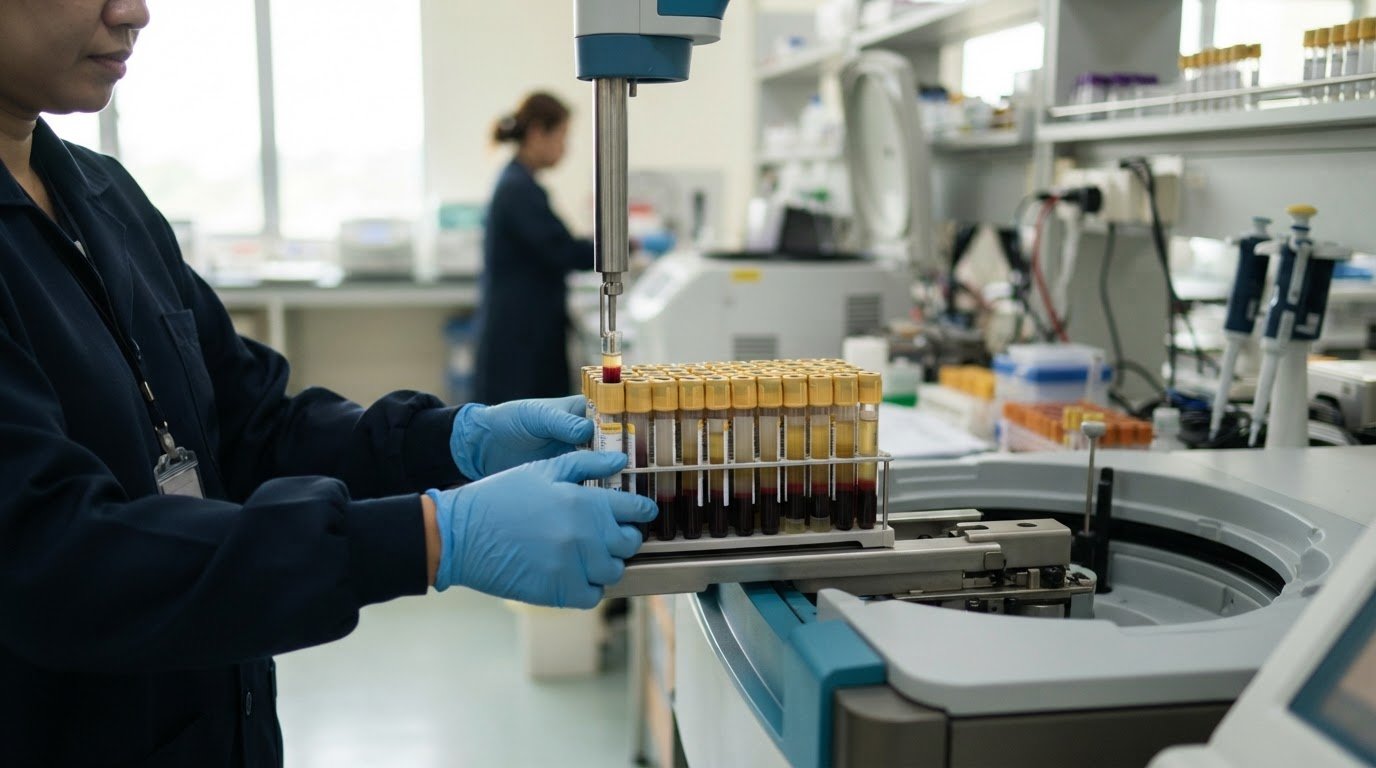

Microbial testing can help assess microbiological quality, but the suitable test depends on the sample and purpose. For organisations reviewing Malaysian pharmaceutical guidance, test categories may include measuring recoverable microorganisms, detecting bacterial endotoxins and assessing the effectiveness of antimicrobial preservatives. These are distinct tests, and their relevance depends on the product and its intended use.
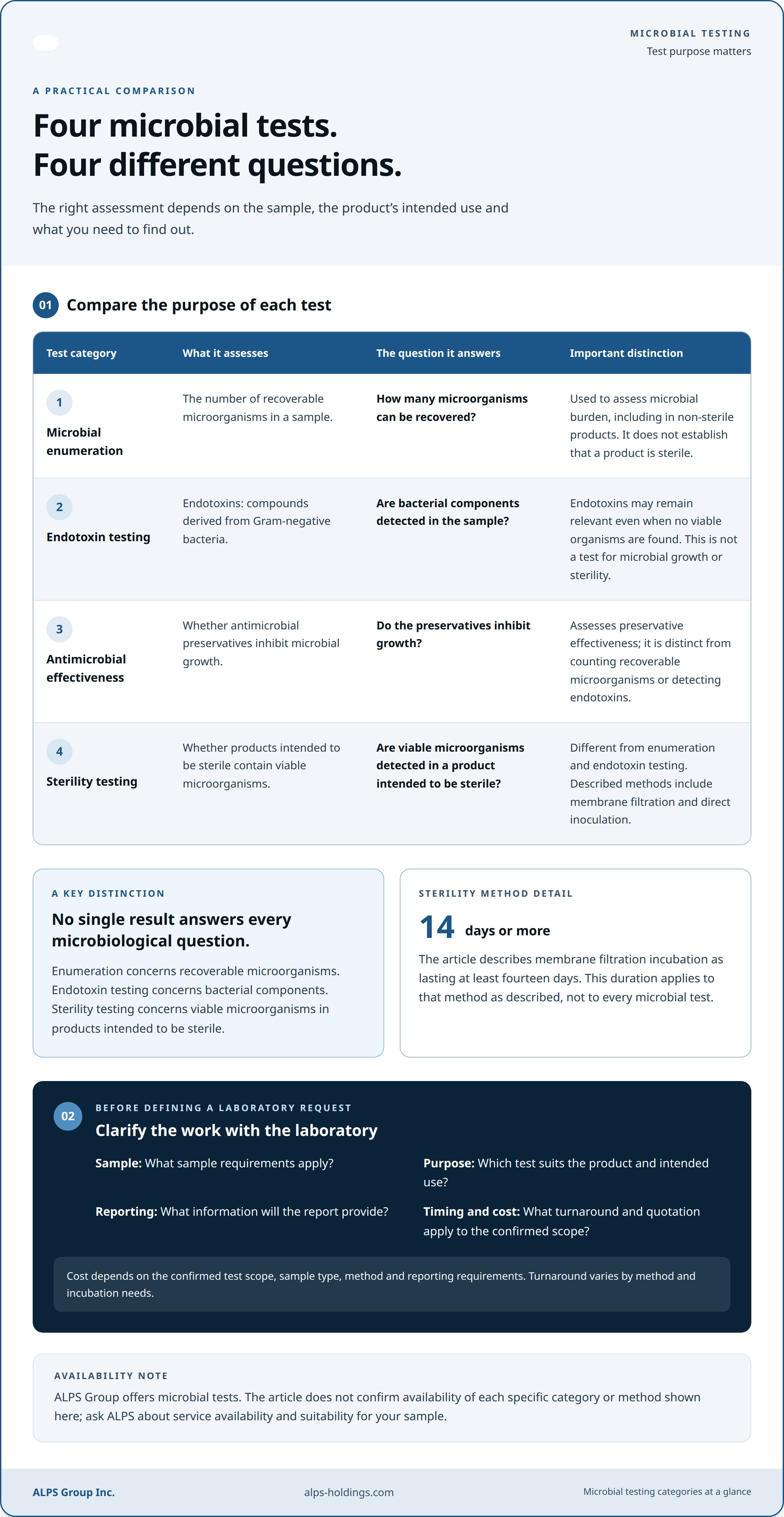
In general, enumeration testing measures recoverable microorganisms in a sample. Endotoxin testing detects bacterial components that may remain even when bacteria are no longer viable. Antimicrobial effectiveness testing assesses whether preservatives inhibit microbial growth. These descriptions explain general testing concepts and do not confirm that each test is available from a particular laboratory.
This article outlines these testing categories, how they differ from sterility testing, and what information can help define a laboratory request. Clinics, hospitals, healthcare professionals and research organisations should ask the laboratory about test availability and suitability, sample requirements, reporting, turnaround and cost. ALPS Group offers microbial tests; contact the team to confirm whether a suitable service is available for your requirements.
Key Takeaways
- Match the testing approach to the medicine’s intended use and microbiological risk, rather than treating every product alike.
- Understand how endotoxin testing assesses bacterial components that can remain a concern even when viable bacteria are absent.
- Use microbial enumeration to assess recoverable microorganisms in non-sterile products and inform quality-control decisions.
- Distinguish sterility testing from other microbiological assessments when evaluating products intended to be sterile.
Importance of microbiological testing
Microbial testing can help assess samples for microorganisms. The appropriate test depends on the sample and the purpose of the analysis. ALPS Group offers microbial tests; confirm service suitability and availability for your sample.
Medicine Safety and Quality Assurance
Microorganisms can affect the quality of medicines, particularly products intended to be sterile. Testing may provide information about microbial presence or levels, but results do not guarantee a clinical outcome. The appropriate assessment depends on the product and the purpose of the test. Ask the laboratory which test is suitable and what sample requirements apply.
Environmental Monitoring and Facility Qualification
Environmental monitoring and facility qualification are distinct activities from testing a submitted sample. References to ISO Class 5 (Grade A) environments and laminar flow cabinets describe controlled conditions discussed in some testing contexts; they do not confirm that ALPS provides environmental monitoring, facility qualification or sterility testing. Contact ALPS to check whether a particular microbial test is available and suitable.
Microbial Quality Control Procedures
The United States Pharmacopeia identifies USP <61> and <62> for microbial limits testing, USP <85> for endotoxin testing, and USP <1117> for microbiological laboratory practices. These references do not confirm that ALPS offers these specific tests. Testing cost depends on the confirmed test scope, sample type, method and reporting requirements; request a quotation based on the work required. Turnaround varies by method and incubation needs. Ask the laboratory about sample requirements, reporting and availability before submitting a sample.
Sterility Testing Requirements
Sterility testing checks whether products intended to be sterile contain viable microorganisms. Membrane filtration retains microorganisms before the filter is incubated in culture media; direct inoculation places the sample directly into liquid culture media. For membrane filtration, incubation lasts at least fourteen days. The United States Pharmacopeia identifies USP <71> as covering sterility testing. These methods and requirements do not confirm that ALPS offers sterility testing; contact the laboratory to check service availability and suitability.
Bacterial endotoxin testing
Endotoxins are compounds derived from Gram-negative bacteria and can cause severe adverse reactions in patients. They may remain relevant even when testing finds no viable organisms, so endotoxin analysis answers a different question from microbial enumeration or sterility testing. The United States Pharmacopeia identifies USP <85> as its bacterial endotoxin testing chapter. Product type, intended use and the test method inform how results support quality decisions.
The LAL method
The Limulus Amebocyte Lysate (LAL) test is an established method for detecting bacterial endotoxins. In this assay, lysate reacts with endotoxin to produce a measurable response. The laboratory selects an approach suited to the sample and assesses whether the product’s properties interfere with the response. Formulation components, sample preparation and dilution can affect interpretation, so the method must suit the material being tested.
For sterile products, endotoxin testing assesses contamination by endotoxins, not whether every microorganism is absent. Medical devices can also raise endotoxin concerns depending on their intended use, but assessment requirements differ by product. A useful report identifies the method and sample tested and presents the result in context. This helps quality teams avoid treating endotoxin results as a substitute for sterility or microbial limits testing.
Bacteriostasis and fungistasis testing
Bacteriostasis and fungistasis refer to the inhibition of bacterial and fungal growth. A product with inhibitory properties may suppress organisms in culture and complicate test interpretation. Assessing this effect helps determine whether the test can recover organisms from the sample or whether interference needs to be addressed through suitable method controls. This differs from endotoxin testing, which detects bacterial components rather than microbial growth.
For pharmaceutical testing in Malaysia, align the requested analysis with the product, purpose and applicable method. Share the product’s formulation and intended test with the laboratory so sample preparation and possible interference can be considered. This general information does not indicate that ALPS offers endotoxin, LAL or bacteriostasis/fungistasis testing. Contact ALPS to ask about its available laboratory testing services.
Microbial enumeration testing
Microbial enumeration measures the number of recoverable microorganisms in a sample. The United States Pharmacopeia identifies USP <61> for enumeration testing of non-sterile products. This assessment helps determine whether microbial loads in products such as creams, tablets and syrups remain within acceptable limits. It addresses microbial burden, not the chemical composition of the final product or its sterility. A programme for microbial testing for pharmaceuticals should distinguish these quality questions.
Methods and sample considerations
USP <61> methods include direct plating, membrane filtration and the most-probable-number method. These are general examples and do not confirm ALPS service availability or capabilities. Each approach measures microbial recovery differently, so the sample and test purpose inform method selection. Direct plating places a prepared portion of the sample onto culture media. Membrane filtration concentrates microorganisms on a filter for assessment. The most-probable-number method estimates microbial levels from growth patterns across sample preparations.
Product properties matter. A cream, tablet or syrup may need preparation suited to its form before testing. The laboratory needs the product identity, sample condition and requested analysis to define the testing approach. If the product inhibits microbial growth, recovery may be affected, making method suitability important to interpretation. Microbial testing for pharmaceuticals should therefore match the product specification and intended purpose.
Interpreting enumeration results
Enumeration results show recoverable microbial levels under the conditions used; they do not establish that a product is sterile. Sterility testing assesses products intended to be sterile, while enumeration supports microbial quality control for non-sterile products. The tests answer different questions and are not interchangeable. Chemical analysis measures other quality attributes and cannot replace a microbial count.
Useful reports identify the sample, method and result, allowing quality teams to interpret findings against product specifications and manufacturing controls. A result above an applicable acceptance limit can prompt a review of relevant processes and sample handling. A result within limits applies to the sample and method tested, not necessarily to every batch or production condition. Medical devices also need assessment suited to their product category, rather than medicine enumeration methods applied without adjustment. The practical takeaway is to match the method to the product and purpose before testing begins.
What sterility tests are required for sterile pharmaceutical products?
Sterility testing checks whether a product intended to be sterile contains viable microorganisms. The United States Pharmacopeia identifies USP <71> for sterility testing. The applicable testing plan depends on the product, its specification and the governing quality framework. A test result addresses the samples examined under the method used; it does not independently demonstrate that every unit in a batch is sterile.
Two established approaches are membrane filtration and direct inoculation. In membrane filtration, the product passes through a filter that retains microorganisms, and the filter is incubated in culture media. This approach may suit filterable products when the sample can pass through the membrane and the method can recover organisms. Membrane filtration testing requires incubation for at least fourteen days.
Direct inoculation places a product sample into liquid culture media, where it is incubated and checked for growth. This approach may be considered when filtration is unsuitable, but product properties and potential inhibition of microbial growth matter. Whichever method is used, it must allow microorganisms, if present, to grow sufficiently for detection. Sample preparation and culture media choices therefore affect interpretation.
For pharmaceutical manufacturers in Malaysia, align the request with the sterile product’s specification and applicable quality framework rather than assuming one method fits every formulation. These methods describe general sterility-testing approaches and are not confirmation of ALPS Group’s service offering. Sterility testing complements process controls; it does not replace validation of sterilisation or routine manufacturing oversight. Contact ALPS to ask about available testing services and suitability for a product.
ALPS Group: mRNA Testing
ALPS Group Inc. provides Microbial Tests for organisations seeking laboratory assessment to support pharmaceutical quality work. The testing objective and product context help define the scope of a laboratory request and the information needed for useful reporting.
ALPS Group Inc. also offers mRNA Testing. Separately, in general cancer-vaccine research, AI can analyse genomic, proteomic and clinical data to help researchers identify targets, design molecules and plan trials. This is research context only, not an ALPS application or service, and does not guarantee clinical outcomes.
Organisations considering laboratory work can discuss the intended sample, analysis and reporting needs. Contact ALPS Group Inc. to discuss testing requirements or request a quotation.
Build the Next Stage of Quality with Confidence
A well-defined programme for microbial testing for pharmaceuticals starts with a clear purpose: connect each laboratory result to the quality decision it is meant to inform. Defining the product, sample and reporting needs before submission can help create a coherent testing plan and support consistent review across research and manufacturing teams.
Microbial Tests support microbiological assessment. ALPS Group also offers Whole Genome Sequencing, mRNA Testing, and Biochemistry, Serology & Immunology Tests for distinct analytical and research needs. Because these services serve different purposes, first identify the question the work must answer and the testing scope that fits it. This helps Malaysian organisations align laboratory requests with their broader quality and research priorities.
Contact ALPS Group about testing to discuss your requirements or request a quotation. A clearly framed request is a practical starting point for informed laboratory planning and continued progress in medicine quality.
Frequently Asked Questions
What Can Go Wrong Without Proper Microbiological Testing?
Without appropriate testing, manufacturers may lack evidence to investigate a quality deviation or assess affected batches. For example, incomplete sample identification can make it harder to link a finding to a particular product, batch or production record. Clear traceability between samples, test requests and manufacturing documentation supports a focused investigation and helps quality teams identify which records to review.
What microbial tests are required for pharmaceutical products?
The testing plan should reflect the product specification and the quality question to be answered. Before submitting a request, assemble the product name, formulation, batch identifier, intended market and applicable acceptance criteria. This information helps the laboratory understand the scope and prepare a report that quality teams can assess against documented product requirements, with the relevant context in view.
What are the pharmacopeial microbial limits for nonsterile pharmaceuticals?
Applicable microbial limits vary by product; there is no single threshold for all non-sterile medicines. The relevant product monograph or approved specification should define acceptance criteria for the formulation and intended use. Quality teams can include the governing criteria in the test request and compare them with the final report. This makes the basis for batch review explicit without assuming one limit applies to every product.
What should clients ask a laboratory about bacterial endotoxin testing for pharmaceuticals?
Clarify how the laboratory will identify the sample, report the result and relate it to the product’s supplied acceptance criteria. Ask what information must accompany the submission, how invalid or inconclusive results are handled, and whether the report records relevant quality-control observations. These details help the receiving quality team assess results consistently and maintain a clear audit trail for its decision.
What are the USP, EP, and JP requirements for pharmaceutical microbiological testing?
Identify the compendium and product-specific text governing the medicine’s intended market, then state that basis in the testing request. USP, EP and JP are separate pharmacopoeial frameworks; do not assume that product criteria in one automatically apply under another. For products supplied to multiple markets, document the applicable specifications and assess differences before interpreting laboratory findings.
What should clients ask a laboratory about microbial limits test validation for pharmaceutical products?
Ask what validation or method-suitability records are available for the specific product and how changes to the testing approach are documented. Clarify how the report identifies the method version, records any departures from the agreed protocol and handles anomalous findings. These records help quality professionals confirm that results are traceable to the planned analysis and support review during audits or investigations.