

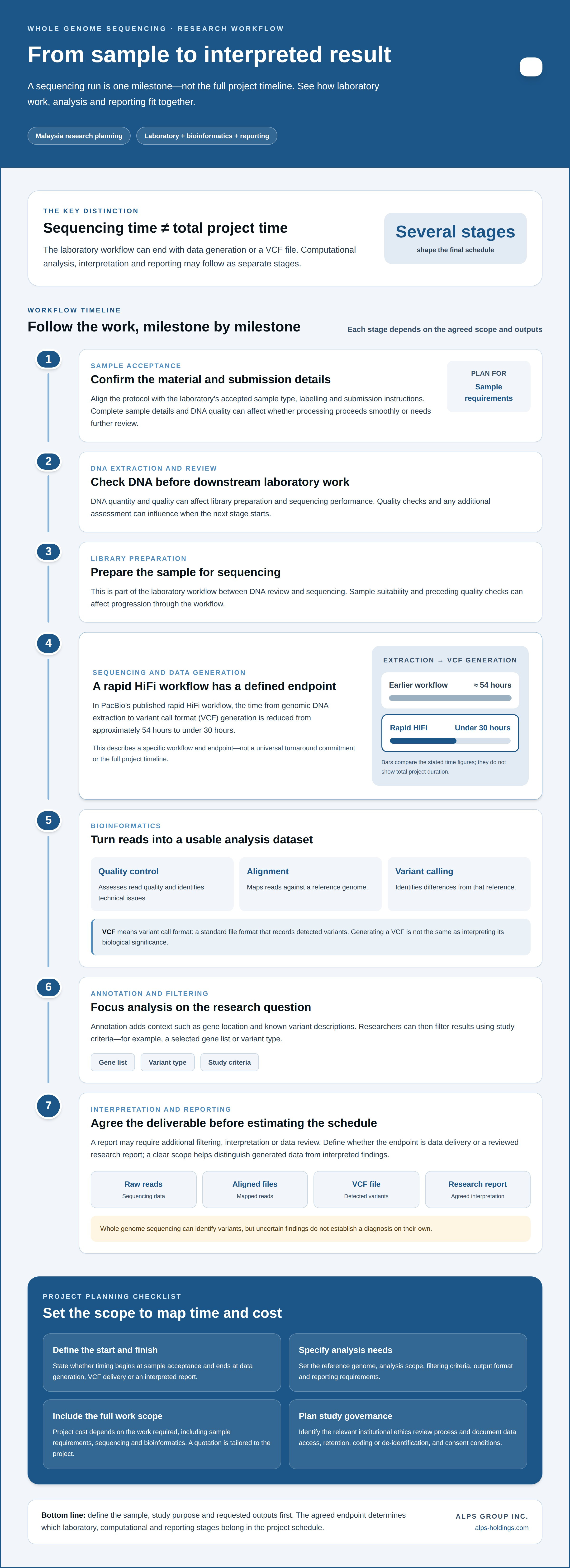
The sequencing run is only one part of the timeline. For clinical research in Malaysia, whole genome sequencing turnaround time depends on the workflow and the stages included: a rapid HiFi workflow reduces the time from genomic DNA extraction to variant call format (VCF) generation from approximately 54 hours to under 30 hours. This does not represent the full project timeline, which can also include sample handling, data analysis and reporting.
Cost depends on the study scope and work required, including sample requirements, sequencing and bioinformatics; a quotation is tailored to the project. This article explains the factors that shape the schedule and cost, what information helps define the scope, and what to consider when planning sequencing and reporting. It also separates sequencing from downstream analysis, helping research teams understand the work involved before planning a project.
Key Takeaways
- Separate laboratory sequencing from bioinformatics and reporting when mapping the project timeline, as each stage contributes to the final deliverable.
- Define the required analysis and report before estimating timing; the scope of interpretation can shape the work after sequencing.
- For clinical and research projects, align turnaround expectations with the study purpose, sample requirements and intended outputs.
- Assess cost by the complete project scope, including sequencing and bioinformatics, and request a quotation tailored to the work required.
Genomic analysis and bioinformatics
Sequencing produces DNA reads, but computational analysis is needed before researchers can interpret them. A bioinformatics pipeline commonly starts with quality control to assess read quality and identify technical issues. Alignment maps reads against a reference genome, and variant calling identifies differences from that reference. Each step provides data for the next, so workflow design affects how long it takes to produce a usable result.
Variant calling identifies candidate changes; it does not explain their biological significance. Annotation adds information such as gene location and known variant descriptions. Researchers can then filter results against study criteria, such as a gene list or variant type. For instance, a study of inherited variation may prioritise variants in selected genes rather than interpret every detected difference equally.
The requested deliverables also shape the analysis workload. A project may need raw sequencing reads, aligned files, a variant call format (VCF) file, or a report interpreting selected findings. A VCF records detected variants in a standard format; interpretation adds context relevant to the research question. The whole genome sequencing turnaround time for clinical research in Malaysia therefore depends partly on the outputs the study requires.
Bioinformatics can take longer when analysis involves additional filtering, interpretation or data review. Sample and sequencing data quality can also affect whether processing proceeds smoothly or needs further work. For a Malaysian research protocol, specify the reference genome, analysis scope, output format and reporting needs. This clarifies which stages involve computational processing, which require scientific interpretation, and how each affects the schedule.
Sequencing turnaround time
Sequencing time covers laboratory processing, not the full research project. The workflow commonly runs from sample receipt and DNA extraction through library preparation, sequencing and data generation. Each stage depends on preceding quality checks, so a sample needing additional review can affect when later laboratory work starts. When setting a deadline, distinguish the sequencing run from analysis and reporting.
A rapid HiFi whole-genome sequencing workflow reduces the time from genomic DNA extraction to variant call format (VCF) generation from approximately 54 hours to under 30 hours, as reported in PacBio’s published rapid HiFi workflow. This figure describes a specific workflow and endpoint, not a universal turnaround commitment. VCF generation produces a file of detected variants; interpretation and reporting may follow as separate stages, depending on the study’s requested outputs.
Before work begins, the laboratory workflow needs to account for the submitted material and intended output. DNA quantity and quality can affect library preparation and sequencing performance, as described in PacBio’s sample preparation guidance. If a sample does not meet processing criteria, further assessment or handling may be needed. Complete sample identification and submission details, together with clear deliverable requirements, help reduce avoidable delays.
Project planning should also separate laboratory milestones: sample acceptance, extraction, sequencing, data generation, and delivery. For example, a schedule ending at VCF generation differs from one requiring interpreted findings and a research report. Agreeing on the endpoint helps teams coordinate downstream analysis and study activities. To discuss how sequencing scope and deliverables shape a research timeline, contact the team about your project requirements.
Whole genome sequencing turnaround time
For Malaysian research teams, the schedule depends on the study endpoint and governance pathway.
Clinical and Research Timelines
Clinical and research timelines vary with the purpose and expected output. Research may need data files for a defined analysis, while clinical work may include interpretation for review. Specify when the schedule starts, such as sample acceptance, and ends, such as delivery of an interpreted report. This helps teams coordinate sequencing with recruitment and later study activities.
In Malaysia, the relevant ethics review and regulatory pathway depends on the study design and setting. Identify the responsible institutional ethics review process, document the protocol, and determine applicable requirements before collecting study data. For data storage and sharing, set out access permissions, retention, coding or de-identification, and consent conditions in the study data plan.
Specimen type and collection requirements depend on the laboratory workflow. Before collection, align the protocol with the laboratory’s accepted sample type, labelling and submission instructions. Agree on report contents in advance; research outputs may describe methods, quality measures, analysed variants and interpretive context. Incidental findings or uncertain variants may arise, so state in the protocol and consent process how they will be handled.
Sources of Delay in Analysis and Reporting
Delays can occur during sample acceptance, DNA quality review, sequencing, computational analysis or report preparation. Further review may be needed if data quality affects interpretation or if the requested report extends beyond the agreed analysis. Define the endpoint early to distinguish generated data from a reviewed report and plan subsequent work accordingly.
Incomplete sample details or analysis criteria can also delay reporting. For example, a study focused on selected genes needs filtering criteria that match its research question. Whole genome sequencing can identify variants, but uncertain findings do not establish a diagnosis on their own. A clearly defined reporting scope helps research teams interpret results responsibly and stay aligned with the approved protocol.
What are typical turnaround times for clinical versus research whole genome sequencing?
Compare clinical and research timelines by their final deliverables, not by assuming a single duration. A clinical workflow may include sequencing, analysis, interpretation and a report for clinical review. A research workflow may end with raw reads, processed data or a variant file for a defined study. Each endpoint involves a different amount of work.
For a Malaysian clinical research project, define the timeline from sample acceptance to the exact required output. If the endpoint is a variant call format file, the schedule includes laboratory processing and computational generation of that file. If the protocol also requires interpretation, review and a structured report, include those stages. File delivery for later analysis is not equivalent to an interpreted report.
A clinical or research label alone does not provide a reliable turnaround estimate. Compare the workflow, sample requirements, analysis scope and reporting endpoint. Two whole genome sequencing turnaround time clinical research Malaysia projects, for example, may follow different schedules if one needs data files and the other requires reviewed findings. A useful estimate identifies specific milestones, such as sample receipt, sequencing completion and report delivery.
Before setting a study schedule, coordinate the laboratory timeline with ethics review, recruitment, sample collection and downstream analysis. These are separate project activities, but late samples or incomplete study details can shift the planned start of laboratory work. If the protocol requires a defined report, specify its contents and intended use. Clear milestones also help teams coordinate data analysis without assuming sequencing completion means the whole study is ready.
To discuss the sequencing scope, deliverables and timeline for a Malaysian project, contact ALPS Group Inc. about your requirements.
ALPS Group: Whole Genome Sequencing
ALPS Group Inc. offers Whole Genome Sequencing for Malaysian clinics, hospitals, healthcare professionals and research organisations planning genomic projects. It is relevant when a study needs whole-genome data and the team must define sample requirements, analysis scope and reporting outputs before setting a timeline.
Before work begins, clarify the study objective, intended deliverables and whether bioinformatics analysis is required. These details help define the project scope and quotation, without confusing sequencing-run time with the full project schedule. ALPS Group Inc. also offers mRNA Testing, Biochemistry, Serology and Immunology Tests, and Microbial Tests for projects that need these laboratory services.
Contact ALPS Group Inc. to discuss Whole Genome Sequencing suitability or request a quotation for your project.
Build the Next Research Milestone
Planning the whole genome sequencing turnaround time for clinical research in Malaysia can support a wider research strategy, including future cancer vaccine development. Artificial intelligence (AI) can analyse genomic, proteomic and clinical datasets to help researchers identify targets, engineer candidate molecules and design trials through predictive modelling. These approaches may make development more data-driven and efficient, while research findings still require scientific evaluation and do not guarantee a treatment outcome.
As these methods advance, genomic data may contribute to more precise research questions and vaccine design. Research teams can assess how sequencing outputs fit their study objectives and inform subsequent investigation. Aligning data, analysis and experimental design gives emerging technologies a disciplined foundation for cancer research.
Discuss your research with ALPS Group Inc. and take the next step towards a well-defined genomic project.
Frequently Asked Questions
How long does it take, and what does it cost?
The timeline and cost depend on the project scope and final deliverable. Sequencing, bioinformatics, interpretation and reporting may all contribute to the requested work. A quotation is more useful when it reflects whether the study needs data files, analysis or an interpreted report. Include the research objective and sample plan when outlining the project instead of relying on a general market estimate.
How long does clinical whole genome sequencing take in Malaysia from sample collection to results?
The timeline from collection to results includes more than laboratory sequencing. The sample must reach the laboratory and pass intake and quality review before processing, followed by analysis and agreed reporting. A schedule starting on collection day differs from one starting after sample acceptance. Define whether “results” means generated data files or a reviewed report, then align that endpoint with recruitment and study milestones.
Which Malaysian laboratories or providers offer whole genome sequencing for clinical research?
ALPS Group Inc. offers Whole Genome Sequencing for Malaysian clinics, hospitals, healthcare professionals and research organisations. For a clinical research project, describe the study objective and intended use of the data, then define the required analysis and report outputs. This helps establish whether the service fits the project scope and provides a basis for discussing sample requirements and a tailored quotation.


